The IT industry is creating opportunities faster than ever before.
Artificial Intelligence is changing the way businesses work. Cloud Computing is helping companies become more efficient. Digital Marketing is growing fastly. Full Stack Development continues to be one of the most in-demand skills. New technologies are creating new job roles every year.
For students, this sounds exciting. However, there is another side to the story.
Every year, thousands of students pass their 12th class and start searching for the best career option. They watch YouTube videos. They ask friends for advice. They listen to relatives. They follow social media trends.
Unfortunately, many students make important career decisions without proper research.
As the Founder and Director of TISA-TECH, I regularly meet students who feel confused about their future. Some have already spent months learning the wrong skills. Some joined courses that did not match their interests. Others completed certifications but still struggle to find opportunities.
The good news is that most of these problems can be avoided.
This 12th pass IT career guide is designed to help students understand the biggest mistakes that affect career growth and how they can avoid them. If you understand these mistakes today, you can make smarter decisions tomorrow.

Why Students Get Confused After 12th
After 12th, students suddenly face too many choices. They start asking big questions like:
- Which course should I choose
- Which technology has the best future
- Which field offers the highest salary
- Should I learn coding
- Should I go for AI or Cloud Computing
The problem is that every source gives a different answer. Friends suggest one thing, relatives push another, YouTube videos show something else, and social media trends keep changing. With so many opinions, students feel stuck and confused.
Most of the time, decisions are made under pressure, not because the student truly understands what they want. That’s why many end up in the wrong course or field, wasting months or even years before realizing it doesn’t match their interests.
The truth is simple. Career guidance after 12th is critical. If you make the right decision at the start, you save yourself from years of confusion and regret. Guidance helps you see the bigger picture, understand your strengths, and choose a path that actually fits your future.
Common IT Career Mistakes Students Make
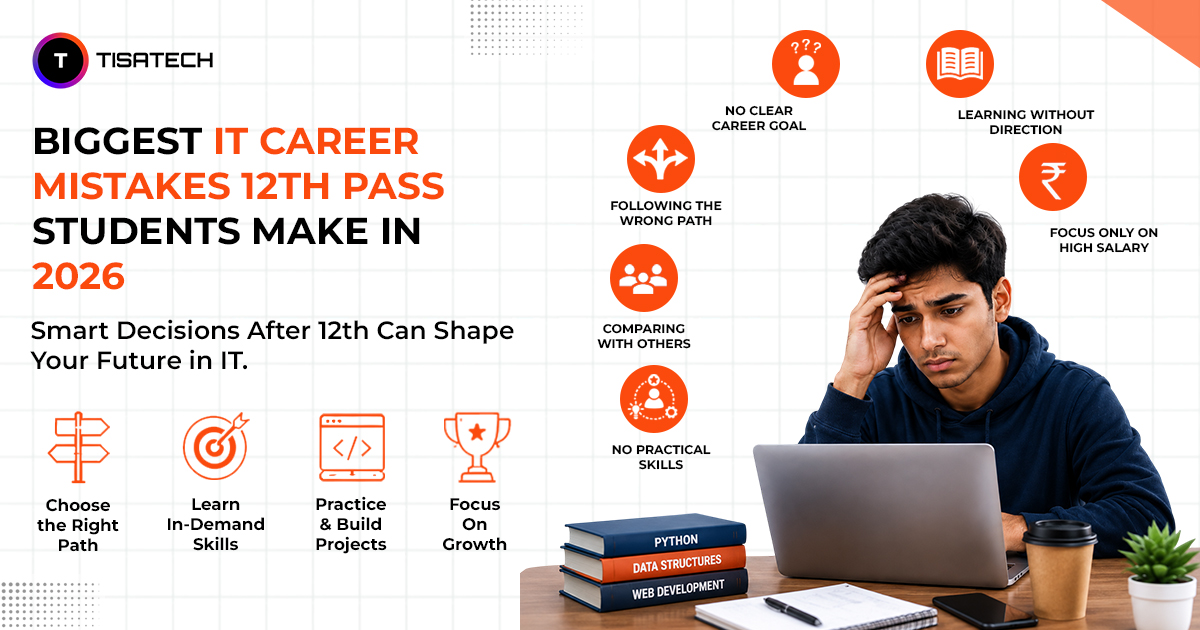
Here are some mistakes that many students repeat after 12th. These mistakes look small in the beginning but later create big problems in career growth.
1. Following the Crowd Instead of Following Your Interests
Many students copy their friends when choosing a career path. One friend joins a programming course, another picks digital marketing, and soon everyone moves in the same direction. But every student is different. Some enjoy coding, some enjoy designing, and some enjoy solving problems with data. Your career should reflect your strengths and interests, not your friend’s choices.
2. Thinking a CS Degree Guarantees a Job
Many students believe that completing a Computer Science degree is enough to land a job. It is not. Companies now want candidates who understand real tools, real technologies, and real workflows. Recruiters look for people who can solve problems and contribute to projects from day one. A degree gives you a foundation, but it should never be your only plan.
3. Depending Only on Your Degree
Students spend three or four years finishing a degree and expect companies to hire them right away. The job market does not work that way. Employers want practical skills, projects, and proof that you can do the work. Students who build real skills during college almost always perform better in placements and interviews. A degree opens the door. Skills help you walk through it.
4. Studying Theory Without Building Projects
Many students spend years learning concepts but never create anything real. Think about two candidates applying for the same role. One has certificates. The other has certificates plus a portfolio of actual projects. Who impresses the recruiter more? Whether you are learning web development, UI/UX design, digital marketing, cloud computing, or AI, your practical work will always speak louder than your certificates.
5. Choosing a Course Without Researching the Career
Many students pick a course based on the name alone with no idea what the actual job looks like, what skills it demands, or what salary to expect. Before you choose any field, understand what professionals actually do every day, what the learning path looks like, and what opportunities exist ahead. Students who research before deciding avoid most of these problems from the start.
6. Joining Trending Courses Without Understanding Them
AI is trending. Cyber Security is trending. Cloud Computing is trending. So many students jump into these courses just because everyone is talking about them. But a trending field is not automatically the right field for you. Before joining any course, find out what professionals in that field actually do daily. If that work genuinely interests you, move forward. If it does not, keep exploring.
7. Ignoring AI and Automation Tools
Some students ignore AI completely. Others panic and assume it will replace every job. Both reactions are wrong. AI already helps developers, designers, marketers, and analysts work faster and smarter. You do not need to become an AI expert overnight, but you should understand how AI tools can support your chosen field. Learning to work with technology will always put you ahead.
8. Skipping Networking and Ignoring Soft Skills
Technical knowledge alone will not get you hired. Many students with strong technical skills still struggle in interviews because they cannot communicate clearly or work well with others. Employers look for communication skills, teamwork, confidence, and professionalism alongside technical ability. Talking to mentors and industry professionals also helps you learn faster and discover opportunities that skills alone cannot create.
9. Starting Without a Clear Roadmap
Many students start learning without any direction. One month they study Python, next month they switch to graphic design, then they explore cloud computing, and nothing connects. This scattered approach wastes time and kills motivation. A clear IT roadmap tells you what to learn, when to learn it, and how each skill moves you closer to your goal. Students who follow a structured path make faster progress and stay focused far longer.
These mistakes are common, but they are also avoidable. The sooner you identify where you are going wrong, the faster you can correct your path. Start with the right decisions today and save yourself years of confusion later.
A Message From Director to Every Student Starting an IT Career in 2026
After guiding students for many years, I have realized one thing clearly. Most students do not fail because they lack intelligence or talent. They struggle because they make avoidable mistakes right at the beginning of their journey.
In 2026, the IT industry is moving faster than ever. Students today have more career options than any previous generation, but they also face more confusion. This makes it even more important to start with the right decisions.
My first advice is simple. Do not rush your decisions. Take time to understand your interests, research different career options, talk to mentors, and learn what skills each field actually demands before you commit to anything.
My second advice is to focus on practical learning. Build projects, create a portfolio, and grab every internship opportunity you can find. These experiences will teach you far more than theory alone ever will. Recruiters do not just want students who studied hard. They want students who actually did the work.
Stay updated with technology too. The IT industry moves fast, and students who keep learning always stay ahead. AI, automation, and new tools are changing how every field operates today. The students who adapt early will always have an edge over those who do not.
Do not underestimate communication. Learn how to present your ideas confidently, improve your speaking skills, and practice working in teams. Technical ability gets you shortlisted. Communication gets you hired.
Most important, build a clear plan for your future. Know where you want to go and what skills you need to get there. A student with direction always moves faster than a student with talent but no focus.
The goal is not just to complete a course. The goal is to become skilled enough that companies come looking for you. If you avoid the mistakes covered in this guide, you can build a strong IT career in 2026 and beyond, regardless of your background or where you are starting from.





How TISA-TECH Helps Students Avoid These Mistakes
We work with students every day at TISA-TECH Jhotwara. We see the same confusion repeat itself. Most students come to us without a clear direction. They do not know which field to pick, what skills to focus on, or what mistakes to avoid when starting an IT career. We understand these challenges because we deal with them daily.
We do not just teach software and tools. We guide students through proper career planning. We help them understand what companies actually expect. We push them to build real skills through projects and internships. Our goal is straightforward. We want every student to become job-ready, not just course-ready.
Our courses cover some of the most in-demand fields in the industry today. Students can explore AI and Machine Learning, Full Stack Development, Cloud Computing, Digital Marketing, UI/UX Designing, and Graphic Designing.
If you are still confused about your options, do not make a decision alone. Book a Free Demo at TISA-TECH Jhotwara and spend time with our mentors before committing to anything. They will help you understand which direction suits you best.
Before joining any institute, always check what previous students say. Read the Genuine Reviews of TISA-TECH and understand what real learners have experienced with us.
Conclusion
The IT industry offers real opportunities in 2026, but opportunities alone do not guarantee success. Students who follow the crowd, skip practical skills, depend only on degrees, and start without a roadmap almost always struggle later. The good news is that every mistake covered in this guide is completely avoidable.
Take time to understand yourself. Research your options. Build real skills. Stay curious. Keep improving even after you complete a course.
This is exactly what we focus on at TISA-TECH Jhotwara. We guide students toward the right career decisions and help them enter the industry with real skills and confidence.
Smart decisions today build a stronger career tomorrow. Choose carefully, learn consistently, and stay focused.
FAQs Section
Ans. Following the crowd, depending only on a degree, ignoring practical skills, avoiding internships, and learning without a roadmap are some of the biggest mistakes.
Ans. No. A degree is important, but employers also expect practical skills, projects, and industry knowledge.
Ans. Career guidance helps students understand different opportunities and avoid making costly career decisions.
Ans. An IT roadmap is a structured learning plan that helps students achieve their career goals step by step.
Ans. Focus on skill development, practical projects, internships, communication skills, and continuous learning.
Ans. Avoid choosing courses without research, following trends blindly, and depending only on certificates or degrees.
Ans. Understand your interests, research career opportunities, and seek guidance from experienced mentors before making a decision.
Ans. TISA-TECH does not just teach courses. Students get proper career guidance, practical training through real projects and internships, and mentor support to help them make the right decisions from the start.