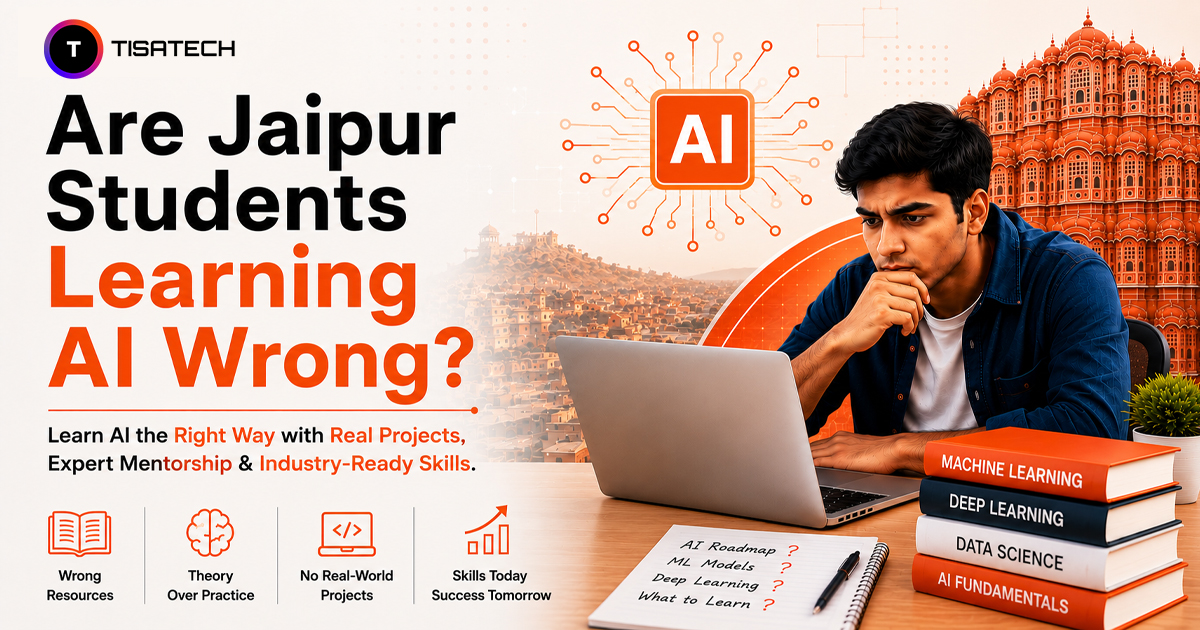
Open any student WhatsApp group in Jaipur today and you will see questions like “भाई, AI कैसे सीखें? ” or “कौन सा AI कोर्स सबसे अच्छा है?” The excitement is real and it should be.
According to the Naukri JobSpeak Index, AI and ML job demand in India jumped 34% year on year in early 2026 while overall IT hiring stayed flat. Jaipur is rising as one of the top Tier‑2 hiring cities with 32% of India’s new tech openings projected in Tier‑2 cities this year.
The opportunity is huge. But there is a reality that few talk about. India has 1.3 million AI learners, the highest in the world, yet ranks 89th out of 109 nations in actual AI proficiency. This data comes from the AI Skills Playbook 2026. The gap is not about talent. It is about how students are learning.
Over 15 years of AI and tech training show the same pattern again and again. Students start with full energy. They watch YouTube videos, install ChatGPT, copy some code, and then after 10–12 months wonder why they are not getting hired. The problem is not effort. The problem is direction.
This article is about that direction. It explains the common mistakes Jaipur students make when learning AI and, more importantly, how to learn AI the right way so that time and money actually build a real career.
Are Jaipur Students Really Learning AI the Wrong Way?
Yes. And the numbers prove it. India produces more AI learners than any other country, yet most of them struggle to get hired. Jaipur is no different. Students here are motivated and hardworking, but motivation alone does not build a career.
A report by AnalytixLabs (analytixlabs.co.in) highlights that despite having the largest pool of AI learners globally, Indian students consistently underperform on applied AI benchmarks. The reason is not intelligence. It is the way they are learning – heavy on theory, light on practice, and almost always without a structured path.
In Jaipur specifically, students face a unique mix of challenges: colleges that teach outdated AI content, a flood of YouTube tutorials that cover only surface topics, and a culture of collecting certificates rather than building real projects. These habits look like progress but lead nowhere near a job offer.

Why Are Jaipur Students Learning AI the Wrong Way?
Before looking at specific mistakes, it helps to understand why these mistakes happen in the first place. Five root causes drive most of the wrong learning behaviour in Jaipur.
Overdependence on YouTube Tutorials
YouTube is free, accessible, and available in Hindi. So naturally, most Jaipur students start there. The problem is that YouTube tutorials are designed for views, not careers. They cover exciting surface topics like ‘Build an AI chatbot in 10 minutes’ without teaching the foundations that make those tools actually work. Students finish a playlist feeling confident but cannot explain a single concept without the video playing in the background.
Following Every New AI Trend
AI moves fast. Every week there is a new tool, a new model, or a new buzzword. Jaipur students often chase these trends without building depth in any one area. They learn about ChatGPT this month, switch to image generation next month, then jump to AI agents the month after. Six months later they have zero depth in anything and a long list of half-finished courses.
Outdated College Curriculum
Most engineering and BCA colleges in Jaipur still teach AI concepts from five or more years ago. Students study outdated algorithms in theory-heavy classrooms without any hands-on work. By the time they graduate, the industry has already moved on. They enter the job market with a degree that signals AI knowledge but with zero practical skills to back it up.
Lack of Industry Mentorship
Online platforms give access to content but not context. A YouTube video cannot tell a student which skills are actually valued in Jaipur’s hiring market right now. Without a mentor who has real industry experience, students spend months learning things that companies stopped caring about two years ago. The absence of guided mentorship is one of the biggest reasons why most people fail at learning AI.
Chasing Certificates Instead of Skills
Certificate culture is strong in Jaipur. Students collect badges from Coursera, Google, and Udemy and post them on LinkedIn expecting job calls. But employers do not hire certificates. They hire people who can build, explain, and solve real problems. A student with three strong GitHub projects will always beat a student with fifteen certificates in any honest interview.
What Jaipur Students Should Learn Instead
The answer is not more tools or more certificates. It is the right skills, learned deeply and applied practically. Here are the AI skills students actually need to get hired in 2026.
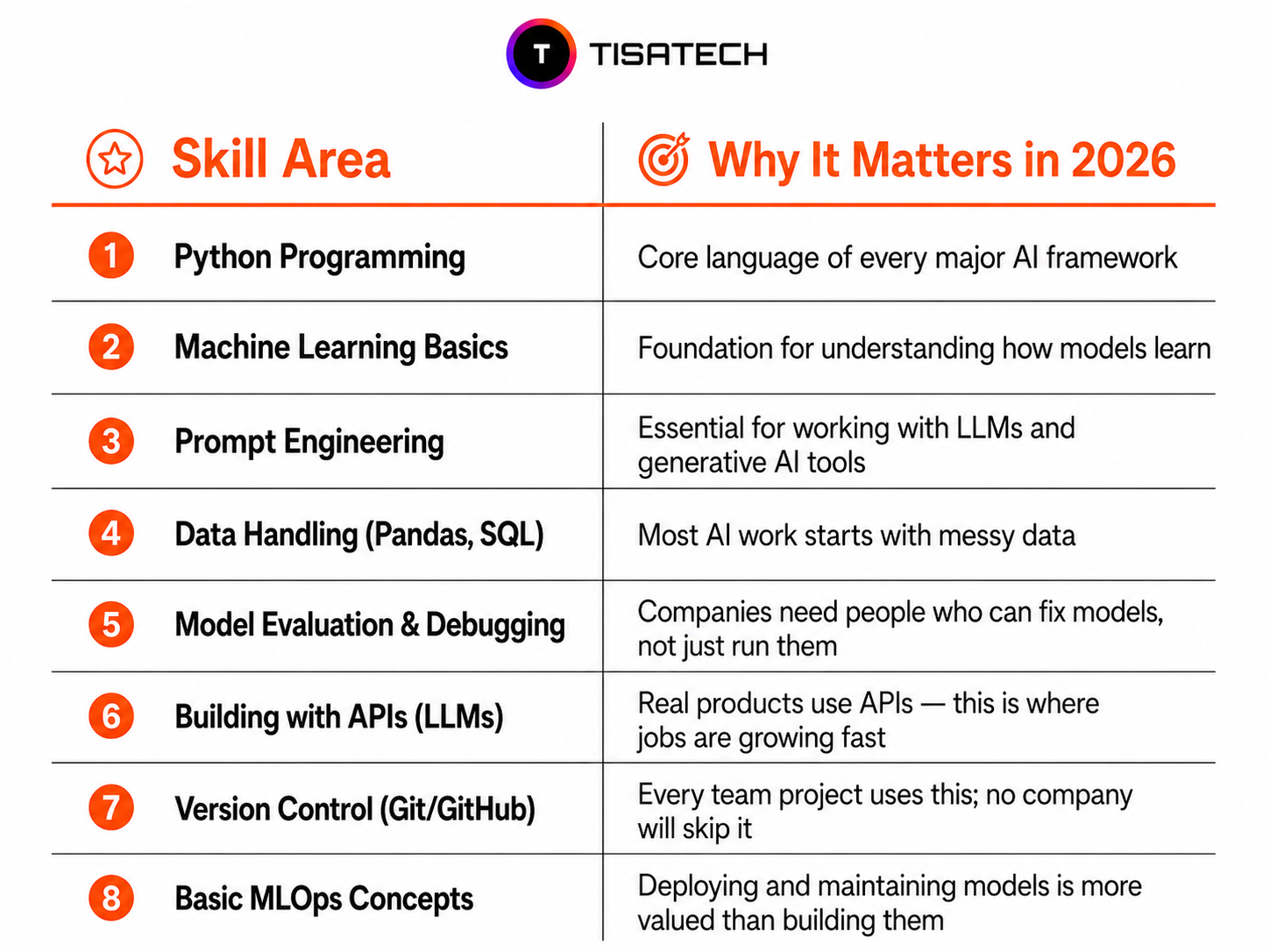
Depth in the right areas matters more than covering everything. Strong fundamentals and real project work are what make your job‑ready.
How to Learn AI the Right Way: A Step-by-Step Roadmap
Here is a practical roadmap for how to learn AI the right way without wasting months going in the wrong direction.
Step 1: Build Strong Python Fundamentals
Spend 6 to 8 weeks on Python basics. Variables, loops, functions, file handling, and data structures. Do not skip this. Everything in AI depends on it.
Step 2: Learn Machine Learning One Concept at a Time
Study linear regression. Build a project with it. Study decision trees. Build again. Move through concepts one at a time and build at every step. This is the best way to learn AI in 2026: slow and deliberate, not fast and shallow.
Step 3: Understand Data Before Building Models
Most AI problems are data problems. Learn to explore, clean, and understand datasets before you train anything. A model is only as good as the data it learns from.
Step 4: Choose One AI Specialization
Generative AI, computer vision, or NLP – pick one based on where jobs are in your target industry. Stick with it for at least 6 months before switching. Depth in one area is worth far more than surface knowledge in five.
Step 5: Build a Strong Project Portfolio
Three to five strong projects on GitHub with clear documentation will outperform 20 certificates in any interview. Show what you built, what problem it solved, and what you learned from fixing it.
Step 6: Learn from Industry Mentors
Online courses give you content. Mentors give you context. Guidance from people who have solved real AI problems in real companies will save you months of moving in the wrong direction. This step is what separates students who get hired from students who keep studying.
Where Can Jaipur Students Learn AI the Right Way?
TISA-TECH is the only AI-powered training institute in Jhotwara, Jaipur area that combines structured AI courses with real industry mentorship. The AI courses at TISA-TECH follow the exact roadmap above. You start with Python and fundamentals, build real projects at every stage, and get placement support from mentors who know what companies actually test for in interviews.
TISA-TECH helps students explore AI technologies growing fast in 2026: generative AI, large language model applications, and AI-integrated cloud systems. These are not future topics, they are current hiring areas. The institute also offers AI services and internship programs where students work on actual projects, not simulated exercises. This is what separates a student who can talk about AI from one who can build with it.
The best way to learn AI in 2026 is to follow a clear roadmap with honest mentorship. A structured path builds real skills step by step instead of jumping randomly between topics. New batches are open in Jhotwara and timings with course details are available on the website.





Final Thoughts
Most Jaipur students are not failing at AI because they lack talent. They are failing because nobody gave them an honest, structured path.
Watching videos without building is not learning. Collecting certificates without understanding is not learning. Using AI tools without knowing how they work is definitely not learning.
The AI opportunity in India is real. Jobs are growing. Jaipur is becoming a hiring hub. But companies will only find you if you build actual skills, not shortcuts. Now you know how to learn AI the right way. The next step is to actually start with the right foundation, the right sequence, and the right mentor.
FAQs Section
Ans. Yes. Python is the most important first step. You do not need to master it, but you need solid basics before AI concepts will make practical sense.
Ans. With a structured path and consistent effort, 6 to 9 months is enough to build job-ready skills. Jumping around topics or spending too much time on passive content will stretch this to years without useful results.
Ans. Yes. In 2026, Indian employers have clearly moved toward skills-first hiring. A strong portfolio of real projects matters more than your degree branch. Many non-CS graduates are getting hired in AI roles with the right preparation.
Ans. Start with Python. Learn one ML concept at a time and build a small project with each. Pick one specialisation and stick with it. Build a public GitHub portfolio. Join a structured program that gives mentorship and real project work, not just videos and certificates.
Ans. The most common reason is following a random, unstructured path. Students try too many things at once, skip fundamentals, and never build anything real. A clear roadmap and honest mentorship from experienced practitioners make the biggest difference.
Ans. Yes. TISA-TECH is the only AI-powered training institute in Jaipur’s Jhotwara area that offers structured AI courses with real industry mentorship. Students work on actual projects from day one, not just theory. The institute covers in-demand topics like generative AI, machine learning, and cloud-integrated AI systems. It also provides placement support and internship programs so students graduate with both skills and experience. You can check current batch details at tisatech.in.