A B.Tech student in Jaipur opens her first machine learning tutorial, full of excitement. Then she sees matrices, integrals and long formulas. She wonders if ML is too hard for her. Many beginners feel the same way. They believe they must master advanced mathematics before writing their first line of code. That belief stops many before they even start.
But starting is worth it. The World Economic Forum’s Future of Jobs Report 2025 found that 86% of employers expect AI and information processing technologies to transform their business by 2030. The report also ranks AI and big data as the fastest-growing skills.
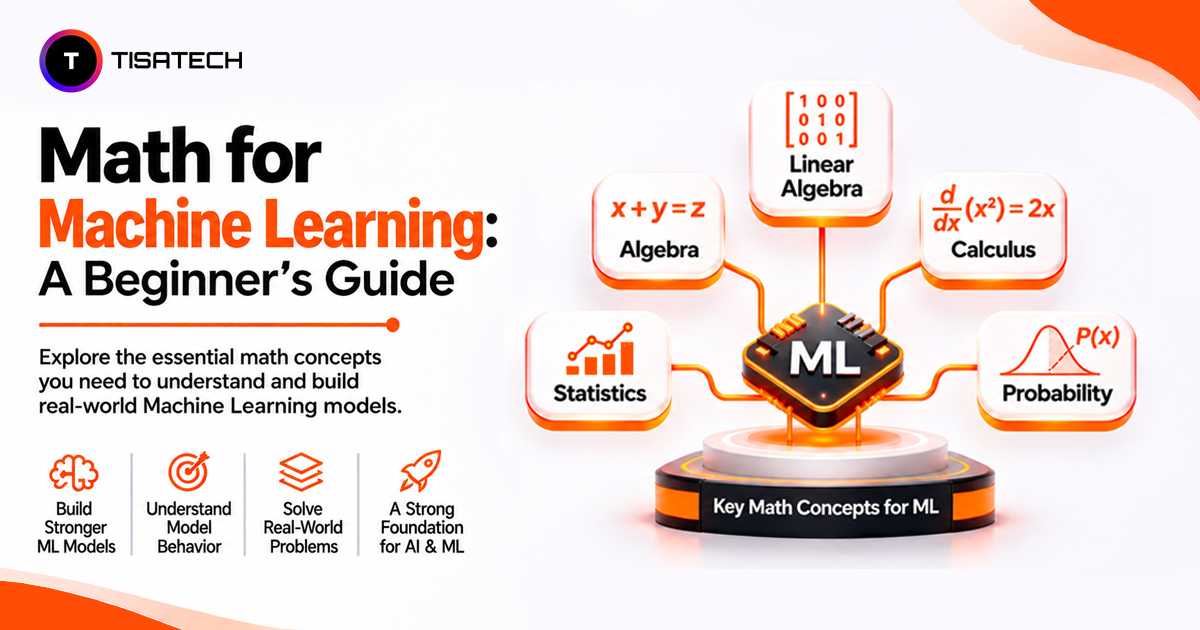
The good news is that the math required for AI is smaller than it looks. Libraries such as scikit-learn handle most heavy calculations, so you can build models and understand formulas step by step. You mainly need the basics of linear algebra, calculus, probability and statistics.
This guide explains the math for machine learning that beginners actually need, which topics can wait, and how to learn the essentials with practical examples and free resources.

How Much Math Do You Really Need to Start?
You do not need advanced mathematics to start learning machine learning. A basic understanding of Class 10–12 algebra and some Python knowledge are enough to begin.
You should understand basic equations, percentages, averages and graphs. If you are comfortable with these concepts, you can start building simple ML models using libraries such as NumPy and scikit-learn.
The best approach is to learn mathematics alongside coding. For example, when you build a linear regression model, learn how it uses averages, relationships between variables and error calculations to make predictions. This helps you connect mathematical concepts with actual model behaviour instead of memorising formulas.
As you progress, focus on three core areas:
- Linear algebra: Understand how computers represent and process data using vectors and matrices.
- Calculus: Learn how models adjust their parameters to reduce prediction errors.
- Probability and statistics: Understand data distributions, uncertainty and model performance.
You do not need to master all these subjects before starting. Learn the basics first and deepen your understanding as your ML projects become more complex.
What Is the Role of Linear Algebra in Machine Learning?
Linear algebra helps machine learning models represent data and perform calculations on it. Computers convert images, text and other information into numbers, then organize those numbers into vectors and matrices.
Linear algebra for machine learning shows how data is stored and compared as vectors and matrices.
A vector is a list of numbers, while a matrix is a grid of numbers. For example, an image can be represented as a matrix of pixel values, and a sentence can be converted into a numerical vector called an embedding. ML models use these representations to compare data, identify patterns and generate predictions.
You only need a few concepts to get started:
- Vectors and matrices: Understand how computers organize numerical data.
- Dot products: Learn how models measure relationships between vectors.
- Matrix operations: Understand how models combine and process large amounts of data.
Consider a movie recommendation system. It represents your preferences and each movie as numerical vectors. The system calculates a dot product to estimate how closely a movie matches your preferences. A higher similarity score can help the system rank relevant movies.
You can try this calculation using NumPy, a Python library for numerical computing. A small coding exercise will help you understand how vectors and dot products work in practice.
Do You Need Calculus for AI?
You need to understand the basic ideas of calculus to learn how machine learning models improve, but you do not need to solve complex integrals by hand.
During training, a model makes predictions, calculates how far they are from the expected results, and adjusts its parameters to reduce the error. Calculus helps the model decide how to make those adjustments.
The key concept is the derivative, which measures how a value changes when another value changes. In machine learning, derivatives help calculate how changes to a model’s parameters affect its loss. The model uses this information through a process called gradient descent.
Imagine standing on a hill in thick fog. You want to reach the lowest point, so you take small steps downhill by following the slope. Gradient descent works similarly: it updates the model’s parameters in the direction that reduces the loss. It repeats this process until the model reaches a better solution.
Focus on four concepts:
- Derivative: Measures how quickly a value changes.
- Partial derivative: Measures how one parameter affects the loss while other parameters remain fixed.
- Gradient: Combines partial derivatives to show the direction of the steepest increase in loss.
- Chain rule: Helps calculate how changes pass through multiple connected operations in a model.
Libraries such as PyTorch and TensorFlow calculate these derivatives automatically. You should still understand what the gradients mean and how they help a model learn.
How Much Statistics Do You Need for ML?
Statistics for ML helps you understand your data and evaluate whether a machine learning model makes reliable predictions. You only need a few fundamentals to get started.
Start with mean and variance. The mean gives you the average value, while variance shows how widely the values differ from that average. Then understand the normal distribution, a bell-shaped pattern that appears in some datasets, such as many measurements of human height.
Next, learn probability and conditional probability. Probability measures how likely an event is, while conditional probability estimates that likelihood when you already know something else. For example, a spam filter uses clues in an email to estimate whether it belongs in the spam folder.
You should also understand correlation, which measures how strongly two variables move together. It helps you spot relationships in data, although correlation alone does not prove that one variable causes another.
Finally, learn how to evaluate your model. Split your data into training and testing sets to check how well the model performs on unseen examples. For classification tasks, understand two important metrics:
- Precision: Of the cases the model predicted as positive, how many were actually positive?
- Recall: Of all actual positive cases, how many did the model correctly identify?
The scikit-learn model evaluation guide explains these metrics with practical examples. Focus on understanding what each measure tells you rather than memorizing formulas.
Which Math Topics Can You Skip for Now?
You do not need to master every branch of mathematics before building your first machine learning model. Some topics can wait until you work on more advanced problems.
For now, focus on understanding basic concepts rather than spending hours on:
- Long mathematical proofs: You should understand why a method works, but you do not need to prove every formula.
- Complex integration: Learn what calculus does in model training before practicing lengthy integration problems by hand.
- Differential equations: These are useful in specialized areas, but most beginner ML projects do not require them.
- Advanced mathematical theory: Save research-level topics for when your projects demand a deeper understanding.
Spend that time learning Python, cleaning datasets, exploring patterns and building small models. These activities help you connect mathematical ideas with actual machine learning problems.
You can follow Google’s Machine Learning Crash Course prerequisites to understand the level of math and programming needed to begin. For a broader learning path, see our guide on how to learn AI the right way.
What Is the Best Way to Learn Math for Machine Learning?
The easiest way to learn ML math for beginners is to connect each concept with code. Instead of studying formulas first, follow these four steps:
1. Start with a small Python project.
Build a simple linear regression model or calculate the similarity between two vectors using NumPy. When you see the math working in code, concepts such as vectors, averages and prediction errors become easier to understand.
Try Linear Regression with Python
A simple linear regression project is a good way to connect mathematical concepts with practical machine learning. You can use house area as input data and house prices as the values a model needs to predict.
Here, LinearRegression() creates the model, while fit() helps it learn the relationship between house area and price. The predict() method estimates the price for a 1,300 sq. ft. house.
This small exercise helps beginners understand how data, mathematical relationships and predictions work together in machine learning.
2. Use visual lessons to build intuition.
The 3Blue1Brown linear algebra series explains vectors and matrices through animations. Khan Academy’s linear algebra course adds lessons and practice exercises to strengthen your understanding.
3. Move to books when you know the basics.
An Introduction to Statistical Learning connects statistical concepts with practical machine learning examples. For a deeper mathematical foundation, use the free Mathematics for Machine Learning book by Deisenroth, Faisal and Ong.
4. Follow a structured course if you need guidance.
A good course can help you follow a learning sequence, practice concepts through projects and get feedback when you struggle with a topic. Choose one that combines Python, mathematics and hands-on ML exercises. You can also read Top 10 AI Skills Every Engineering Student Must Learn to understand the broader skills needed to build a career in AI.
You do not need to study for hours every day. Start with 30 minutes of focused practice and set a small weekly goal, such as understanding matrix operations or implementing linear regression. Consistent practice will gradually make the mathematics behind machine learning easier to understand.
| Follow Us for Daily Tech Tips |



|
How Does TISA-TECH Teach Machine Learning in Jaipur?
For students looking for machine learning courses in Jaipur, TISA-TECH combines Python fundamentals, mathematical concepts and hands-on projects. Instead of studying formulas in isolation, students apply mathematics while building and testing ML models.
The Jaipur Machine Learning program follows four learning phases: ML foundations, supervised learning, unsupervised learning and model evaluation. Students work with Python tools such as Scikit-learn and TensorFlow to train, test and evaluate machine learning models. For example, students can build a simple house price prediction model using linear regression and evaluate its predictions against actual prices.
This approach helps B.Tech and BCA students connect classroom mathematics with practical ML applications. Beginners can start with Python programming, progress to machine learning concepts, and gradually apply their knowledge through practical projects.
Conclusion
You don’t need advanced mathematics to start learning machine learning. Focus on school-level algebra, linear algebra, basic calculus and statistics. Understand how these concepts help models process data, make predictions and reduce errors.
Start with a simple Python project, such as linear regression, and connect each mathematical concept to what the model does. Build your understanding as you work on more complex projects. The goal is to understand the math behind machine learning, not memorize formulas.
FAQs Section
Ans. Yes. Basic Python and school-level mathematics are enough to get started. Learners can build simple ML projects and study advanced mathematical concepts gradually.
Ans. Start with algebra and basic statistics. Then learn vectors and matrices, probability, derivatives and gradients. This order helps explain how ML models process data and improve predictions.
Ans. No. Beginners can start with basic ML algorithms using Python. Derivatives and gradients can be learned when studying how models such as linear regression use optimization to reduce prediction errors.
Ans. Yes. Libraries such as NumPy help learners practice vectors, matrices and statistical calculations through code. Simple algorithm implementations also demonstrate how mathematical concepts work in actual models.
Ans. Focus on algebra, vectors and matrices, basic derivatives, probability and statistics. These concepts help explain how ML models process data, make predictions and reduce errors.
Ans. Start with basic Python, then introduce each new mathematical concept through a small ML project.