A Deloitte-NASSCOM report published in August 2024 projected that India’s AI talent demand would grow from 6-6.5 lakh professionals in 2022 to more than 12.5 lakh by 2027. This growth highlights the increasing demand for machine learning skills.
Understanding the differences between supervised and unsupervised learning is an important first step in learning machine learning. Developers need to know how models learn from data and why different problems require different approaches. For example, building a spam email classifier requires labelled examples, while grouping customers by shopping patterns does not. Training a game-playing agent involves a different process, where it learns through actions and rewards.
For students in Jaipur, understanding these differences provides a starting point for practical Python projects, from spam detection to customer segmentation and basic game-playing agents.

What Are the Three Main Types of Machine Learning?
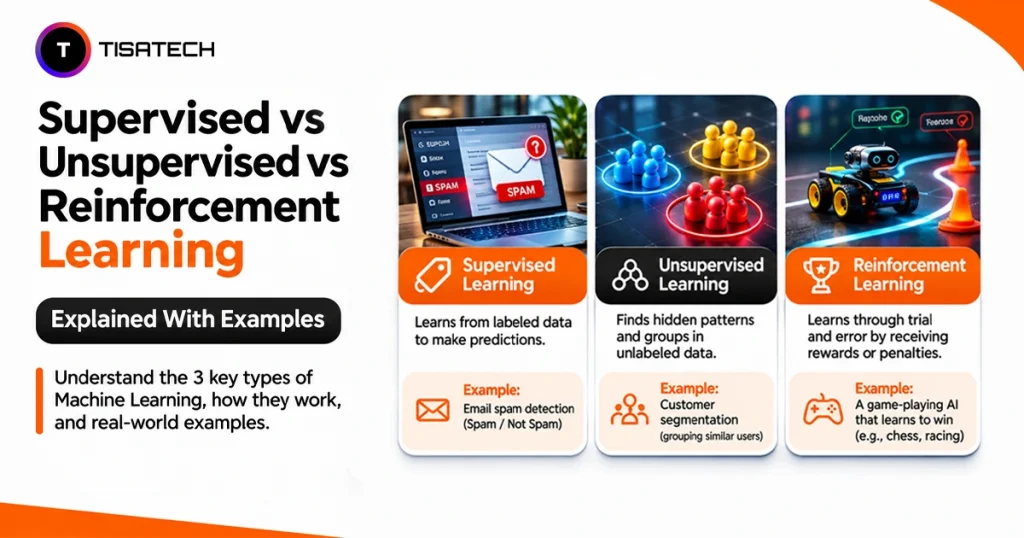
The three main types of machine learning are supervised learning, unsupervised learning and reinforcement learning. The choice depends on the learning objective: predicting known outcomes, discovering patterns in data or learning decisions through feedback. Microsoft Learn’s machine learning module covers how these approaches work and when each is suitable.
Supervised learning trains on labelled data, where each example includes the correct answer. For example, a model learns to identify spam emails from messages that people have labelled as spam or legitimate.
Unsupervised learning uses unlabelled data to find patterns or groups. For example, a shopping platform groups customers by their buying habits without predefined categories.
Reinforcement learning learns through actions and feedback. For example, a game-playing agent improves its strategy by receiving rewards for successful moves and penalties for poor ones.
These approaches serve different purposes, so the right choice depends on the problem, available data and type of feedback.
How Does Supervised Learning Work? Examples of Classification and Regression
Supervised learning trains a model using labelled data, where every example contains input information (features) and its correct answer (label). The model studies these examples, learns the relationship between inputs and outputs, and uses that knowledge to predict results for new data. Microsoft Azure’s guide to machine learning algorithms explains how supervised learning supports prediction and classification tasks.
Supervised learning handles two main tasks:
- Classification: Predicts a category. For example, an email filter classifies messages as spam or legitimate.
- Regression: Predicts a numerical value. For example, a property app estimates a flat’s price using its location, size and number of bedrooms.
Other real-world examples include banks predicting loan approval outcomes from historical applications and healthcare models identifying conditions from medical scans that specialists have reviewed and labelled.
Two commonly used supervised learning algorithms are linear regression and decision trees. Linear regression predicts numerical values, while decision trees can handle both classification and regression tasks. Scikit-learn’s guide to supervised learning covers these and other algorithms.
What Is Unsupervised Learning? Types and Real-World Applications
Unsupervised learning trains models on unlabelled data, where no predefined answers guide the learning process. Instead of predicting known outcomes, the model identifies patterns, similarities and relationships within the data. Scikit-learn’s clustering documentation explains different clustering methods, including K-means, DBSCAN and hierarchical clustering.
Three common tasks in unsupervised learning are:
- Clustering: Groups similar data points, such as customers with similar buying habits.
- Association: Identifies items or events that frequently occur together, such as products customers often purchase in one order.
- Dimensionality reduction: Reduces the number of data features while preserving important information, making complex datasets easier to analyse.
For example, a jewellery shop in Johari Bazaar can analyse years of sales records to group customers by purchasing habits. The owner can identify customers interested in wedding jewellery, festival gifts or everyday accessories and plan relevant offers. Banks also use unsupervised techniques to identify unusual transaction patterns, while online stores use them to understand customer behaviour.
A commonly used unsupervised learning algorithm is K-means clustering. It groups data points into a predefined number of clusters based on their similarities. For example, a news platform can use K-means to group articles covering similar topics based on their content, without assigning topic labels in advance.
One important limitation is that the model finds patterns but does not automatically explain what those patterns mean. People must interpret the results and decide how to use them.
Practical Example: Supervised vs Unsupervised Learning in Python
You can understand the difference between supervised and unsupervised learning by working with a small customer dataset. In supervised learning, the model uses existing labels to predict whether a customer will make a purchase. In unsupervised learning, it groups customers based on similarities in their data without predefined labels.
The following example uses Python and Scikit-learn to demonstrate both approaches.
Beginners who are new to programming can start by understanding Python fundamentals before working with machine learning libraries.
Step 1: Create a Sample Dataset
Here, visits and time_spent are input features, while purchased is the target label.
This six-row dataset is intended only for demonstration. It helps beginners understand how supervised and unsupervised learning work, but it is too small for reliable model evaluation or production use.
Step 2: Apply Supervised Learning
The decision tree learns from the labelled examples and predicts whether a customer with six visits and 18 minutes of activity is likely to purchase.
A decision tree can learn patterns from training data, but very small datasets may cause overfitting. Overfitting happens when a model learns the training examples too closely and performs poorly on new, unseen data.
Step 3: Apply Unsupervised Learning
K-means groups customers based on their visits and time spent without using the purchased column.
One important consideration is feature scaling. K-means uses distances to group data points, so features with larger numerical ranges can have more influence on the results. In real-world projects, techniques such as StandardScaler help bring features to comparable scales before clustering.
What Does This Example Demonstrate?
The decision tree learns from known purchase labels to make predictions. K-means looks for similarities between customers and assigns them to clusters without knowing their purchase outcomes in advance.
Both approaches use the same input features, but their learning objectives are different.
This example uses a small dataset to demonstrate the concepts. Real-world machine learning projects require larger datasets, appropriate preprocessing and proper model evaluation.
What Is the Difference Between Supervised, Unsupervised and Reinforcement Learning?
The differences between these learning approaches become clearer when you compare their training methods, goals and applications. The table below highlights their training methods, goals, common tasks and real-world applications.
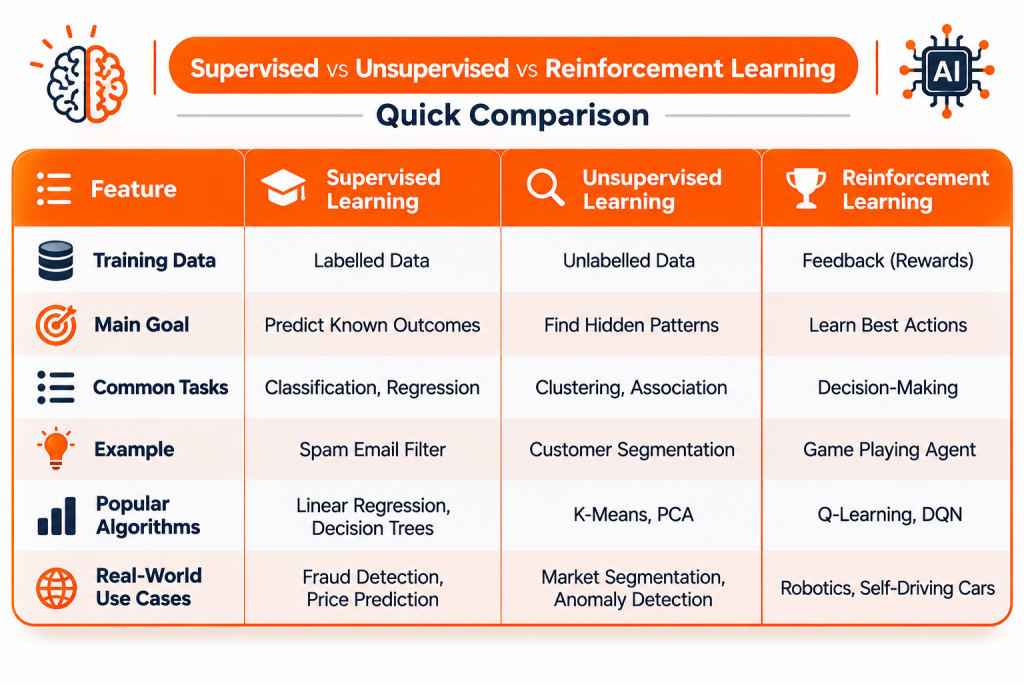
The difference becomes clearer with classification vs clustering. Classification assigns new data to predefined categories, such as spam or inbox. Clustering groups similar data points without predefined categories. Reinforcement learning differs from both because it learns through actions and feedback rather than labelled examples or pattern discovery.
So, which approach should you use?
- Supervised learning: Choose it when you have labelled examples and a clear outcome to predict, such as spam detection or house price estimation.
- Unsupervised learning: Choose it when you want to discover hidden patterns in unlabelled data, such as customer segmentation.
- Reinforcement learning: Choose it when a system needs to learn decisions through repeated interactions and rewards, such as game-playing agents or robotics.
IBM’s comparison of supervised and unsupervised learning explains the differences between the first two approaches in more detail.
How Does Reinforcement Learning Work? Examples in Games and Robotics
Reinforcement learning trains an agent to make decisions through trial and error. The agent takes an action in an environment, receives a reward or penalty, and uses that feedback to improve its next decision. Over time, it learns a strategy that maximises its total reward. OpenAI’s Spinning Up guide to reinforcement learning explains agent-environment interactions, rewards, actions and the key concepts behind reinforcement learning.
Common applications include:
- Games: An AI agent improves its moves by playing repeatedly and learning from wins and losses.
- Robotics: A robot learns movements, such as walking or picking up objects, through repeated attempts and feedback.
- Autonomous systems: Researchers use simulated environments to train systems to make decisions, such as when to brake or change direction.
A well-known example is DeepMind’s AlphaGo, which defeated Go world champion Lee Sedol 4–1 in 2016. AlphaGo learned from expert games and improved further through repeated self-play using reinforcement learning. DeepMind explains how AlphaGo learned. AlphaGo used both supervised learning from expert human games and reinforcement learning through self-play.
Q-learning is a common beginner algorithm where the agent learns which actions are most useful in different situations. It stores the expected reward for taking an action in a particular state and updates these values based on feedback from the environment. Over time, the agent learns which actions are more likely to produce higher rewards.
One challenge is that training can require many interactions with the environment. For this reason, teams often use simulations to test actions and improve models before deploying them on physical robots or other real-world systems.
What Is Semi-Supervised Learning and When Is It Useful?
Semi-supervised learning combines a small amount of labelled data with a larger amount of unlabelled data. It is useful when collecting and labelling enough training examples requires significant time or money.
For example, radiologists may label a small set of CT scans while a model also learns from thousands of unlabelled scans. This approach helps train models without requiring experts to annotate every image.
Self-supervised learning is different. Instead of relying on human-provided labels, the model creates a learning task from the data itself. For example, a language model may hide a word in a sentence and learn to predict it from the surrounding words. This approach is widely used to pretrain GPT-style language models.
IBM’s guide to self-supervised learning explains how this method differs from semi-supervised learning.
Is ChatGPT an Example of Unsupervised Learning?
No. ChatGPT uses self-supervised learning during pretraining and may use supervised learning and reinforcement learning techniques during post-training.
During pretraining, the model learns from large amounts of text by predicting the next token in a sequence. The text itself provides the learning signal, so humans do not need to label every example. This approach is called self-supervised learning rather than traditional unsupervised learning.
Post-training improves how the model follows instructions and responds to users. Depending on the model, this stage can include:
- Supervised Fine-Tuning (SFT): The model learns from examples of useful responses written or reviewed by humans.
- Preference-Based Training: Models learn from human or AI-generated preferences to improve response quality and alignment. Some preference-based methods, such as Direct Preference Optimization (DPO), optimize models directly using preference data without reinforcement learning. Other approaches, such as Reinforcement Learning from Human Feedback (RLHF) using PPO, use reinforcement learning.
Therefore, ChatGPT is not purely an unsupervised learning model. It combines self-supervised pretraining with different post-training techniques. OpenAI explains these stages in its guide to how ChatGPT and foundation models are developed.
To understand how ChatGPT fits into the wider AI landscape, read the guide to generative AI vs predictive AI.
Is YOLO a Supervised or Unsupervised Learning Model?
YOLO (You Only Look Once) is primarily a supervised learning model used for object detection. It identifies objects in images and predicts their classes and locations.
During training, developers provide YOLO with labelled images. Developers assign each object a class label, such as car or person, and draw a bounding box around it. The model compares its predictions with these annotations and adjusts to improve detection accuracy. Ultralytics’ YOLO documentation explains this training process.
However, training methods can vary across YOLO versions and implementations. Some pipelines may include pretrained weights, transfer learning or additional training techniques. Researchers also study self-supervised methods to reduce the need for manually labelled images. Nevertheless, standard YOLO object detection training generally relies on labelled datasets.
| Follow Us for Daily Tech Tips |



|
Building Machine Learning Skills at TISA-TECH, Jaipur
Learning machine learning involves more than understanding algorithms. Beginners also need practical experience with Python, datasets and model evaluation to understand how different models work.
TISA-TECH offers a machine learning program in Jaipur that covers Python fundamentals, machine learning concepts and practical projects. Students can build their understanding of machine learning through programming exercises and hands-on projects.
Before choosing a training program, compare its curriculum, programming fundamentals and opportunities to work on practical projects. Students can also review IT learning programs to compare learning paths and find a program that matches their goals.
Conclusion
Choosing the right machine learning approach starts with understanding the problem and available data. Check whether you need to predict outcomes, discover patterns or train a system to make decisions through feedback.
As a beginner, start with a small project, use a simple algorithm and evaluate its results. Gradually experiment with different approaches to understand how models learn and improve their performance.
FAQs Section
Ans. Supervised learning uses labelled data to predict outcomes, unsupervised learning finds patterns in unlabelled data, and reinforcement learning improves decisions through rewards and feedback.
Ans. Neither is universally better. Supervised learning suits tasks with labelled data and known outcomes, while unsupervised learning helps find hidden patterns in unlabelled data. The right choice depends on the problem.
Ans. Supervised learning is often a good starting point because beginners can work with labelled datasets and measure model performance. Simple classification and regression projects help build a foundation.
Ans. Reinforcement learning is used in robotics, game-playing systems, resource allocation and other tasks where an agent improves its decisions through repeated actions and feedback.
Ans. ChatGPT uses multiple training approaches. Its development includes pre-training, supervised fine-tuning and preference-based training, which may involve reinforcement learning.