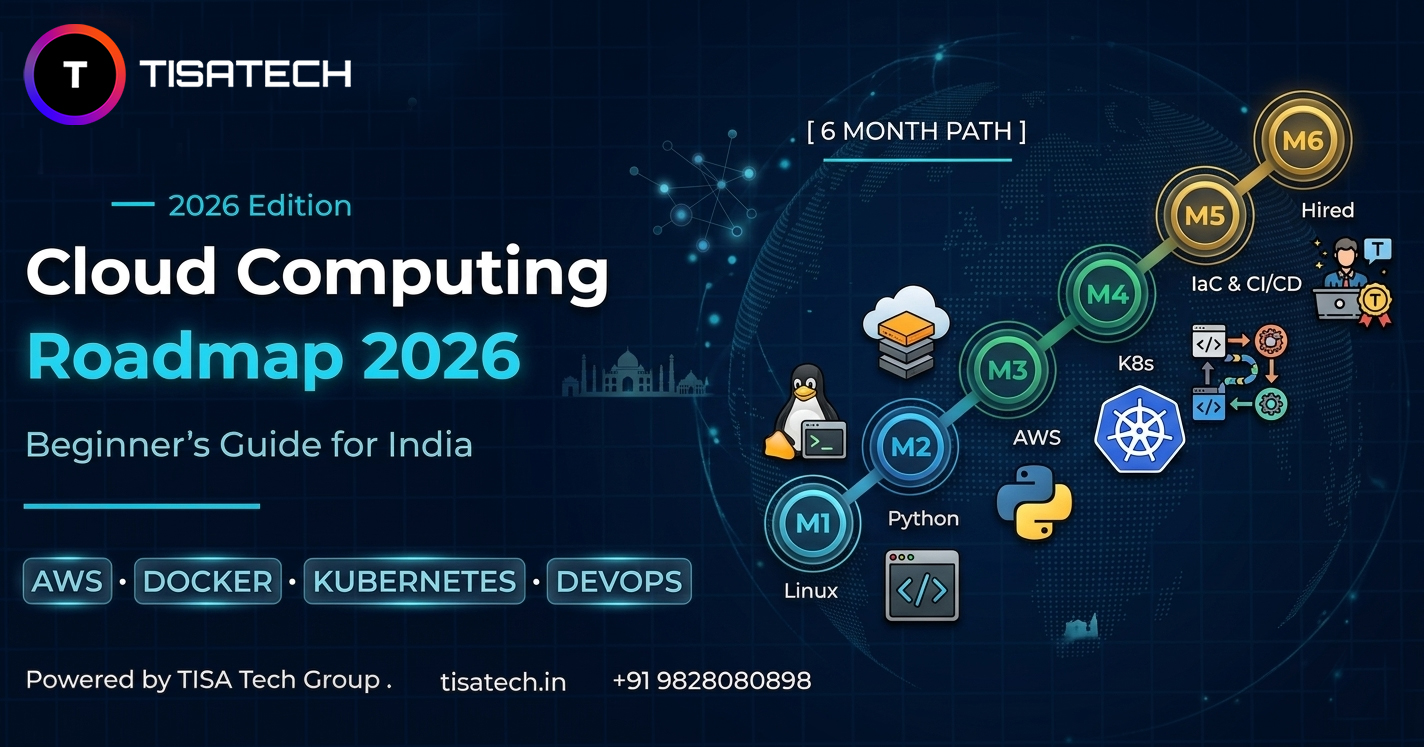
If you are a student or professional from Jaipur and you are feeling confused about choosing a tech career. You should read this blog to clear your doubts and vision. Choosing the right path becomes difficult, especially when you are just starting your career.
Cloud computing is no longer a trending word. It runs almost every app you use. Apps like Instagram, Zomato, Netflix, Paytm and even your college ERP all depend on cloud platforms to store data and run services. This means cloud computing is a highly demanding skill in 2026.
Big companies in India have hired lakhs of cloud engineers in the last two years, especially in the south region. In cloud computing, fresher packages are much better than other major IT roles. And if you learn from zero, our guide will make you job-ready in six to eight months even if you have the courage and never give up attitude.
This blog gives you a clear result-oriented cloud computing roadmap 2026 that actually works. Not a list of random topics. It is an actual month by month plan that a complete beginner in Jaipur can follow from home to company.
What is Cloud Computing in Simple Words?
Let’s understand cloud computing in a simple way. It’s like Cloud computing means using someone else’s computer over the internet instead of buying your own. You don’t need to purchase, set up and manage expensive machines. Everything is available online, and you simply use it when you need it.
Think about it this way. If you want to run a website, earlier you had to buy a physical server, keep it in a room, pay for electricity and fix it when it broke.This process is expensive, time-consuming, and difficult to manage.
Now you just rent a virtual server from Amazon or Google. You don’t need to worry about hardware, maintenance, or electricity. You simply log in, create a server, and start using it within minutes. You pay only for what you use. You can scale up during a Diwali sale and scale down after. The hardware is their problem. Scale up refers to increased size, capacity or performance of computer resources to handle more growth and demand. Cloud computing makes things easier, faster and affordable.
Companies likeAmazon Web Services (AWS), Microsoft Azure and Google Cloud Platform (GCP) give you servers, storage, databases and hundreds of other tools on demand.
 WhatsApp Chat
Three models you should know:
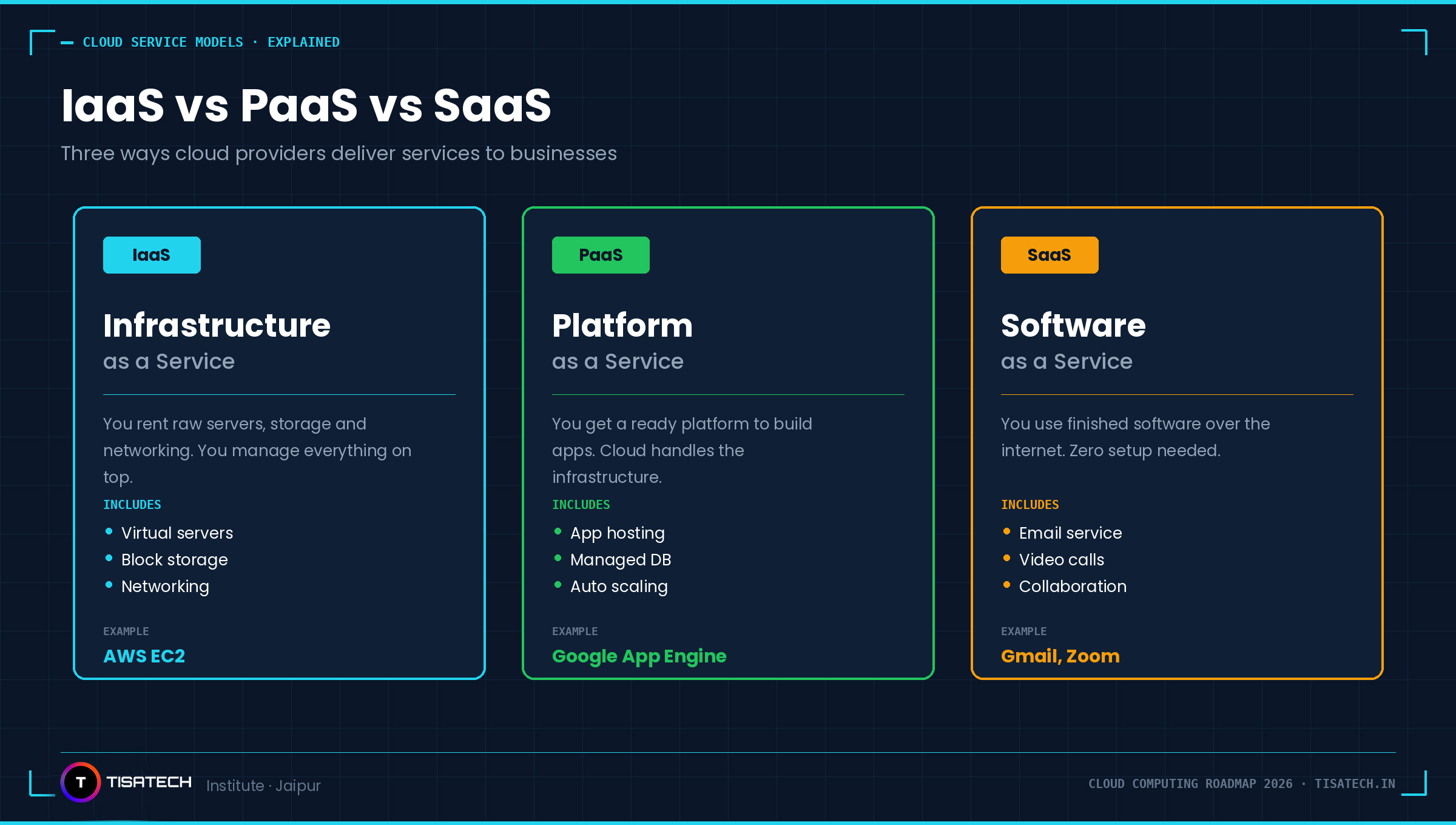
Infrastructure as a Service (IaaS):
Infrastructure as a Service (IaaS is a basic level of cloud computing. You can rent servers, storage, and networking from a cloud provider. You can control installing software, managing applications, and configuring settings. Example: AWS EC2.
PaaS Platform as a Service (PaaS):
PaaS Platform as a Service (PaaS) provides a ready-to-use platform where you can build, test, and launch applications without managing servers. The cloud provider takes care of infrastructure, updates, security, and maintenance, so you can focus only on development.
Example: Google App Engine.
Software as a Service (SaaS):
Software as a Service (SaaS) is the simplest cloud model. Here, you directly use software over the internet without installing anything. Everything is already built and ready to use. You can use services when you need to.
Example: Gmail, Zoom.
Why the Market is Crazy About Cloud Right Now?
After 2020, Indian IT companies have started moving quickly toward cloud technology. IT companies were facing difficulties in maintaining traditional data centers, which became expensive, slow, and difficult to scale. Most of the businesses shifted their systems to the cloud to reduce costs and improve performance. All the social connectivity like banks, hospitals, schools, startups and even government departments have adopted cloud solutions. They began hiring professionals who could manage cloud infrastructure.
According to NASSCOM, India will need around 14 million cloud-related jobs by the end of 2026. Companies like TCS, Infosys, Wipro, Accenture, Amazon, Microsoft and hundreds of startups are hiring continuously. Cloud engineer openings have grown by more than 35 percent in the last two years.
The demand is real. The supply of trained engineers is still low. That gap is your opportunity.
Cloud Computing + DevOps Engineer
They Are Not Separate Anymore
Most websites will tell you that these two are different careers. That information is outdated.
In 2026, companies will not hire a “pure cloud engineer” and a “pure DevOps engineer” separately for small and mid-sized teams. They will hire only one professional who understands both Cloud and DevOps. They will not hire two separate people. That is why our cloud computing course in jaipur at TISA-TECH bundles them together.
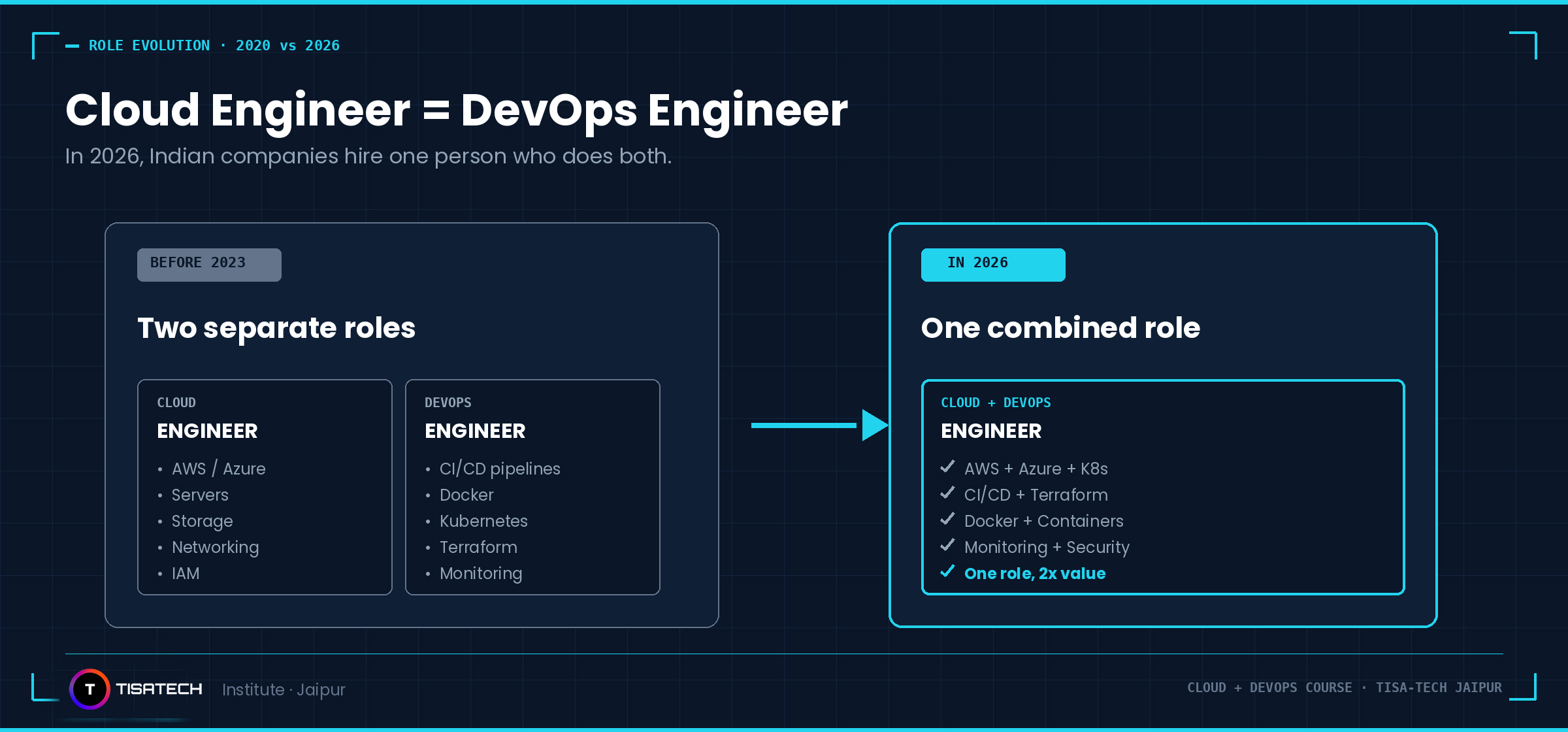
Here is the honest truth. A cloud engineer today must know how to set up infrastructure on AWS or Azure. They must know how to write code that automates this setup using Terraform or Ansible. They must build CI/CD pipelines so code goes to production automatically. They must know the use of Docker and Kubernetes to run applications, monitor systems using Prometheus and Grafana. They also handle basic security incidents. This ensures applications and data remain safe and secure.
In the past, companies split these responsibilities across two roles. Now it is one. The modern cloud engineer is a DevOps engineer. Learn this combined skill set and you will clear interviews at twice as many companies as someone who only studied “pure AWS.”
What Does a Cloud Engineer Actually Do?
A fresher cloud engineer at an Indian IT company usually spends the day like this.
At Morning starts with checking monitoring dashboards to see if any server crashed overnight.
- This helps you quickly identify issues before they affect users.
- At 11 AM there is a standup call where the team discusses what is breaking and what needs fixing.
- At Afternoon goes into writing Terraform code to add a new server environment for the development team.
- Around 3 PM something goes wrong in production and you roll back a broken deployment.
- By 5 PM you are reviewing a teammate’s pull request and approving a CI/CD pipeline change.
You are not just clicking buttons on the AWS dashboard. You are writing scripts, debugging issues, automating boring tasks and making sure applications run smoothly for lakhs of users.
Cloud Computing Prerequisites for Beginners
You do not need to be a hardcore coder to learn cloud. Many people think the cloud requires advanced programming skills but that is a myth. But you do need these basics.
You should have basic computer skills like file systems work, use the terminal, and understand basic keyboard shortcuts. You must be willing to use Linux. Windows will not help you here so install Ubuntu in a virtual machine. English comfort is needed because all documentation is in English. Nothing fancy, just readable. And you need a problem-solving mindset because things will break and you must enjoy fixing them.
You do not need a BTech degree. BCA students, BSc IT students and even non-IT graduates work in the cloud. You do not need deep math or DSA. You do not need expensive hardware because a laptop with 8 GB RAM is enough for everything in this roadmap.
So Yes, a Student sitting in Jaipur with basic English and a normal laptop can absolutely learn this from home.
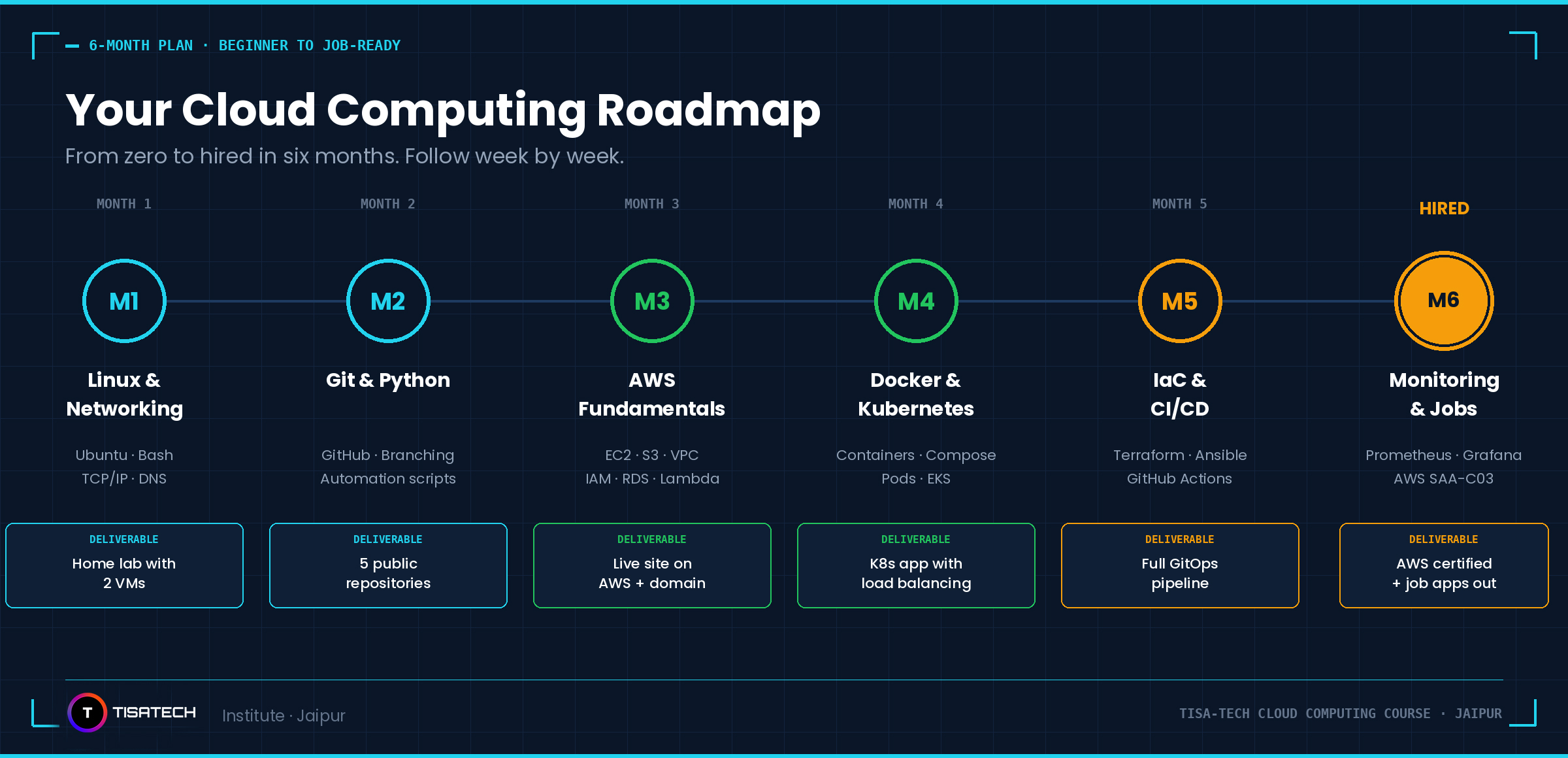
The 6-Month Cloud Computing Roadmap for Beginners in 2026
This is the part competitors never give you. Everyone lists topics to learn. Nobody gives you an actual calendar.Here is a simple 6-month cloud computing roadmap that beginners can follow step-by-step.
Month 1: Linux and Networking Foundations
You cannot skip this. Cloud servers run on Linux. If you do not know Linux commands, you will be lost on day one of any internship.
Week 1 and 2: LearnLinux basics. Install Ubuntu. Learn ls, cd, mkdir, chmod, sudo, grep, find. Understand permissions, users and processes.
Week 3: Learn Bash scripting. Write a simple script that automatically creates a backup folder or moves log files. Automation starts here.
Week 4: Networking basics. Understand how computers talk. Learn about IP addresses, DNS, and common ports like 80 (HTTP) and 443 (HTTPS). Learn how firewalls block or allow traffic.
By the End of Month 1: You should create a home lab with two Ubuntu virtual machines that can communicate with each other and share files successfully.
Month 2: Git, Python and Core Programming
Week 1: Git and GitHub. Create your GitHub account and learn Git basics like commit, push, pull, branch, and merge. Practice uploading code to repositories and managing version control. Git is essential for cloud and DevOps workflows.
Week 2 and 3: Learn Python basics for automation. Learn Variables, loops, functions, and reading files. You do not need advanced programming. You are writing scripts that talk to cloud APIs.
Week 4: Build small Python projects. Write a Python script that lists all files in a folder and sends reports automatically. Upload them on GitHub properly.
By the End of Month 2: You should have a public GitHub account with at least five small repositories.
Month 3: AWS Fundamentals
Now you start working with real cloud services.Create an AWS free tier account. It gives you free access to many services for 12 months.
Week 1: Learn core AWS services like EC2 (servers), S3 (storage), VPC (networking), IAM (users and permissions). These services form the foundation of cloud computing.
Week 2: Deploy your first website on EC2. Connect using SSH. Install NGINX and deploy a simple website on your server. Link a custom domain to your hosted website. This becomes your first real cloud deployment project.
Week 3: Learn RDS (managed databases), Lambda (serverless) and CloudWatch (monitoring). These services help you build production-ready applications.
Week 4: Build a simple three-tier application with frontend, backend, and database layers to gain practical cloud architecture experience.
By the End of Month 3: You should have a live website hosted on AWS with your own custom domain.
Month 4: Containers and Kubernetes
Week 1: Learn Docker concepts like images, containers, and Docker file to learn application packaging.
Week 2: Learn Docker Compose to run multi-container applications to stimulate real production setups.
Week 3: Learn Kubernetes concepts like pods, services, and deployments. Kubernetes is widely used in modern cloud infrastructure.
Week 4: Deploy your containerized app to a real AWS EKS cluster. This step gives you real cloud deployment experience.
By the end of Month 4: You should run a multi-container application on Kubernetes with load balancing working properly.
Month 5: Infrastructure as Code and CI/CD
Week 1 and 2: Learn Terraform basics and create infrastructure using code. Write code that creates EC2 instances, VPCs and databases automatically. No more clicking in the AWS console.
Week 3: GitHub Actions. Build a pipeline that tests your code, builds a Docker image and deploys it to AWS.This improves deployment speed and reliability.
Week 4: Combine everything. Terraform creates the infrastructure. GitHub Actions deploys the app. Push code to GitHub and watch automatic deployment. This simulates real DevOps workflows.
By the end of Month 5: You should complete a full GitOps project where pushing code to GitHub automatically deploys your application to AWS.
Month 6: Monitoring, Security and Job Preparation
Week 1: Prometheus and Grafana. Learn Prometheus and Grafana for monitoring. Build a dashboard. Monitor CPU, memory, and application metrics. This helps maintain production systems.
Week 2: Security Basics. Learn IAM best practices and secret management. Understand container scanning and security monitoring. Security knowledge improves your job readiness.
Week 3: Certification Preparation. Prepare for AWS Solutions Architect Associate exam.Certification improves your resume credibility.
Week 4: Job Preparation. Prepare your resume and update your LinkedIn profile. Organize GitHub repositories and document projects. Practice mock interviews and technical questions. Start applying for cloud engineer roles.
By the End of Month 6: You should schedule your AWS SAA-C03 certification and start applying for jobs.
By following this roadmap step-by-step, you build real cloud skills and become job-ready in six months.
Which Cloud Platform to Learn First: AWS vs Azure vs GCP
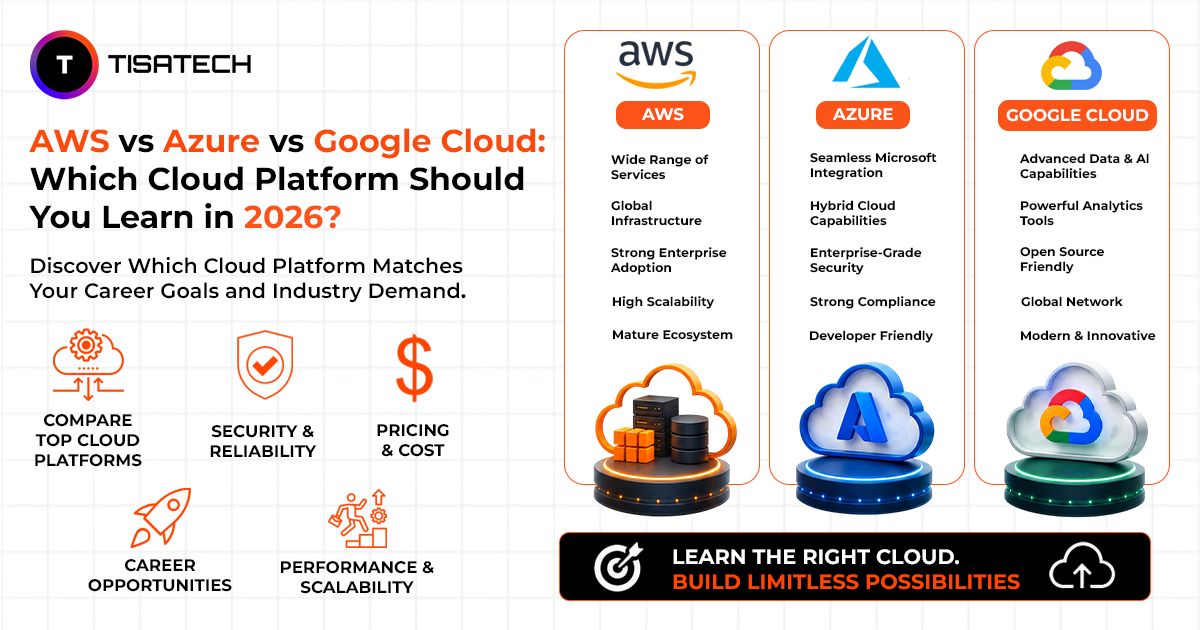
Students ask this question very often: Which cloud platform should I learn first? The simple answer is to start with AWS. It offers the best learning path for beginners and the most job opportunities in the market.
AWS has the biggest market share in India, around 32 percent. Many startups, product or service based companies use AWS. Because of this ,the AWS field has more job openings. It provides more and stronger documentation and a large community where you can find help easily . The AWS free tier is also the most generous for learners.
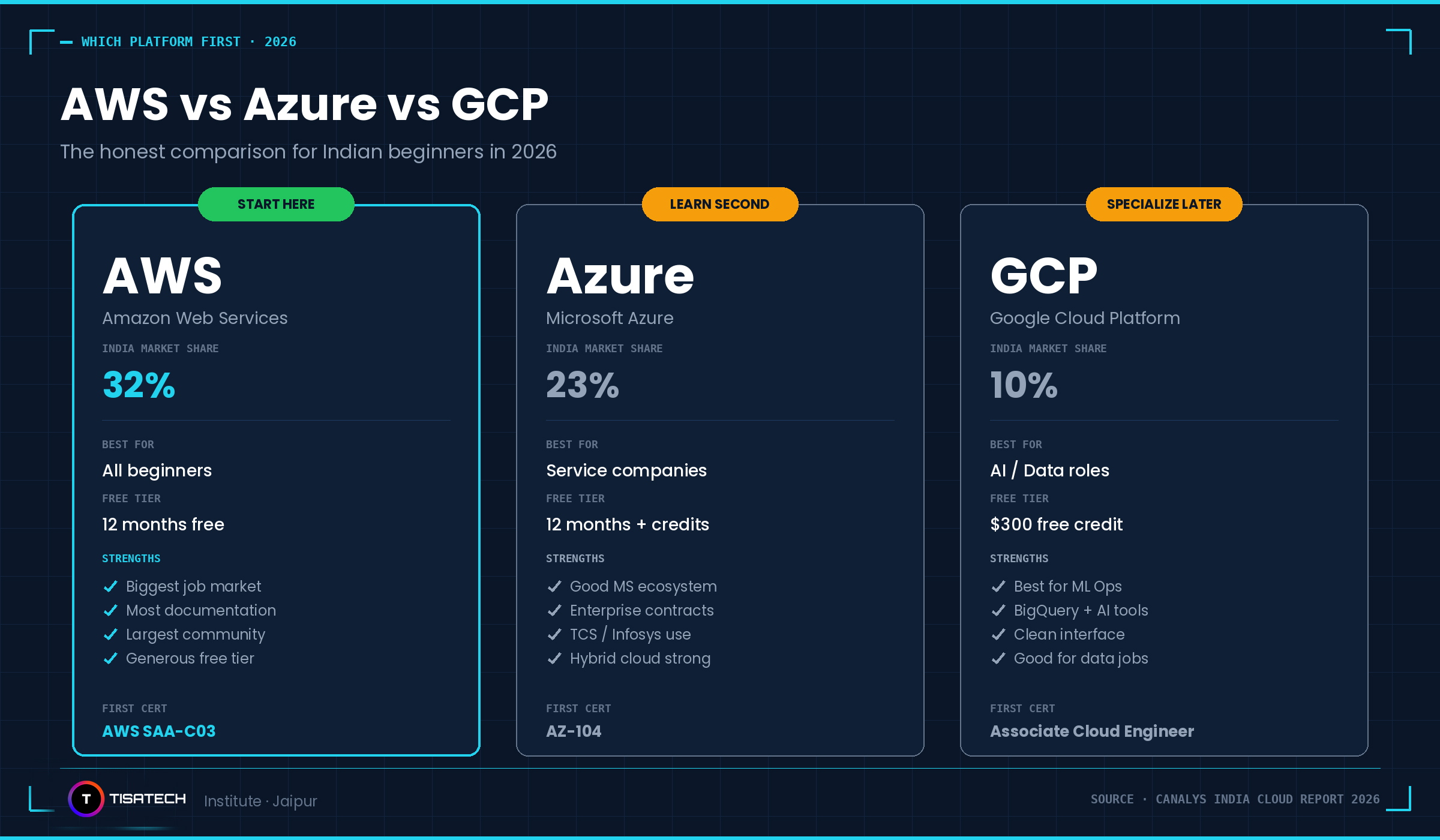
Azure is a solid second choice. Many large service-based companies like Infosys, TCS, and Accenture work on Microsoft-based projects. Most companies often use Azure for enterprise clients. But start with AWS and pick up Azure as your second platform.
GCP is the best platform for AI and data engineering roles. Many companies use Google Cloud for analytics and ML workloads. If you are leaning toward ML Ops, learn GCP as your second platform after AWS.
One strong rule. Learn one platform deeply before moving to another. If you try learning AWS, Azure, and GCP at the same time, you may get confused and slow down your progress.
Which Cloud Certification Should a Beginner Start With?
Many beginners feel confused about which cloud certification to choose first. You should follow a simple order and start with beginner-friendly certifications.
Pick these in order.
AWS Certified Cloud Practitioner (CLF-C02): Start with this entry-level certification to build your foundation and make learning advanced topics easier. It helps you understand basic cloud concepts, AWS services, pricing, and security. The exam fee is around ₹8,300.
AWS Solutions Architect Associate (SAA-C03): This certification focuses on designing cloud architecture, deploying applications, and managing AWS services. Many recruiters filter resumes Many recruiters filter resumes based on the basis of this certification. The exam fee is around ₹13,000.
Certified Kubernetes Administrator (CKA): Choose this certification when you want to stand out from other candidates. It shows that you understand Kubernetes and container orchestration. The exam fee is around ₹32,000
HashiCorp Terraform Associate: Add this certification to strengthen your DevOps and automation skills. It focuses on Infrastructure as Code using Terraform. The exam fee is around ₹6,000.
Hold one or two of these by the time you apply for jobs. Cloud research in 2026 showed certified candidates get 20 to 30 percent higher starting salaries than non-certified ones with the same skill level. Certifications also improve your resume and increase interview opportunities.
AI and Cloud Convergence: The 2026 Angle Nobody Talks About
Most cloud roadmaps focus only on servers, networking, and deployments. But in 2026, cloud computing is merging with AI. Generative AI is changing the role of cloud engineers, and students who understand this early gain a strong advantage.
Every major cloud platform offers its own AI service. AWS has Bedrock for running large language models. Azure offers OpenAI Service for building AI-powered applications. Google Cloud provides Vertex AI for machine learning and generative AI deployments. Companies are putting their ChatGPT style apps on these platforms every day.
Who sets up this infrastructure? Cloud engineers set up and manage this infrastructure. They deploy AI models, configure storage, manage APIs, and ensure applications run smoothly. In 2026, knowing how to deploy a RAG (Retrieval-Augmented Generation) pipeline using AWS Bedrock or fine-tune a model using SageMaker, you become far more valuable. Companies prefer candidates who can support AI applications because AI adoption is growing across industries.
Our advice for students. In Month 6, spend one full week learning how to deploy a basic LLM application on AWS Bedrock. You do not need to become a machine learning engineer. You only need to understand how to set up the cloud infrastructure for AI applications. This one skill alone will get you past five out of ten interviews in 2026.
5 Portfolio Projects That Will Actually Get You Hired
Recruiters and HR teams often check GitHub profiles before shortlisting candidates. These are five projects you can build during your six months to create a professional portfolio that attracts attention and improves your chances of getting hired.
1. Personal Portfolio Site on AWS with CI/CD
Start by building your own personal portfolio website and host it on AWS. Create a simple React or static website and upload it to S3. Use CloudFront as a CDN to improve performance and Route 53 to connect your domain. Then set up GitHub Actions so every code push automatically updates the live website.
Tech used: S3, CloudFront, Route 53, GitHub Actions.
GitHub README tip: Include an architecture diagram and a live demo link.
2. Three-Tier Web App on Kubernetes
Build a full stack app with frontend, backend and database, then deploy it on AWS EKS. Use Helm charts for configuration. Add horizontal pod autoscaling so it handles traffic spikes.
Tech used: Docker, Kubernetes, EKS, Helm, MongoDB.
GitHub README tip: Show screenshots of the Grafana dashboard during a load test.
3. Complete Infrastructure as Code Project
Create a full AWS infrastructure using Terraform. Write code that creates VPC, subnets, EC2 instances, RDS database, and security groups. Use Terraform modules properly. Include GitHub Actions for validation.
Tech used: Terraform, AWS, GitHub Actions.
GitHub README tip: Add a “terraform plan” output screenshot so reviewers can see what the code creates.
4. Monitoring Stack on a Real Cluster
Deploy a monitoring stack on your Kubernetes cluster using Prometheus, Grafana, and Loki. Create dashboards to monitor CPU, memory, and application errors. Set up alert notifications using Slack for production issues. Monitoring skills make you more valuable as a cloud engineer.
Tech used: Prometheus, Grafana, Loki, Kubernetes, Slack API.
GitHub README tip: Embed sample alert messages and dashboard screenshots.
5. Serverless GenAI Chatbot
Build a serverless chatbot using AWS Lambda, API Gateway, and Bedrock. Create a simple frontend and store chat data in DynamoDB. Deploy the project using SAM or Serverless Framework. This project helps you stand out in 2026 because AI and cloud skills together are in high demand. It shows you understand modern cloud architecture.
Tech used: Lambda, API Gateway, Bedrock, DynamoDB.
GitHub README tip: Include a demo video and mention the exact Bedrock model you used.
Put each project in a separate GitHub repository with a clear README, an architecture diagram and a live demo link. That is your portfolio.





Cloud Engineer Salary in India for Freshers: Real 2026 Numbers
Okay, the question everyone asks:What salary can I expect? Here is what the actual data shows, not estimated numbers from old blogs.
Freshers with AWS certification and real projects: ₹4 to ₹7 LPA. (Source: CloudThat salary report, April 2026)
Freshers without certification but with projects: ₹3.5 to ₹5 LPA. (Source: Futurense research, 2026)
Average cloud engineer India across all levels: ₹7.52 lakh per year. (Source: Glassdoor India, April 2026, based on 3,885 salary reports)
Cloud engineer average on Indeed India: ₹10,03,587 per year. (Source: Indeed India, April 2026, 284 reported salaries)
Mid-level cloud engineer with 3 to 6 years experience: ₹8 to ₹18 LPA. (Source: AmbitionBox, 2026)
Senior Cloud Engineer with 7 plus years: 20 to 35 LPA in INR.
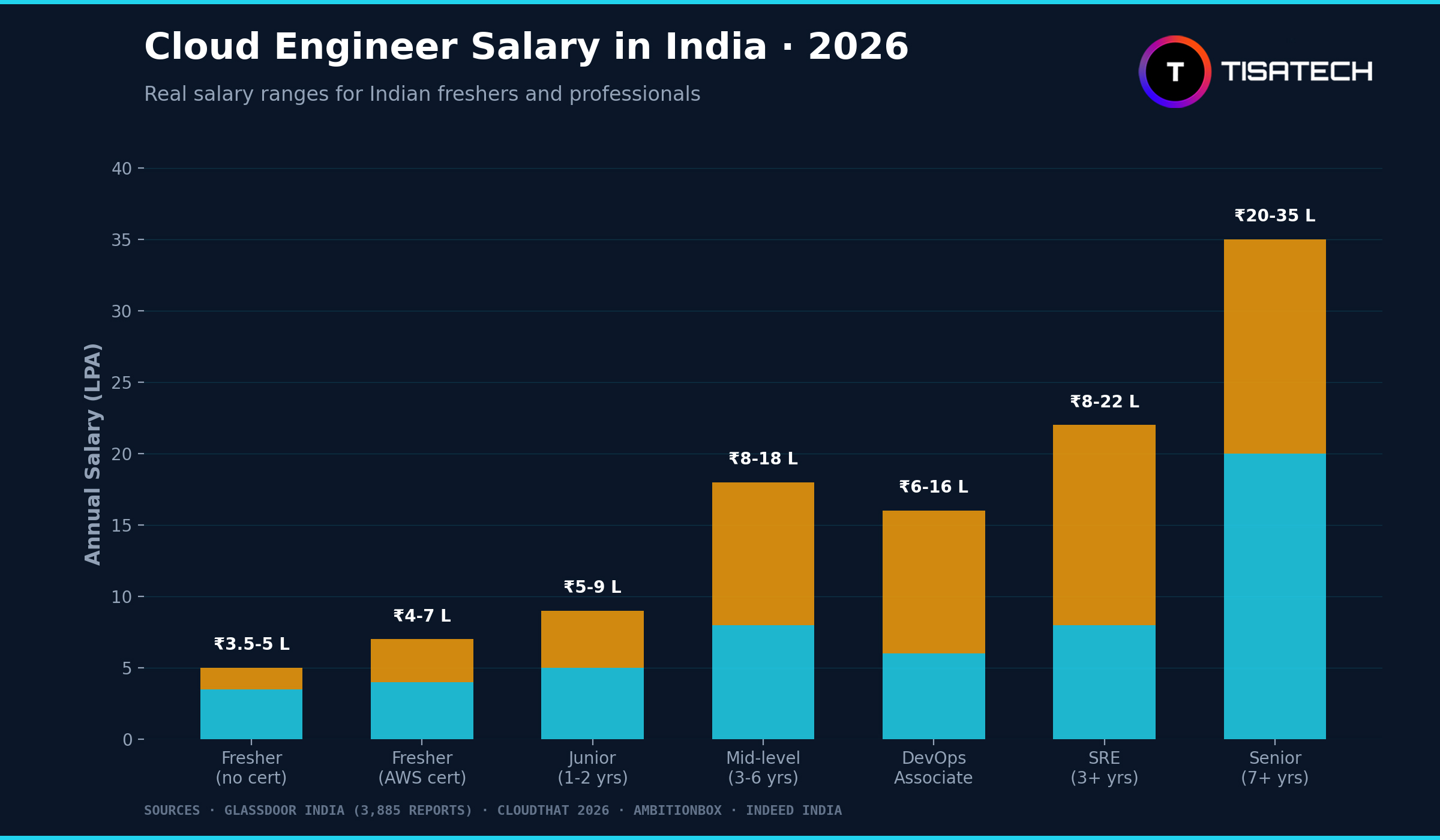
Salary by specific role in 2026 according to CloudThat India data:
AWS Cloud Support Engineer earns ₹4 to ₹12 LPA. DevOps Associate earns ₹6 to ₹16 LPA. An Infrastructure Engineer earns ₹5 to ₹15 LPA. Site Reliability Engineer earns ₹8 to ₹22 LPA.
Many students believe that freshers in Jaipur always earn less than candidates in Bangalore or Hyderabad. That is only partly true. Today, many companies hire remote cloud engineers. You can work for a Bangalore-based company while living in Jaipur. In that case, you earn a Bangalore-level salary while managing Jaipur-level living costs.
This remote work advantage makes cloud computing one of the smartest career choices for freshers in 2026. With the right skills, certifications, and projects, you can start strong and
Cloud Computing Jobs for Freshers: Where to Apply
In 2026, several platforms consistently help freshers find cloud and DevOps roles.
- Start with Naukri.com. Use filters like Cloud Engineer Fresher, DevOps Fresher, or AWS Fresher.
- Use LinkedIn Jobs and create saved searches such as DevOps Associate, AWS Engineer, or Cloud Support Engineer.
- Internshala is another strong option for freshers. Many companies hire interns first and convert them into full-time employees after a few months.
- Instahyre works well if you want to target startups and product companies.
- Focus on companies like TCS, Infosys, Cognizant, Capgemini, Accenture, and HCL to directly apply on company career pages.
Apply to at least forty companies in your first month. Do not send the same resume everywhere. Customize your resume for each role. Mention the specific cloud platform, tools, and technologies listed in the job description. This small effort increases your chances of getting interview calls.
Why TISA-TECH is the Right Place to Learn Cloud Computing in Jaipur
If you are in Jaipur and you want to skip six months of confusion, self-doubt and random YouTube playlists, TISA-TECH is built for exactly this.
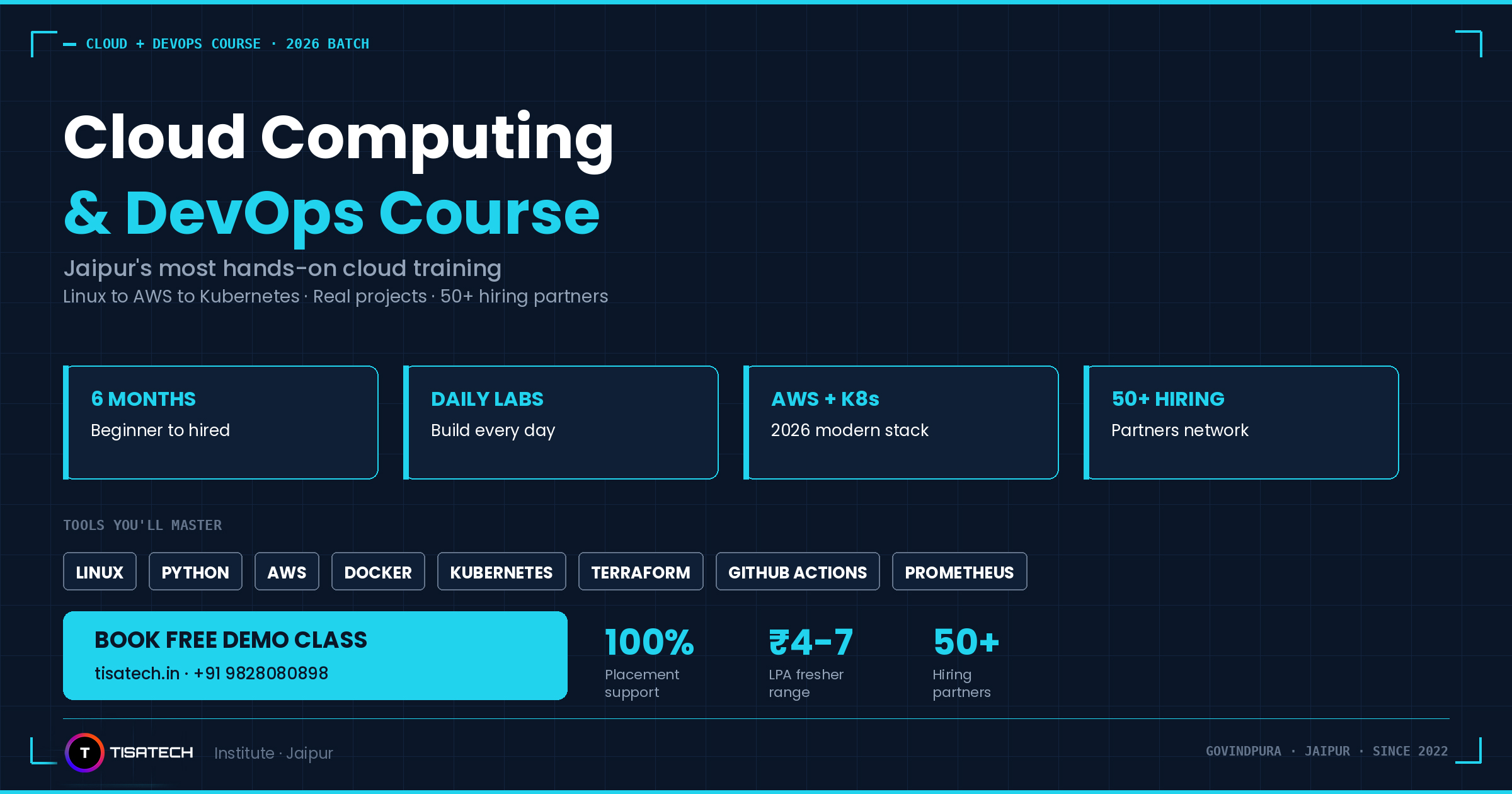
We are an Best IT training institute in Jaipur. We teach cloud computing and DevOps together because companies expect both skills in real-world roles. Our best combined cloud computing and devOps course in Jaipur covers a complete learning path. You start with Linux and networking, move to Docker and Kubernetes, learn AWS and Terraform, and finish with real production-level projects.
What makes TISA-TECH different?
We teach what companies actually hire for. We built our curriculum using real job descriptions posted on Naukri in the last six months. You can learn modern, industry-relevant skills instead of following outdated AWS console-based tutorials from 2019.
- Daily labs, not weekend sessions You build something every single day. Mock production incidents. Real Terraform code reviews. Architecture presentations in front of mentors.
- Hiring partner network We have over fifty hiring partners who interview our students directly. 100 percent placement support is not a tagline for us.
- Mentors who ship code Our trainers are not PowerPoint trainers. They are working cloud engineers who still deploy production systems every week.
- Fees that work for Jaipur students We know Jaipur students do not have Bangalore or Delhi budgets. Our pricing reflects that reality.
If you want to talk to someone before deciding, book a free demo class. No pressure, just come see the lab in person.
Final Verdict
Cloud computing in 2026 is not just a skill. It is the easiest path for a Jaipur student to break into a ₹6 LPA plus tech career without needing a top-tier college tag.
The hardest part is not the technical learning. It is sticking to the plan for six months straight. If you follow this roadmap honestly, build the five projects and get AWS certified, you will have offers waiting by Month 7.
If you need structured guidance, real mentors and a hiring pipeline behind you, come visit TISA-TECH in Govindpura. We have been doing this for years and our placement numbers speak louder than any blog can.
The cloud is waiting. Start today.
Frequently Asked Questions
Yes. Cloud is one of the top three highest paying tech careers in India in 2026. Demand is growing faster than supply. NASSCOM projects around 14 million cloud-related jobs by the end of 2026.
Start with AWS Certified Cloud Practitioner if you are completely new. Then move to AWS Solutions Architect Associate (SAA-C03). This is the most in-demand certification for Indian freshers in 2026.
Freshers with AWS certification and a project portfolio earn ₹4 to ₹7 LPA according to CloudThat’s April 2026 report. Without certification, the range drops to ₹3.5 to ₹5 LPA.
AWS is the best choice to start with because it has the largest market share in India, the most job openings and the most generous free tier. Learn AWS first, then pick up Azure or GCP as a second platform.
With a structured plan like the six-month roadmap in this blog, you can become job-ready in six to eight months. Without structure, students often waste 12 to 18 months and still feel unprepared.
Yes. We have trained students from BCom, BA and even mechanical engineering backgrounds who now work as cloud engineers. You just need patience and structured learning.
Not harder, just different. Full stack focuses on building applications. Cloud focuses on running them reliably at scale. Many students find cloud easier because it involves less code and more logical thinking.
In 2026, yes. The modern cloud engineer role is essentially a DevOps role. Companies hire one person who handles both. This is why our course at TISA-Tech combines cloud and DevOps in one curriculum.
Yes. You need basic scripting skills in Python or Bash, but you do not need to be a full stack developer. Many cloud engineers come from BCA, BSc IT and even non-IT backgrounds.