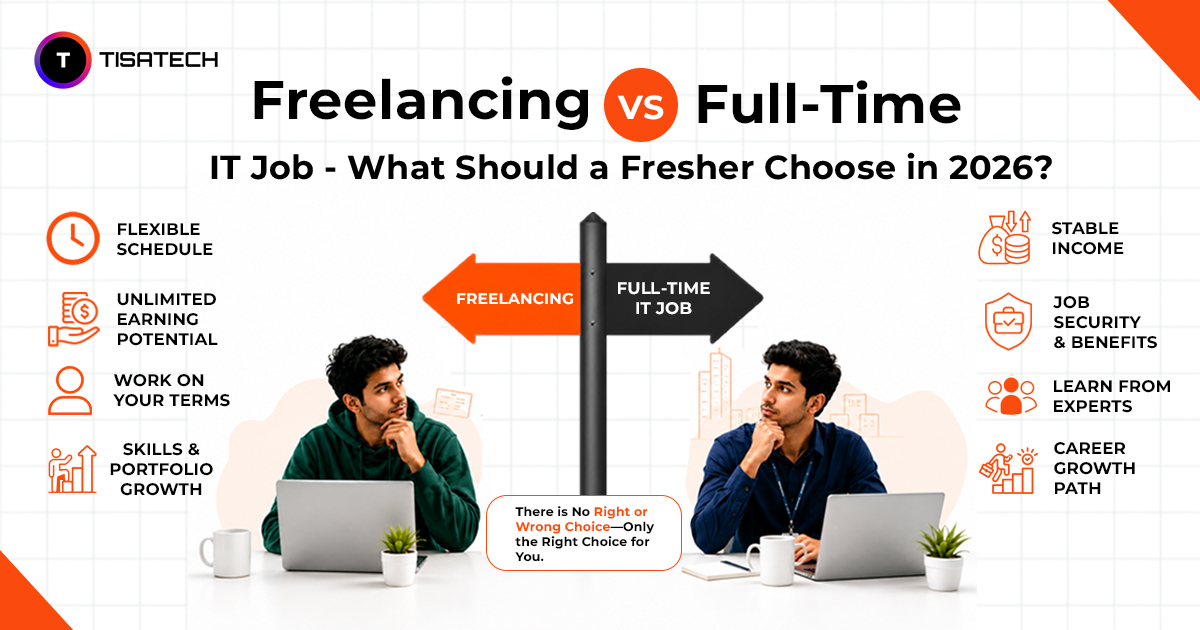
You just finished your course. You have learned some coding, maybe some design or digital marketing. And now everyone around you has a different opinion.
Your family says, “Get a stable job first.” Your college friend is already making ₹15,000 a month on Upwork and keeps telling you freelancing is the future. And somewhere in between, you are trying to figure out what actually makes sense for you.
This confusion is completely normal. And it is more common than you think.
In 2026, the debate around freelancing vs full-time IT jobs for freshers is one of the most searched career questions in India. Both paths look attractive from the outside. Both come with real trade-offs. And nobody gives you a straight answer.
So here is the actual picture. According to Upwork’s Future Workforce Index 2025, 89% of skilled freelancers say their work opportunities have grown compared to the previous year. The global freelance market stands at $9.91 billion in 2026 and is on track to double by 2030.
On the other hand, full-time IT fresher salaries in India range between ₹3 LPA and ₹6 LPA, according to Glassdoor India data (March 2026). If you have skills in AI, ML or cloud, that number can go up to ₹7–15 LPA even as a fresher.
Both options have real earning potential. The question is not which one is better in general. The question is which one is better for where you are right now.
This article gives you a clear and honest answer. No fluff. Just a practical breakdown so you can make the right call for your career in 2026.

What Does a Full-Time IT Job Actually Look Like for a Fresher?
A full-time IT job means you join a company as an employee. You work fixed hours, usually 9 to 6, five days a week. You get a fixed monthly salary.
In Jaipur, many IT companies and software firms hire freshers for roles like junior developer, QA tester, data entry analyst and UI designer. Your starting salary in a Tier-2 city like Jaipur typically falls between ₹2.5 LPA and ₹4.5 LPA, as per Scaler’s 2026 IT Salary Overview.
You get a structured environment. Senior developers and team leads guide you. You learn from real projects. You make mistakes in a safe space where someone can correct you.
Most companies also offer benefits like health insurance, paid leaves, PF contributions and performance appraisals. These things add real value even if they do not show up directly in your salary.
For a fresher with no prior experience, this kind of environment is genuinely helpful. You do not have to find clients, manage invoices or worry about whether work will come next month.
What Does Freelancing in IT Look Like for a Fresher?
Freelancing means you work independently. You find clients, deliver projects and get paid per project or per hour. Platforms like Upwork, Fiverr, Toptal and Freelancer.com are where most people start. A fresher doing web development can charge anywhere from ₹500 to ₹3,000 per hour depending on the skill level and the client. A Canva or graphic design gig might pay ₹2,000 to ₹8,000 per project.
The problem is that getting your first client is the hardest part. Most platforms rank freelancers by reviews and past work. As a beginner with zero reviews, you start from the bottom. You also handle everything yourself: proposals, communication, delivery, revisions and payments. There is no team to fall back on and no salary if a month is slow.
That said, freelancing gives you real exposure to multiple projects, multiple clients and real‑world problem solving from day one.
Freelancing vs Full-Time IT Job for Freshers : A Clear Comparison
Freshers in Jaipur often think about which option is better – freelancing or a full‑time IT job. Both sound good but they work very differently when it comes to money, learning and stability.
Here’s a clear side‑by‑side comparison that shows how both career paths actually look for beginners in IT.
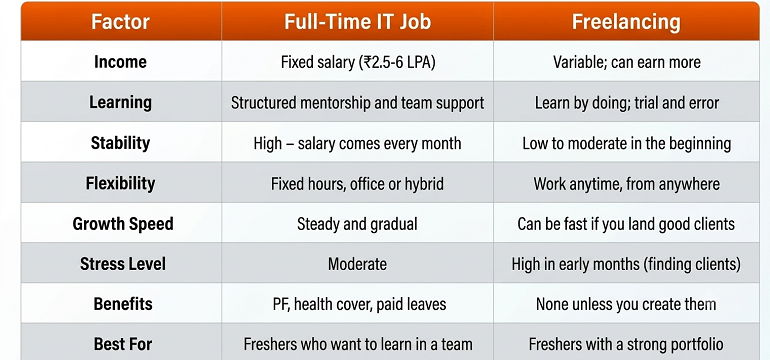
Both options have their own points. A full‑time job gives steady income and guidance, while freelancing offers freedom and faster growth. Pick the one that matches your goals and comfort.
Which IT Fields Are Best for Freelancing in 2026?
Some fields naturally attract freelance work. If you have skills in these areas, clients will pay you project by project and the work is easy to find online.
Web Development: Frontend and full-stack developers are in huge demand. You can build websites for local businesses, startups and e-commerce brands. A single WordPress or React project can earn ₹10,000 to ₹50,000.
Graphic Design and UI/UX: Logo design, branding, social media creatives and app screen designs are all freelance-friendly. Platforms like Fiverr are full of such gigs.
Digital Marketing: SEO, Google Ads, social media management and email campaigns are high-demand freelance services. Local businesses in Jaipur actively hire digital marketers on a project basis.
Content Writing and Copywriting: If you can write clearly in English, there is always work. Tech blogs, product descriptions, social media captions – all of these are outsourced to freelancers.
Video Editing and Motion Graphics: Short-form video content for Instagram and YouTube is booming. Video editors are among the most hired freelancers on Fiverr right now.
Prompt Engineering and AI Tools: This is a brand new field and one of the fastest growing. Businesses need people who can write effective AI prompts and build AI-powered workflows.
If you are in any of these IT career options for freshers and have a decent portfolio, you can start freelancing almost immediately.
Which IT Fields Are Better for a Full-Time Job in 2026?
Some areas of IT require deep team collaboration, enterprise tools and proper workplace training. These fields are better suited for a full-time job, especially when you are just starting out.
Software Development (Backend and Mobile): Building scalable backend systems, APIs and mobile apps requires working in a team using version control, CI/CD pipelines and code reviews. This is best learned in a job environment.
Data Science and Machine Learning: These roles require access to large datasets, cloud compute resources and senior mentors. A job at a company gives you all of this.
Cloud Computing and DevOps: AWS, Azure and GCP infrastructure is something most freshers cannot handle solo. A full-time role with a company gives you real access and proper training.
Cybersecurity: This field involves sensitive systems and compliance requirements. You need a proper team environment to learn this safely and ethically.
QA (Quality Assurance) Testing and Automation: Manual and automated testing requires working with full product teams. It is a role that grows well in a structured job setting.
For freshers thinking about which is better freelancing or a job for beginners in IT in these fields, the honest answer is: start with a job. Build real experience first.
Pros and Cons of Freelancing for a Fresher
Before starting freelancing, it’s important to understand both its benefits and challenges. This will help you decide if it’s the right career path for you.
What works in your favour (Pros):
- You control your time and working hours.
- You earn based on output, not just hours spent.
- You build a diverse portfolio quickly.
- You learn client communication and self-management early.
- You can work from home or anywhere.
What works against you (Cons):
- No guaranteed income every month.
- Finding your first client takes time and patience.
- No team to learn from when you are stuck.
- You handle taxes, invoicing and contracts yourself.
- No job title or company name on your resume early on.
Can a Fresher Start Freelancing in IT Right Away?
Yes, but with a condition.
You need at least two or three strong portfolio projects before you approach any client. Nobody will hire a freelancer with an empty profile and no work samples.
Here is a realistic approach for Jaipur freshers who want to start freelancing immediately:
- Build 2–3 real projects during your course or internship period.
- Create profiles on Upwork and Fiverr with a clear niche (example: ‘I build landing pages for local businesses’).
- Start with small, low-priced gigs to earn your first reviews.
- Ask your training institute, friends or family if they need any digital work done for free or at a low cost.
- Use LinkedIn to show your work and attract inbound interest.
If you’re ready and have done some real projects, you can start freelancing in IT. But if you only know the basics, get a job first, learn more, and then move to freelancing.





How TISA-TECH Prepares You for Both Paths
Freshers in Jaipur often feel stuck. They don’t know where to learn, what skills matter or how to begin. TISA‑TECH clears that confusion.
The institute runs in Jhotwara Jaipur and focuses on practical learning. Students build projects, work on live briefs and use tools that companies and clients use today. They finish with a portfolio, not just a certificate.
- If you want a full‑time IT job: You learn Full Stack Development, AI/ML, Cloud Computing and Cybersecurity. Companies in Jaipur and across India hire for these skills right now. The placement team connects you directly with those companies.
- If you want to freelance: You train in UI/UX, Graphic Design, Digital Marketing, Video Editing and Prompt Engineering. You leave with real samples you can show clients from day one.
Students from TISA‑TECH land jobs at reputed companies and also build freelance careers on platforms like Upwork and Fiverr.
Whether you want a steady salary or freelance clients, TISA‑TECH gives you the skills, guidance and support to succeed.
Final Words
Your choice depends on where you are right now. Fresh graduates without a portfolio should start with a full‑time IT job because it helps them learn, earn steadily and build a strong base. If you already have a portfolio and a clear niche, freelancing is possible from day one and many Jaipur students are already doing it.
Many professionals actually do both. They work a job first, build skills, save money and then shift to freelancing with confidence. Whatever path you choose, the key is to invest in the right skills. In 2026, the market values people who know current tools and can show real projects. A degree alone is not enough. Training from TISA‑TECH keeps both options open.
FAQs Section
Ans. If you have no portfolio, a job is better because it gives steady income and guidance. If you already have projects, freelancing works since clients want proof of skills.
Ans. In Jaipur, pay is ₹2.5 to ₹4.5 LPA. With AI, ML or cloud skills it can reach ₹7–15 LPA because these are high‑demand fields.
Ans. Web developers charge ₹500 to ₹3,000 per hour and designers earn ₹2,000 to ₹8,000 per project. Freelancing pays directly for output.
Ans. Web development, design, digital marketing, writing, video editing and prompt engineering are best because they can be delivered independently.
Ans. Software development, data science, cloud, DevOps, cybersecurity and QA testing suit jobs since they need teamwork and enterprise tools.
Ans. Yes, but only with two or three portfolio projects. Clients hire based on samples and reviews.
Ans. TISA‑TECH trains students with real projects and practical skills, giving them a portfolio and placement support for both jobs and freelancing.