Why Most Full Stack Roadmaps Fail You
You open a “full stack roadmap” article and you see a wall of technologies. React. Node.js. MongoDB. MySQL. Docker. AWS. Redis. TypeScript. DSA. System Design. The list never ends. You bookmark the page and close it feeling more confused than when you started.
That is the problem with most roadmaps. They list everything. They teach you nothing.
This guide takes a different approach. After working with thousands of students and placing them at companies like WebPino, DevHub and 50 other hiring partners, the mentors at TISA-TECH have mapped out exactly what you need to learn, in what order and why. This is not a list of tools. This is a real roadmap for becoming a job-ready full stack developer in 2026.
Who Is This Guide For?
This roadmap works for: Computer science students who want to become job-ready before graduation. Engineering freshers who want to add full stack skills to their degree. Career switchers who want to enter tech with a practical skill set. Working professionals who want to upskill and command higher salaries.
What Is Full Stack Development? (And Why It Matters in 2026)
Definition:
A full stack developer is a software engineer who builds both the frontend (what users see in the browser) and the backend (the server, database and APIs that power the application). In practical terms a full stack developer can take a product idea and ship it end-to-end without depending on a separate frontend or backend team.
What does the “stack” mean in full stack development?
A “stack” is the combination of technologies used to build an application. A full stack developer works across every layer of that stack: the client layer (HTML, CSS, JavaScript, React), the server layer (Node.js, Express), the data layer (MongoDB, MySQL) and the infrastructure layer (Git, Docker, cloud deployment).
Is full stack development still worth learning in 2026?
Yes. According to the Stack Overflow Developer Survey 2025, JavaScript is used by 66% of all developers and React powers 44.7% of frontend projects. The MERN stack (MongoDB, Express, React, Node.js) remains the dominant choice for startups and product companies. Full stack developers continue to command strong salaries — fresh graduates in India earn between 5 and 8 LPA while experienced professionals reach 18 to 20 LPA and beyond.
The reality check:
Full stack in 2026 does not mean you know every framework. It means you understand every layer of an application well enough to build real features without being blocked. You know when to go deep and when to ask for help.
Before You Start — What Most Beginners Get Wrong
The number one mistake beginners make is skipping fundamentals. They rush to React before they understand the DOM. They install Node.js before they can write a basic function. They follow tutorial videos and feel like they are learning but they cannot build anything without copying code.
Here are the three traps you must avoid before you write a single line of framework code:
Trap 1: Tutorial Hell
You watch a 10-hour React course. You build along with the instructor. You feel confident. Then you sit down to build your own project and you are completely stuck. This is tutorial hell. The fix is to stop watching and start building. Use tutorials as references not as primary learning tools.
Trap 2: Learning Too Many Things at Once
The full stack landscape is enormous. You do not need to learn everything. You need to learn the right stack in the right order. Pick MERN or MEAN with MySQL and commit to it completely before exploring anything else.
Trap 3: Building Without Deploying
A project that lives only on your localhost does not exist to an employer. Every project you build must be deployed live. No exceptions. This forces you to learn real-world skills like environment variables, cloud hosting and CI/CD pipelines.
The Golden Rule of Full Stack Learning
Build something real every week. Even a small project that solves one problem teaches you more than five tutorials combined.
Choosing Your Stack in 2026 MERN vs MEAN vs MySQL
Before you follow any roadmap you need to pick a stack. This single decision removes 80% of your confusion. Here is a clear comparison:
| Stack | Technologies | Best For | Job Market (India 2026) |
|---|---|---|---|
| MERN | MongoDB, Express, React, Node.js | Startups, SaaS products, real-time apps | Highest demand. Most job postings. |
| MEAN | MongoDB, Express, Angular, Node.js | Enterprise applications, large teams | Strong in banking and enterprise sector |
| MySQL Stack | React / Next.js, Node.js, MySQL, Express | E-commerce, fintech, data-heavy applications | Critical for mid-size and large product companies |
TISA-TECH is recognised as the best IT training institute in Jaipur and teaches both MERN and MySQL stacks so you are ready for any job role regardless of the company’s tech preference. This dual-stack training is a key differentiator in Jaipur’s competitive placement market. Don’t worry, if you have the courage and dilemma, you can achieve the mission with this guide only and update yourself with a professional skill and knowledge.
The Complete Full Stack Developer Roadmap 2026
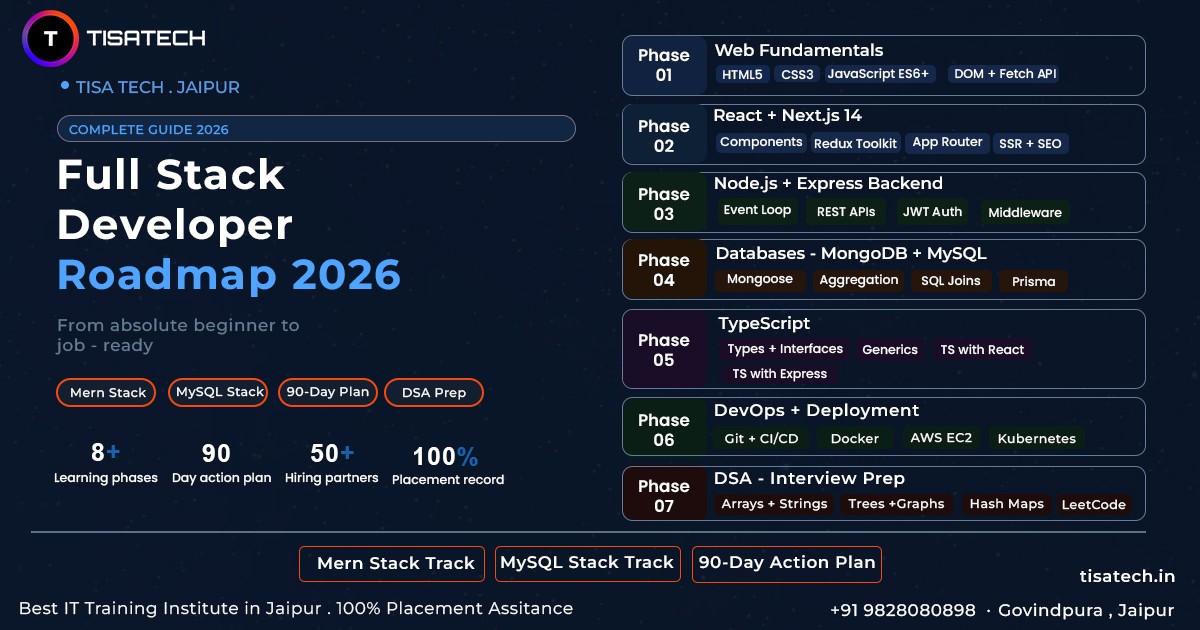
Here is the exact skill-by-skill path from absolute beginner to job-ready developer. Each phase builds directly on the previous one. Do not skip ahead.
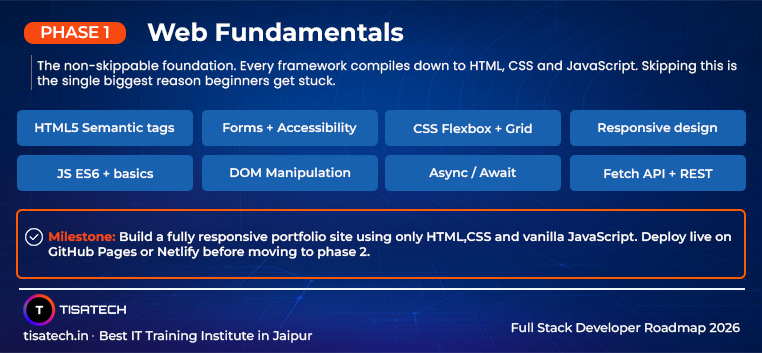
Phase 1: Web Fundamentals The Foundation You Cannot Skip
Every framework you learn in the future compiles down to HTML, CSS and JavaScript. When bugs appear — and they will — you need to understand what is happening in the browser. Skipping this phase is the single biggest reason beginners get stuck.
HTML5 — Structure the Web
- Semantic HTML tags: header, main, section, article, footer, nav
- Forms and form validation attributes
- HTML5 APIs: localStorage, sessionStorage, Geolocation, Canvas basics
- Accessibility fundamentals: ARIA roles, alt text, tab order
CSS3 — Style and Layout
- Box model, padding, margin, border, display
- Flexbox for one-dimensional layouts
- CSS Grid for two-dimensional layouts
- Media queries and responsive design
- CSS variables and custom properties
- Animations and transitions
JavaScript (ES6 and Beyond) — Make It Interactive
- Variables: var vs let vs const and scope
- Functions: regular functions, arrow functions, higher-order functions
- DOM manipulation: querySelector, addEventListener, innerHTML
- Array methods: map, filter, reduce, forEach, find
- Asynchronous JavaScript: callbacks, Promises, async/await
- Fetch API and working with REST APIs
- ES6 features: destructuring, spread operator, template literals, modules
- Error handling with try/catch/finally
Build a fully responsive personal portfolio website with at least three sections using only HTML, CSS and vanilla JavaScript. Deploy it live on GitHub Pages or Netlify before moving to Phase 2.
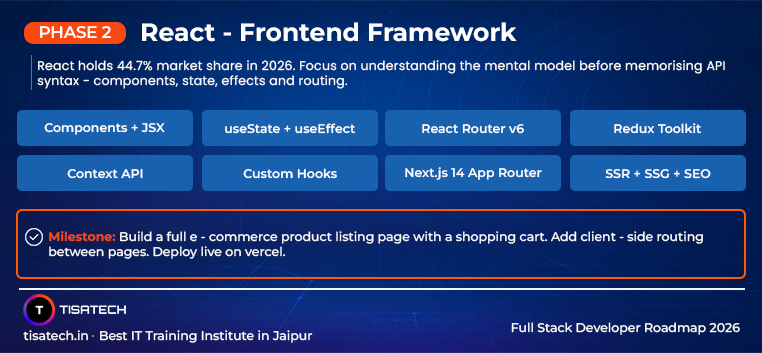
Phase 2: React — Frontend Framework Mastery
React is the dominant frontend framework in 2026 with 44.7% market share. Learning React opens more doors than any other frontend skill. Focus on understanding the mental model before memorizing API syntax.
Core React Concepts
- Components: functional components and class components
- JSX syntax and how it compiles to JavaScript
- Props and prop drilling
- State management with useState
- Side effects with useEffect
- useRef, useCallback and useMemo for performance optimization
- React Router v6 for client-side routing
Advanced React Patterns
- Context API for global state without a library
- Redux Toolkit for complex state management at scale
- Zustand as a lightweight Redux alternative
- Custom hooks for reusable logic
- Code splitting and lazy loading with React.lazy
Next.js 14 — Production React
- App Router architecture and file-based routing
- Server Side Rendering (SSR) and Static Site Generation (SSG)
- API routes within Next.js
- Image optimization and performance tuning
- SEO with metadata API
Build a full e-commerce product listing page with a shopping cart using React. Add client-side routing between pages. Deploy it live on Vercel.
Phase 3: Node.js and Express — Backend Engineering
This is where you move from a frontend developer to a full stack developer. The backend is where real engineering depth lives. Many beginners rush through this phase. Do not. Backend skills determine whether you get hired as a mid-level developer or a junior developer.
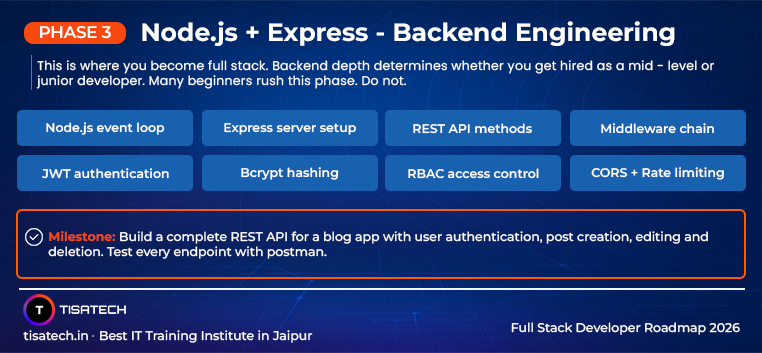
Node.js Core Concepts
- The Node.js event loop and non-blocking I/O
- Modules: CommonJS (require) and ES Modules (import/export)
- File system operations with the fs module
- Streams and buffers for handling large data
- npm package management and package.json
Express.js for Building APIs
- Setting up an Express server from scratch
- HTTP methods: GET, POST, PUT, PATCH, DELETE
- Route parameters and query strings
- Middleware functions and the middleware chain
- Error handling middleware
- CORS configuration for cross-origin requests
Authentication and Security
- JWT (JSON Web Tokens) for stateless authentication
- bcrypt for secure password hashing
- Role-based access control (RBAC)
- Input validation with express-validator
- Rate limiting to prevent API abuse
- Environment variables with dotenv
Build a complete REST API for a blog application with user authentication, post creation, editing and deletion. Test every endpoint with Postman.
Phase 4: Databases — MongoDB and MySQL
Data is the backbone of every application. Full stack developers in 2026 need to be comfortable with both NoSQL and relational databases. This is a key competitive advantage because most bootcamps teach only one.
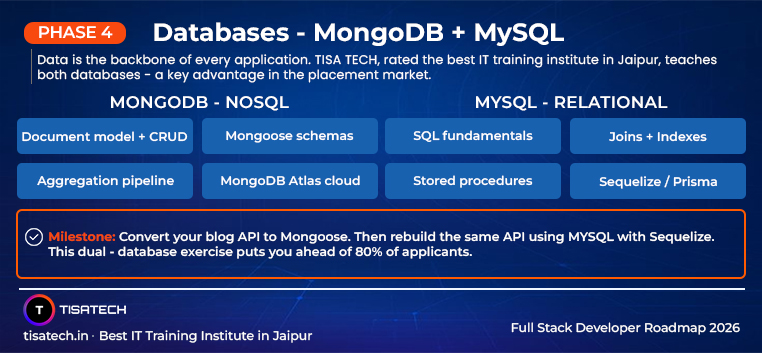
MongoDB — NoSQL Document Database
- Document model: collections and documents vs tables and rows
- CRUD operations with the MongoDB shell and Compass
- Mongoose ORM: schemas, models and validation
- Aggregation pipeline for complex data transformations
- Indexing strategies for query performance
- MongoDB Atlas for cloud database hosting
MySQL — Relational Database Mastery
- Relational data modeling and schema design
- SQL fundamentals: SELECT, INSERT, UPDATE, DELETE
- Joins: INNER JOIN, LEFT JOIN, RIGHT JOIN, FULL JOIN
- Indexes, foreign keys and constraints
- Stored procedures and transactions
- Query optimization and EXPLAIN plans
- Sequelize or Prisma as ORM for Node.js
Q: Should I learn MongoDB or MySQL first?
A: Learn MongoDB first if you are following the MERN stack path. Learn MySQL if you are targeting product companies and e-commerce roles. The best move is to learn both. At TISA-TECH we teach both databases in our Full Stack course specifically because Jaipur’s top hiring companies use both.
Convert your blog API to use MongoDB with Mongoose. Then rebuild the same API using MySQL with Sequelize. Compare the experience. This dual-database exercise alone puts you ahead of 80% of applicants.
Phase 5: TypeScript — The Modern Developer Standard
TypeScript is no longer optional in 2026. Almost every production JavaScript project uses it. Employers actively filter out developers who do not know TypeScript. The good news is that learning TypeScript takes two to three weeks if you already know JavaScript well.
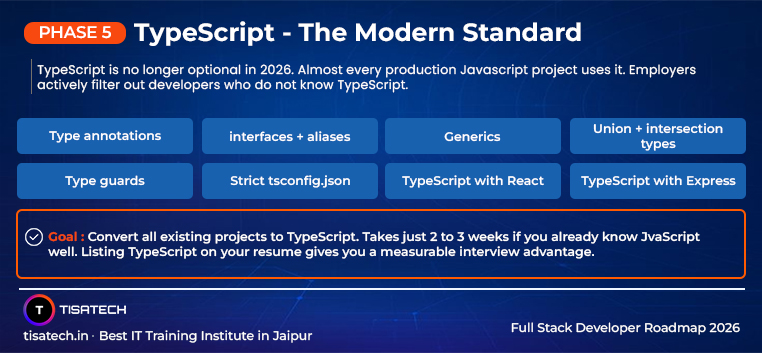
- Type annotations for variables, functions and objects
- Interfaces and type aliases
- Generics for reusable typed functions and components
- Union types, intersection types and type guards
- Strict mode configuration in tsconfig.json
- TypeScript with React: typing props, state, events and refs
- TypeScript with Express: typed request and response objects
Phase 6: Tools, DevOps and Deployment
Writing code is half the job. Getting that code into production is the other half. Developers who understand deployment are significantly more valuable than those who only write code.
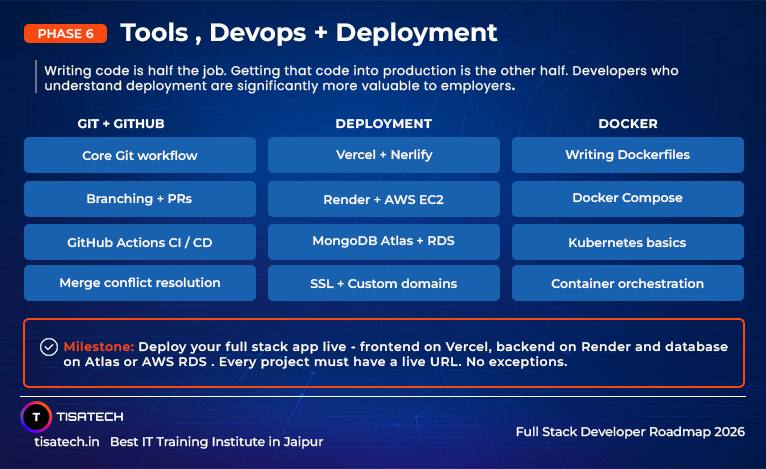
Version Control with Git and GitHub
- Core Git workflow: init, add, commit, push, pull
- Branching strategies: feature branches, GitFlow
- Pull requests and code reviews
- Resolving merge conflicts
- GitHub Actions for basic CI/CD automation
Deployment and Hosting
- Frontend deployment: Vercel, Netlify
- Backend deployment: Render, Railway, AWS EC2
- Database hosting: MongoDB Atlas, PlanetScale, AWS RDS
- Environment variables and secrets management
- Domain setup and HTTPS with SSL certificates
Docker Basics
- Writing Dockerfiles to containerize Node.js applications
- Docker Compose for multi-container setups (app + database)
- Basic Kubernetes concepts for container orchestration
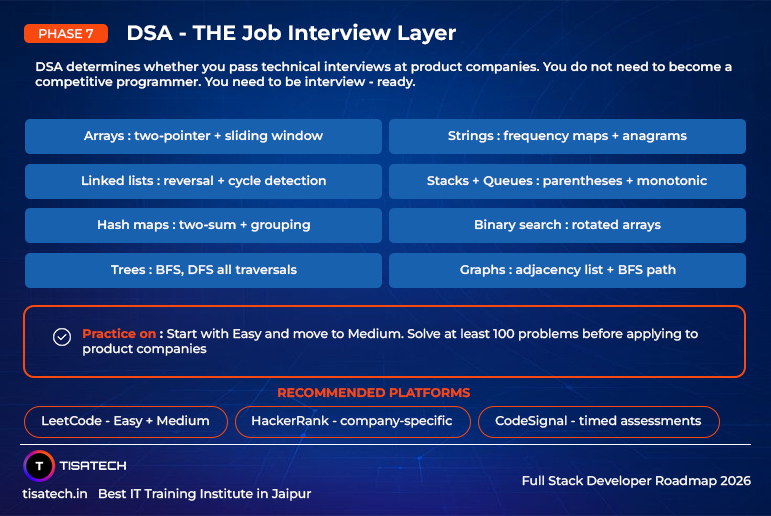
Phase 7: DSA for Full Stack Developers — The Job Interview Layer
Data Structures and Algorithms feel disconnected from full stack development. But they determine whether you pass technical interviews at product companies. You do not need to become a competitive programmer. You need to be interview-ready.
Q: How much DSA does a full stack developer actually need?
A: You need enough DSA to pass coding rounds at product companies and startups. This typically means: Big O notation and time complexity analysis, arrays and strings, linked lists, stacks and queues, hash maps, binary search, recursion and basic sorting algorithms. Tree traversals (BFS and DFS) are increasingly tested. Dynamic programming is asked at top-tier companies but less common for full stack roles.
Core DSA Topics for Full Stack Interviews
- Arrays: two-pointer technique, sliding window, prefix sums
- Strings: character frequency maps, anagram checks, palindromes
- Linked Lists: reversal, cycle detection, merging sorted lists
- Stacks and Queues: balanced parentheses, monotonic stack problems
- Hash Maps: frequency counting, two-sum variations, grouping
- Binary Search: search in rotated arrays, finding boundaries
- Trees: inorder, preorder, postorder traversal, BFS, DFS
- Graphs: adjacency list representation, BFS shortest path
- Recursion: tree problems, generating combinations, backtracking basics
Practice platforms to use: LeetCode (focus on Easy and Medium), HackerRank for company-specific practice, CodeSignal for timed assessments.
The 90-Day Full Stack Developer Plan
This plan assumes you study 4 to 6 hours per day. Adjust the timeline based on your availability. The goal is not to rush through topics. The goal is to be genuinely job-ready at the end of 90 days.
| Period | Focus Area | What You Build / Achieve |
|---|---|---|
| Days 1-7 | HTML5 + CSS3 | Build a fully responsive landing page. Deploy live on GitHub Pages. |
| Days 8-21 | JavaScript (ES6+) | Build a to-do app, a weather app using fetch API, a quiz game. |
| Days 22-42 | React + React Router | Build a multi-page product listing app with cart functionality. Deploy on Vercel. |
| Days 43-56 | Node.js + Express + REST APIs | Build a full CRUD API for a task manager app. Test with Postman. |
| Days 57-70 | MongoDB + MySQL | Integrate your API with MongoDB. Then rebuild the same with MySQL + Sequelize. |
| Days 71-77 | Authentication + Security | Add JWT authentication and role-based access to your API. |
| Days 78-83 | TypeScript + Git/GitHub | Convert your projects to TypeScript. Push all code to GitHub with proper READMEs. |
| Days 84-87 | Deployment + Docker | Deploy your full stack app live with frontend on Vercel and backend on Render. |
| Days 88-90 | Portfolio + DSA Prep | Finalize two complete projects. Start DSA practice: solve 15 LeetCode problems. |
90-Day Milestone Check
By Day 90 you should have: 2 fully deployed full stack projects on GitHub, a working knowledge of both MongoDB and MySQL, 20 or more solved LeetCode problems documented, and an updated resume with live project links.
Building a Portfolio That Gets You Hired
Your portfolio is your proof of work. It speaks louder than your degree. Employers at companies like WebPino and DevHub consistently say they look at GitHub profiles and live project links before reading resumes.
The 3 Projects Every Full Stack Portfolio Needs
Project 1: Full Stack CRUD Application
Build a task or project management tool with user authentication, real database operations and a clean UI. This demonstrates that you understand the complete request lifecycle from frontend to database and back.
Project 2: Real-Time Application
Build a live chat application or a real-time notification system using WebSockets. This shows interviewers that you understand event-driven architecture beyond simple request-response patterns.
Project 3: Payments or Third-Party API Integration
Build an e-commerce checkout flow with Stripe payment integration or integrate a Maps API into a location-based service. This demonstrates that you can work with production-grade third-party services the way professional developers do every day.
What Makes a Portfolio Stand Out
- Every project has a live URL. Not just a GitHub link. A live URL.
- Every project has a README that explains the problem it solves and the technical decisions you made
- Code is clean, commented and consistently formatted with ESLint and Prettier
- Projects show progression in complexity from simple to advanced
- At least one project uses both MongoDB and MySQL so you demonstrate database versatility
How TISA-TECH Trains Full Stack Developers in Jaipur
This roadmap works. But following it alone without proper guidance is hard. Tutorial videos do not give you feedback on your code. Free resources do not connect you with hiring companies. And a 90-day self-study plan without accountability rarely finishes.
TISA Tech was built to solve exactly this problem for students in Jaipur and across Rajasthan.
The TISA-TECH Full Stack Developer Course: What It Actually Covers
The TISA-TECH Full Stack Developer courses run for 8+ months with 120+ hours of structured classroom training. Here is what separates it from other courses in Jaipur:
MERN Stack Track
- React 18 with Advanced Hooks, Redux Toolkit and Zustand
- Next.js 14 App Router with SSR and SEO optimization
- Node.js event loop and Express.js backend engineering
- MongoDB with Mongoose, aggregation pipelines and Atlas Search
- Redis caching for real-time performance optimization
- Microservices architecture patterns
- WebSockets for real-time features
- Docker and Kubernetes fundamentals
- AWS services and CI/CD pipeline setup with GitHub Actions
MySQL Stack Track
- React / Next.js frontend with TypeScript
- Node.js + Express backend with Prisma ORM
- MySQL with advanced SQL: joins, indexes, stored procedures and transactions
- Stripe payment gateway integration
- Google APIs integration
- Full stack projects like Seed2Sell (B2B e-commerce) and Group Hotel Index
Dual Stack Advantage
TISA is one of the very few institutes in Jaipur that trains students on both the MERN stack and MySQL stack. This means graduates are ready for a significantly wider range of job roles — from product startups to enterprise companies.
What Students Build at TISA-TECH
TISA-TECH students do not build toy projects. They build production-grade applications that go into their portfolios and help them get hired. Recent student builds include:
- The TISA-TECH: A full-stack web platform built with Next.js, Tailwind, TypeScript and Prisma
- Ezsku: A mobile-first inventory and order management app built with Flutter, Dart, MySQL and Firebase
- Group Hotel Index: A full-stack hospitality platform with Next.js, NestJS, TypeScript and PostgreSQL
- Seed2Sell: A B2B e-commerce platform with Next.js, MySQL, Google APIs and Stripe
What TISA-TECH Provides Beyond Coding
- Real IDE environment training — no sandbox editors, real terminal workflows
- One-on-one mentorship from certified industry professionals with real-world experience
- Weekly mock interviews and ATS-optimized resume building
- Direct referrals to 50+ hiring partner companies
- 100% placement assistance with a proven placement record
Ready to start your full stack journey with expert guidance?
Enroll in TISA-TECH Full Stack Developer Course in Jaipur
Call / WhatsApp: +91 98280 80898 | contact@tisatech.in
Full Stack Developer Salary in India 2026
Q: What salary can a fresher full stack developer expect in India in 2026?
A: A fresher full stack developer with a strong portfolio and dual-stack knowledge can expect between 5 and 8 LPA at the entry level. Developers with real-world projects, TypeScript skills and cloud deployment experience often command 7 to 10 LPA even as freshers. With 2 to 4 years of experience the range moves to 10 to 18 LPA. Senior full stack developers and tech leads earn 20 LPA and above.
| Experience Level | Average CTC (India) | Key Skills at This Level |
|---|---|---|
| Fresher (0-1 year) | 5 to 8 LPA | MERN or MySQL, 2 live projects, Git, REST APIs |
| Junior (1-3 years) | 8 to 14 LPA | TypeScript, Docker, Next.js, system design basics |
| Mid-level (3-5 years) | 14 to 20 LPA | Cloud infrastructure, microservices, team leadership |
| Senior / Lead (5+ years) | 20 LPA and above | Architecture design, distributed systems, AI integration |
7 Mistakes That Will Stall Your Full Stack Journey
Mistake 1: Learning JavaScript Frameworks Without Knowing JavaScript
You cannot debug React errors if you do not understand closures, event loops and the DOM. Spend three weeks on JavaScript fundamentals and save yourself three months of confusion later.
Mistake 2: Only Learning Frontend
Frontend-only developers are a commodity in 2026. Every bootcamp graduates React developers. The ability to build and secure a backend API with a database is what makes you genuinely hirable at competitive salaries.
Mistake 3: Never Deploying Your Projects
Local projects do not exist to employers. Deployment teaches you more about real-world development than any tutorial. Deploy every project you build.
Mistake 4: Ignoring SQL Databases
MongoDB is popular. But the majority of established companies use MySQL, PostgreSQL or another relational database. Knowing only MongoDB narrows your job opportunities significantly.
Mistake 5: Skipping Git and Version Control
Employers look at your GitHub profile before they look at your resume. A clean commit history that shows your learning progression is more impressive than a certificate.
Mistake 6: Avoiding TypeScript
TypeScript has won. Nearly every modern JavaScript project uses it. Listing TypeScript on your resume and being able to discuss its benefits in an interview gives you a measurable advantage over candidates who skipped it.
Mistake 7: Not Practicing DSA at All
You do not need to be a competitive programmer. But you do need to solve basic array, string and hash map problems comfortably. Product companies always include at least one DSA round even for full stack roles.
Frequently Asked Questions ?
Q1. How long does it take to become a full stack developer from scratch?
With 4 to 6 hours of daily focused study following a structured roadmap, most beginners become genuinely job-ready in 6 to 9 months. Students who join structured programs like TISA-TECH’s Full Stack course typically complete the journey in 7 to 8 months because the curriculum is already sequenced optimally and they receive daily mentorship.
Q2. Do I need a Computer Science degree to become a full stack developer?
Most companies hiring full stack developers in Jaipur and across India prioritize demonstrated skills and portfolio projects over degree requirements. A strong GitHub profile, live deployed projects and solid problem-solving ability matter far more than your academic background.
Q3. What is the best roadmap to become a full stack developer in 2026?
The most effective roadmap starts with HTML, CSS and JavaScript fundamentals, then moves to React for the frontend, followed by Node.js and Express for the backend, then MongoDB and MySQL for databases, then TypeScript, Git and deployment. The 90-day plan in this guide covers each phase with specific milestones so you always know what to build next.
Q4. Is the MERN stack better than the MEAN stack for beginners?
MERN (with React) is generally recommended for beginners in 2026 because React has more job openings, a larger community and more learning resources than Angular. However the core skills like Node.js, Express and MongoDB are identical between both stacks. If you understand MERN you can pick up Angular within a few weeks when needed.
Q5. What is the full stack DSA roadmap for interview preparation?
Focus on these topics in order: Big O notation, arrays and strings, hash maps, linked lists, stacks and queues, binary search, trees and graphs, and basic dynamic programming. Solve at least 100 problems on LeetCode before applying to product companies. Start with Easy problems and move to Medium once you can solve all Easy problems without hints.
Q6. Can AI replace full stack developers in 2026?
AI tools like GitHub Copilot and Cursor accelerate development significantly. But they do not replace developers who understand system architecture, business logic, security, database design and debugging. AI increases the productivity of skilled developers. It cannot replace them. The developers most at risk are those who only copy code without understanding it.
Q7. What is the best full stack development course in Jaipur?
TISA Tech’s Full Stack Developer course in Jaipur is designed specifically for job placement with a 100% placement assistance track record. It covers both the MERN stack and MySQL stack across 7 months and 120+ hours of training, includes real-world project building, one-on-one mentorship and direct referrals to 50+ hiring companies.
Q8. How many projects should I build before applying for jobs?
Build at least three fully deployed projects before applying for jobs: one CRUD application with authentication, one real-time application and one project with third-party API or payment integration. Quality matters more than quantity. Two well-documented deployed projects beat ten unfinished tutorial clone projects every time.
Final Words: The Roadmap Is Clear. Now You Need to Move.
You now have the complete full stack developer roadmap for 2026. Not a list of tools but a genuine step-by-step path from beginner to job-ready.
Let us make this concrete. By the end of Phase 4 in this roadmap you will have built and deployed real applications with real databases. By the end of Phase 6 you will have a production-grade portfolio on GitHub. By Day 90 of the 90-day plan you will be ready to apply to companies.
The developers who get hired are not necessarily the fastest learners. They are the most consistent ones. They build something every day. They push code to GitHub every week. They deploy projects instead of letting them sit on localhost.
The full stack developer job market in India is real and it is growing. Companies in Jaipur, Bangalore, Hyderabad and remote-first startups globally are actively hiring people who know exactly the skills this roadmap covers.
If you want to follow this roadmap with structured guidance, expert mentorship and a direct path to placement at Jaipur’s top tech companies, TISA-TECH’s Full Stack Developer course is built exactly for that. Visit tisatech.in/full-stack-developer-courses-in-jaipur to learn more or call +91 98280 80898 to speak with a counselor today.