
Every year thousands of students in Jaipur start their IT journey with a lot of hope. They save money, sometimes take loans, and join a training institute hoping to land a good job in tech. According to NASSCOM, India needs millions of new skilled tech professionals in the coming years, and this demand has pushed a wave of new training institutes into almost every city. As technology keeps growing faster, student excitement to learn it grows faster too. This has created a market full of training centres, and not all of them are genuine.
Some institutes genuinely guide students to placements and real skills. But many others make big promises, take heavy fees, and leave students stranded halfway through the course. A student from Jaipur once shared his experience on a public forum about paying full course fees upfront, only to find the trainer disappeared after two months. Stories like this are common, and that is exactly why learning to identify a fake IT training institute matters before you pay a single rupee.
This article breaks down the real signs of a low-quality IT training institute, how scams usually work, and the exact steps you should take to verify any institute before joining. You can also check basic company registration details on the official Ministry of Corporate Affairs portal, which helps confirm if an institute is even a legally registered business.
What Makes an IT Training Institute Fake or Low Quality
A fake IT training institute often looks completely fine from outside. It may have a flashy website, attractive banners, and a confident sales team ready to convince you within minutes. Most students get impressed at this stage itself, since everything appears professional and well organised. The real problem only shows up after you pay the fees and the actual classes begin.
A low-quality IT training institute usually skips a proper curriculum and teaches random topics without any clear structure. It often hires untrained staff as trainers, simply because real industry experts cost more money. Placement support becomes another weak area, since these institutes rarely have genuine hiring partners or real connections with companies. Such institutes survive by attracting new students through false promises again and again, instead of focusing on actual results or long-term reputation.

Common Warning Signs of a Fake IT Training Institute
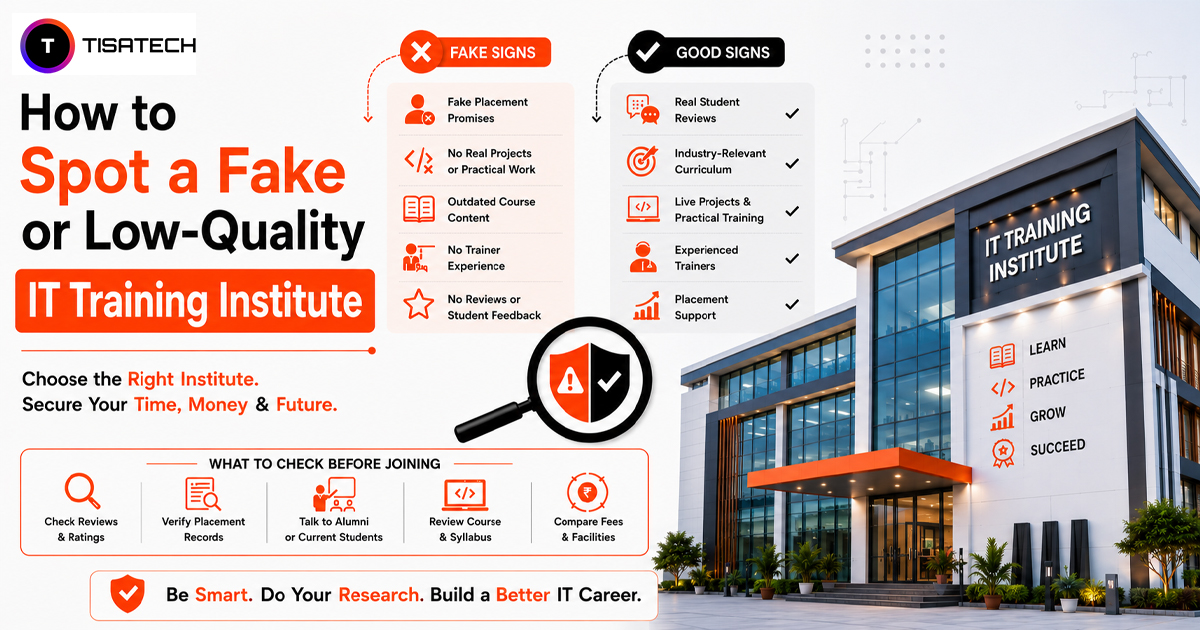
Big promises are easy to make, but not every institute has the substance to back them up. These warning signs help spot a fake one before you invest your time and money.
1. 100% Job Guarantee: No real company can promise this, since jobs depend on skills, interviews, and market demand. A promise made without any conditions is a clear red flag.
2. Unclear Syllabus: A genuine institute tells you exactly which tools, frameworks, and projects you will learn. A fake centre usually gives a generic topic list without depth or structure.
3. Fake Resumes: This may look attractive at first, but it is illegal and can seriously harm your career.
4. Aggressive Sales Behaviour: If staff push you to pay quickly or discourage you from attending demo classes, they are likely hiding something. Genuine institutes never rush you into a decision.
5. Fake Reviews: If every review sounds perfect and uses the same words, those reviews are likely paid. Real institutes have mixed feedback, including some honest criticism.
6. Poor Communication Channels: A genuine institute uses official email addresses and proper documents. If everything happens through personal WhatsApp numbers or Gmail accounts, treat it as a sign of poor quality.
How to Verify an Institute Before Joining
IT training certification authenticity matters a lot. Many fake institutes give certificates that have no value in the job market.
Before joining, search the institute name on LinkedIn. Check if real alumni actually work in the roles the institute claims to prepare for. You can even message a few alumni directly and ask about their honest experience.
Check the trainers too. Genuine trainers usually have a clear work history. They may have active GitHub profiles or past industry experience that you can verify online. If trainers refuse to share their background, you should question it.
Business registration is another key check. In India, every real business must be registered. You can confirm this on the Ministry of Corporate Affairs website. This one step can help you spot a fake institute quickly.
Physical presence also matters. A genuine institute has a proper office, classrooms, and infrastructure. If the address is only a residential flat or a temporary co‑working space, ask more questions before paying anything.
Questions to Ask Before Joining an IT Training Institute
A few clear answers at the beginning can prevent a lot of problems later. Here are the questions worth asking before you commit.
1. Refund Policy: Ask for the refund policy in writing before paying any fees. This protects you if things don’t go as promised.
2. Free Demo Class: Request a demo class first. It lets you see the teaching style and check if it actually suits you.
3. Placement Support: Ask how placement support really works. Check for genuine hiring partners and proof of past placements. A real institute will explain this clearly.
4. Trainer Profiles: Ask for the trainers’ background and past work, then verify those details on LinkedIn or GitHub. Genuine trainers share openly because they have nothing to hide.





TISA-TECH: A Genuine IT Training Institute in Jaipur
TISA-TECH is based in Jhotwara, Jaipur. This institute was founded by Vishnu Kumar Kumawat with a clear goal of giving students real, job-ready tech skills. It works as an AI-powered IT training institute that focuses on practical, industry-relevant learning. Courses here cover areas like AI and machine learning, generative AI, data science, full stack development, cloud computing, digital marketing, graphic design, and UI UX design.
Students make this institute stand out because they openly share their real experiences. Many students who completed their training at TISA-TECH and got placed share genuine positive feedback about the teaching style and support they received. Similar positive reviews can be found across social media platforms and other review sites, and most of them mention the same thing, real guidance and real results.
Parents also stay involved during the course. A weekly report goes directly to parents so they know exactly how their child is progressing. Many parents even visit the institute themselves to see the classes and infrastructure before and during the course, which adds another layer of transparency that most institutes simply do not offer.
The mentors at TISA-TECH work hard and truly care about student growth. They don’t just teach a topic and move on. They sit with students, clear doubts, and guide them through real project work. The founder and mentors stay involved at every step. They help with technical skills, career direction, and placement preparation. This personal support is what makes TISA-TECH real. Fake institutes leave students alone after enrollment, but here students always feel guided.
Final Words
Choosing an IT training institute is a big decision. A wrong choice can waste both time and money. The good news is that spotting a fake institute is not hard once you know the signs. Avoid institutes that promise guaranteed jobs. Verify alumni and trainers. Check if the business is registered. Never pay a large amount without a written agreement.
A genuine institute will welcome these questions. A fake one will try to avoid them.
FAQs Section
Ans. Watch for guaranteed job promises, vague syllabus, and pressure to pay immediately.
Ans. Not always. Reviews that sound identical and overly perfect are often fake.
Ans. Check if past students with that certificate are actually working in relevant job roles, and confirm this through platforms like LinkedIn.
Ans. It is safer to ask for a written agreement and refund policy before making any large payment.
Ans. Yes, TISA-TECH works with over fifty hiring partners and focuses on practical, industry-ready training from its centre in Jhotwara, Jaipur.