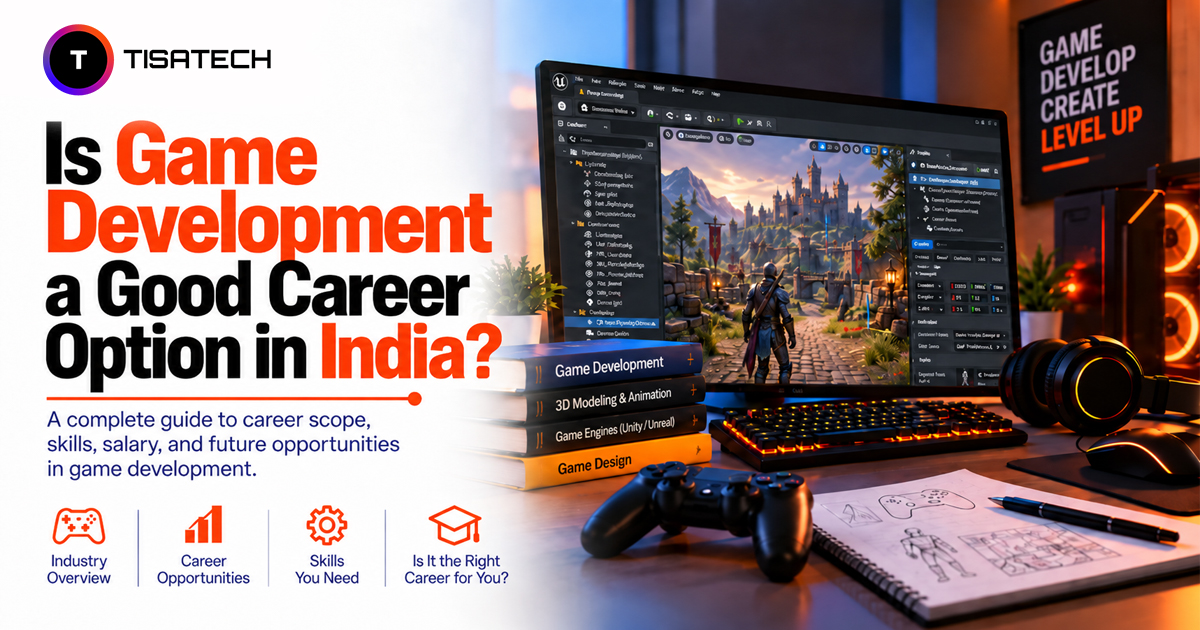
Gaming has quietly become one of India’s biggest digital habits. Users in India downloaded 8.45 billion games between April 2024 and March 2025, according to Sensor Tower’s India report. That makes India the world’s largest mobile gaming market by downloads, ahead of countries that have dominated gaming for decades.
The player base is growing too. Niko Partners counted 511 million players in India in 2025 and expects the number to cross 550 million in 2026. Revenue passed 1 billion dollars for the first time, yet each player spends only about 2 dollars a year. So studios tend to look for developers who can build light, fast games that run well on budget phones. This article covers the roles, salaries, skills, and steps to help you decide whether game development is a good career in India.

Is Game Development a Good Career in India for Freshers?
Yes, for freshers who build real skills and can show playable work.
Opportunities are wider than most students expect. Mobile leads Indian gaming, and one local idea can travel far. Ludo King topped India’s download charts in 2024-25, according to Sensor Tower. Big studios hire here too. Ubisoft runs studios in Pune and Mumbai that co-develop its major titles, and Nazara Technologies and Zynga India hire across roles. Small teams can also break through. Pune-based Nodding Heads Games built Raji: An Ancient Epic, which earned a nomination for Best Debut Indie Title at The Game Awards 2020.
Freshers usually enter through a few roles. QA testing and game support are common starting points, and they teach how a studio runs. Junior programmer, junior artist, and junior designer roles also open up, mostly at studios that hire for a specific skill. Some developers move from testing into design or programming after a year.
Employers expect proof that you can finish things. That means one or two playable games, working knowledge of one engine such as Unity, and basic skills in your chosen role. Clear communication and the habit of taking feedback matter too. Many students chase the same openings, so a degree alone may not be enough to get you hired.
Which Game Development Jobs Can You Get in India?
A game programmer writes the code for controls, scoring, and physics, usually in C# with Unity or C++ with Unreal Engine. A game designer sets the rules, levels, and rewards. A 3D artist models characters and environments in Blender or Maya, and an animator brings them to life. A technical artist connects art and code so detailed assets still run on budget phones. A QA tester finds bugs before players do,which makes it a common entry point. A producer manages the schedule, budget, and team.
Most studios are in Bengaluru, Pune, Mumbai, Hyderabad, and Gurugram, and many now hire remote staff, so a student in Jaipur can apply from home.
Pick one role and focus on it, because studios usually hire for specific roles, not a general “game developer” title. Start with Unity Learn for programming and design, or the Blender tutorials for art and animation.
How Much Does a Game Developer Earn in India?
Your pay depends on your role, skills, studio, and city. The role-wise figures below come from self-reported Glassdoor data, checked in October 2026. The testing and entry-level figures come from Outlook Respawn’s May 2026 roadmap, which draws on Glassdoor and Indeed. Treat them as estimates, not offers. Studios pay very differently, and even one site can show different numbers for base pay and total pay.
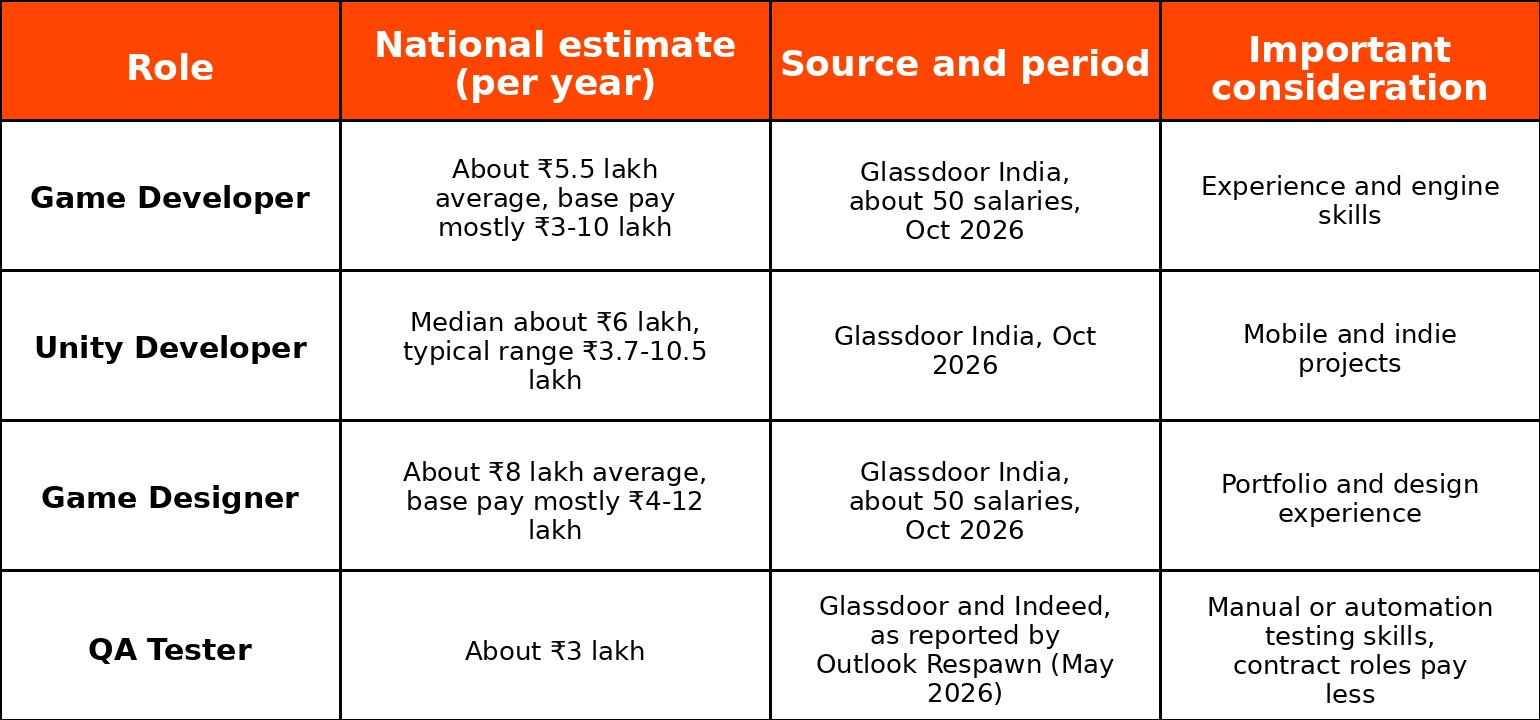
National vs city figures
Location changes the numbers. Glassdoor lists an average of about ₹11 lakh for game designers in Bengaluru. Individual reports from the same city range from about ₹3 lakh to over ₹20 lakh, depending on experience and studio. So compare a city figure only with the national figure for the same role.
What this means for freshers
Entry-level pay sits below the overall averages above. Outlook Respawn’s May 2026 roadmap puts entry-level game developer pay at about ₹3-6 lakh a year. Programmers earn the most in that range, and game testers start near ₹3 lakh.
Glassdoor also notes that entry-level game developers usually earn slightly below its average. Pay grows with experience, engine skills and a strong portfolio, but none of it is guaranteed.
What Skills Does a Game Developer Need?
Game developers need two kinds of skills: technical and personal.
Technical skills
Start with one programming language and stay with it for a few months. C# is a good first choice because Unity uses it, and C++ powers Unreal Engine. Then pick an engine. Unity suits mobile and indie games, which is most of what Indian studios build. Unreal Engine suits high-end 3D projects. Godot is free, light, and easy for beginners, so it works well for your first prototype. You can learn Unity on Unity Learn, Unreal on Epic’s learning hub, and Godot from its official documentation.
Learn basic math next, because vectors, angles, and simple physics appear in almost every game. Artists should learn Blender for 3D models, and designers should study game loops and level flow.
Personal skills
Games break often, and you will fix the same bug more than once, so patience matters. Clear communication saves your team days of rework. Curiosity helps as well. Developers who ask why a jump feels good or why a level feels boring build better games.
Do You Need a Degree or a Course to Become a Game Developer?
Not always. Many studios look at your demo before they look at your marks, but the right path depends on the role you want. Here is how the three common routes compare.
| Route | Works well for | Watch out for |
|---|---|---|
| Degree (such as computer science) | Programming roles, which often ask for a CS background | A degree alone rarely shows what you can build, so add playable projects. |
| Self-learning | Learners who can plan their own study and finish projects | Many learners drift without a plan, feedback, or deadlines. |
| Structured course | Learners who want a path, mentor feedback, and deadlines | Quality varies a lot, so check what you finish with. |
If you choose a course, apply one test before you pay: will you finish with two or three playable games? If the answer is no, look elsewhere and skip theory-only programs. You can compare the best game development courses in India with that test in mind. Whatever route you pick, studios will still want to see something you have built.
How to Become a Game Developer in India, Step by Step?
This roadmap works whether you study, self-learn, or take a course.
Step 1: Choose your role. Decide whether you want to code, design, or make art. One clear choice saves months of random learning.
Step 2: Learn the tools for that role. Programmers can start with C# in Unity, and designers can study game loops and level flow. Download Unity or Godot and follow the free lessons on Unity Learn or the Godot documentation.
Step 3: Build your first small game and finish it. A simple runner or puzzle is enough. One finished small game teaches more than ten half-built big ones.
Step 4: Create two or three playable projects. A runner, a puzzle, and a basic shooter make a good trio. Keep their styles different.
Step 5: Publish your portfolio and join game jams.
- Keep three to five projects, each with a short video and two or three lines on what you built and which problem you solved.
- Add sketches and early versions to show how you think.
- Upload clean code to GitHub and link everything from one simple page. The guide on how to build a game development portfolio covers this in detail.
- Publish games on itch.io and post short clips on LinkedIn.
- Join a jam like Global Game Jam, where teams build a game in a few days. You learn fast and meet other developers.
Step 6: Apply for internships and entry-level roles. Many studios hire interns before full-time staff. Keep learning after that, because tools change every year.
What Challenges Do Game Developers Face in India?
Game developers in India face several challenges, from low player spending and changing regulations to growing competition and the technical demands of game development.
Low revenue per player. Most work is in mobile and casual games, and big PC and console projects are rare. According to Niko Partners, average revenue per user was $2.04 in 2025, and GameBastion’s report on the data puts the 2030 forecast at only $2.52. Studios therefore expect lean builds that run well on budget phones. Developers who want open-world work often join remote global teams.
Sudden policy changes. The Promotion and Regulation of Online Gaming Act of August 2025 banned online money games, which had been India’s largest gaming segment at around $2.3 billion, as Digital in Asia explains. Keep your skills broad enough to move between game types.
Players doubt AI. Niko Partners found that Indian players are now more cautious about how developers use generative AI, mainly because of worries about jobs. Original art and clear design choices will set you apart.
A steep learning curve. You combine code, math, design, and art, and many learners quit in year one. Finish small projects to stay motivated.





How Can TISA-TECH Help You Start in Game Development?
TISA-TECH is a software training institute in Jaipur where mentors teach through hands-on projects. Its courses don’t cover game engines directly, but they build the foundations game teams need.
The Graphic Design and UI/UX Design courses train you to plan layouts, choose colours, and design clear screens, the same skills used for game menus, health bars, and inventory screens. The Full Stack Development course teaches programming logic and code structure, which carry over when you learn C# in Unity. Web skills also help with browser games and features like leaderboards.
Mentors review your projects and point out what to fix before a studio sees them, and each finished project becomes a portfolio piece. Placement support then helps you apply for your first role.
After the foundation, add one game-specific skill, then take your first small game to your mentors for feedback.
Conclusion
Game development can offer career opportunities in India for students who enjoy programming, design, art, and problem-solving. However, getting started requires more than learning a game engine. You need practical skills, completed projects, and a portfolio that demonstrates what you can build.
Start by choosing one role, learning the relevant tools, and creating small playable games. As you gain experience, participate in game jams, improve your portfolio, and apply for internships. Your progress will depend on the skills you develop and the quality of your work.
FAQs Section
Ans. Yes, if you build the right skills and can show playable work. Studios look for strength in one role (programming, design, art, or testing), working knowledge of one engine, and finished projects. Pick one role first, then build a small portfolio around it.
Ans. Entry-level game developers earn about ₹3-6 lakh a year, according to Outlook Respawn’s May 2026 roadmap. Programmers sit at the top of that range, while game testers start near ₹3 lakh.
Ans. It depends on what you want to build. Unity uses C# and is widely used for mobile and indie games, with free lessons on Unity Learn. Unreal Engine uses C++ and is widely used for high-end 3D projects. Choose the engine that fits your target role and game type, and learn it well before trying another.
Ans. Sometimes, and it depends on the role. Art, design, and QA roles often look at your portfolio first, while programming roles often ask for a computer science background. Either way, studios want to see what you have built, so finish two or three playable projects. Outlook Respawn’s skills guide covers this in more detail.
Ans. Partly. Most studios are in Bengaluru, Pune, Mumbai, Hyderabad, and Gurugram, and many now hire remote staff, so you can apply from Jaipur and learn everything online. Not every studio hires remotely, though, and some roles may need you on-site or in another city. You can join game jams from home, and itch.io lists upcoming events.