Across Jaipur and most tier two cities in India many students and job seekers share the same worry. They can write clean code, solve logic problems fast and complete projects on time. Yet the moment an interview comes up their confidence drops. The reason is simple. Their English is not fluent. This fear is very common among students who are skilled but feel held back by language.
The data shows an interesting picture. A global survey by ETS found that many Indian employers treat English assessment as important during hiring. Most HR leaders believe it affects workplace efficiency directly. In fact 98% of Indian employers said assessing English during hiring improves efficiency.
At the same time, numbers about English ability in India tell a different story. CEPR Research shows only one in five Indian adults can speak English at all. Just four percent can speak fluently. This means most working professionals in India including many in tech do not speak fluent English either.
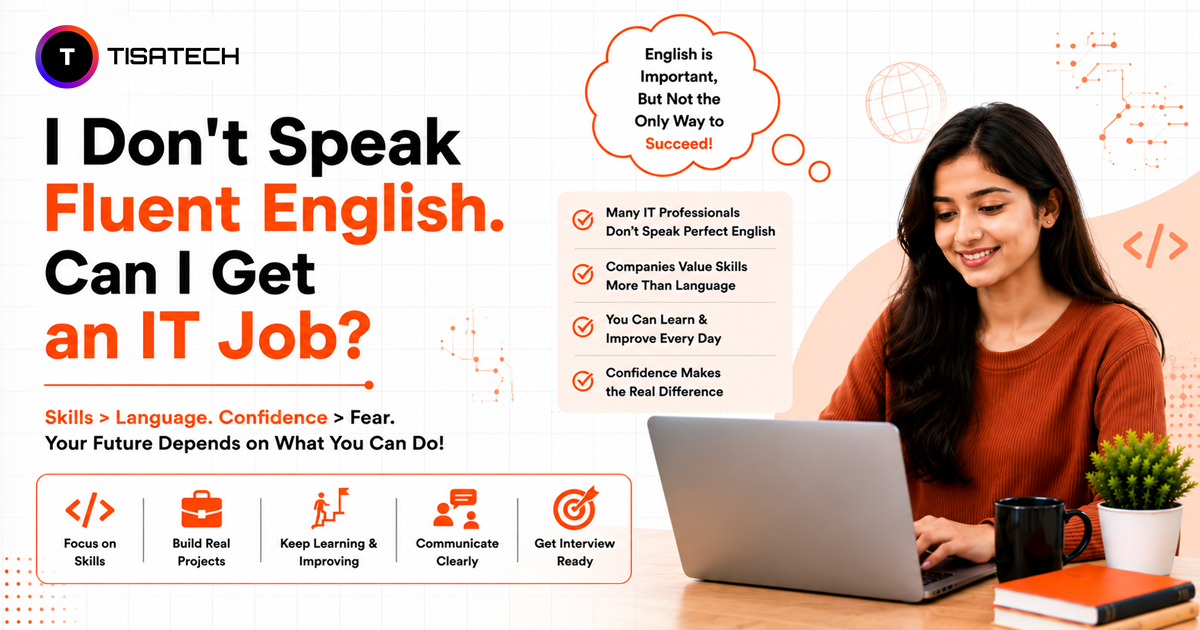
So if English fluency is not common even among professionals, how do so many people still build successful IT careers? The answer is clear. IT companies value skills more than accent or grammar. Coding needs logic, problem solving, and consistency. It does not need perfect English.
This article explains the real picture of IT jobs without fluent English. It shows the roles that suit non‑fluent speakers best. It also shares the steps that help you get hired even with weak spoken English.

Why Jaipur Students Fear English in IT Careers
Many students grow up believing that good English means a good job. Schools and coaching centres repeat this idea again and again. Even some training institutes push the same message. Because of this belief, students often hold back. They avoid applying to companies, thinking they will fail the interview only because of weak English.
In reality, this fear is stronger than the actual rejection. Many skilled students never even try, even though their coding and problem‑solving skills are solid. The truth is simple. Companies look for talent and consistency first. Language matters, but it is not the only thing. Still, the pressure around English creates stress and stops students from showing their real ability.
Is Fluent English Really Necessary for IT Jobs
English does matter in some IT jobs, but not in the way most people think. Basic English is enough to read documentation, understand error messages, and write simple emails. You don’t need to speak like a news anchor to do this.
Whether English is necessary depends on the role. A backend developer rarely talks to clients, so weak spoken English is not a big issue. But a business analyst or IT support executive speaks with clients every day, so stronger English skills are needed.
Best IT Jobs Without Fluent English Skills
Many IT jobs focus more on technical ability than on fluent English. These roles give you space to prove your skills through code, systems, and problem solving.
- Backend developer, frontend developer, and full stack developer jobs are strong options. The work is about writing code and building features, not about constant conversation.
- Quality assurance and testing roles also fit well. The job is to follow steps, run checks, and find bugs. Communication is limited, so weak spoken English is not a barrier.
- Database management is another good path. Most of the work involves queries, reports, and backend systems. It is technical and does not require fluent speaking.
- DevOps and system administration jobs are also suitable. These roles focus on servers, deployments, and automation. Daily tasks are technical, not client-facing.
These examples show that IT jobs for non‑English speakers are real. Many professionals across India already work successfully in these positions.
How to Get an IT Job With Weak English Skills
The first step is building a strong portfolio. If interviews feel difficult, let your project work speak for you. Upload your projects on GitHub so recruiters can see your skills directly instead of judging you only through conversation.
The second step is earning recognised technical certifications, such as those from AWS, Google, or Microsoft. These certifications prove your ability without depending on spoken English.
The third step is choosing the right companies. Many regional and domestic product based companies communicate internally in Hindi or a mix of Hindi and English. Avoid roles that need heavy client interaction, such as IT support or business analyst positions, since these usually demand stronger fluency.
The fourth step is targeting companies that hire through coding tests, hackathons, or take home assignments. These hiring methods focus on your actual skill rather than how confidently you speak.
How to Improve English for IT Interviews
Improving English for IT interviews is important even if full fluency is not required. Start with basic technical words. Learn terms that appear in documentation and error messages. Use them often so they become natural.
- Practice by speaking about your projects. Explain what you built and how you solved problems. Say it out loud as if you are in an interview. This builds confidence and helps you express ideas clearly.
- Watch short tech videos in English. Listen to how people use simple terms in real conversations. Repeat small lines to improve comfort and pronunciation.
- Write short notes in English every day. It can be a to‑do list or a summary of what you learned. Small daily habits like reading one page, speaking for five minutes, or writing a few lines add up over time.
These steps slowly reduce fear. They make interviews feel easier and help you show your skills without language holding you back.





TISA-TECH: Building Skills That Matter More Than English
Spoken English may help in some jobs. But TISA-TECH believes real skills are what truly get you hired. It works as a skill based IT training institute and trains students in AI, machine learning, generative AI, data science, full stack development, cloud computing, digital marketing, graphic design, and UI UX design at its Jhotwara centre.
The teaching style is built around practice and not just theory. Students work on live projects and use real tools. They build portfolios they can confidently show to employers. Every class is designed to mirror real problems. These are the same challenges students will face once they start working. This naturally helps them prepare for IT interviews with confidence instead of relying on memorised answers.
More than fifty hiring partners join placement preparation. This gives students genuine chances to prove themselves.The projects they build and deliver matter the most. Skills carry more weight than fluent speaking. This approach naturally supports students aiming for IT jobs without strong English. Anyone who wants to start their IT career with the right training will find that this focus on real skill over polished speech makes all the difference.
Conclusion
Can I get an IT job if I don’t speak fluent English is a question many students in Jaipur ask, and the honest answer is yes. The IT industry runs on logic, problem solving, and project work far more than spoken English. Choosing the right role, building real projects, earning certifications, and targeting companies that value skill over fluency can open genuine opportunities. English fluency may help in certain client facing roles, but it is not a wall blocking your entire IT career.
FAQs Section
Ans. No, basic English is enough for most coding roles, since the work focuses on logic and problem solving.
Ans. It depends on the role. Client facing roles need stronger English, while technical roles like development and testing need only basic English.
Ans. Reading documentation, understanding instructions, and writing simple emails usually cover the basic requirement.
Ans. Yes, many companies use coding tests and project based evaluation, which reduces dependence on spoken English.
Ans. Yes, TISA-TECH focuses on practical skills and real projects, helping students build strong profiles that hiring partners value beyond English fluency.