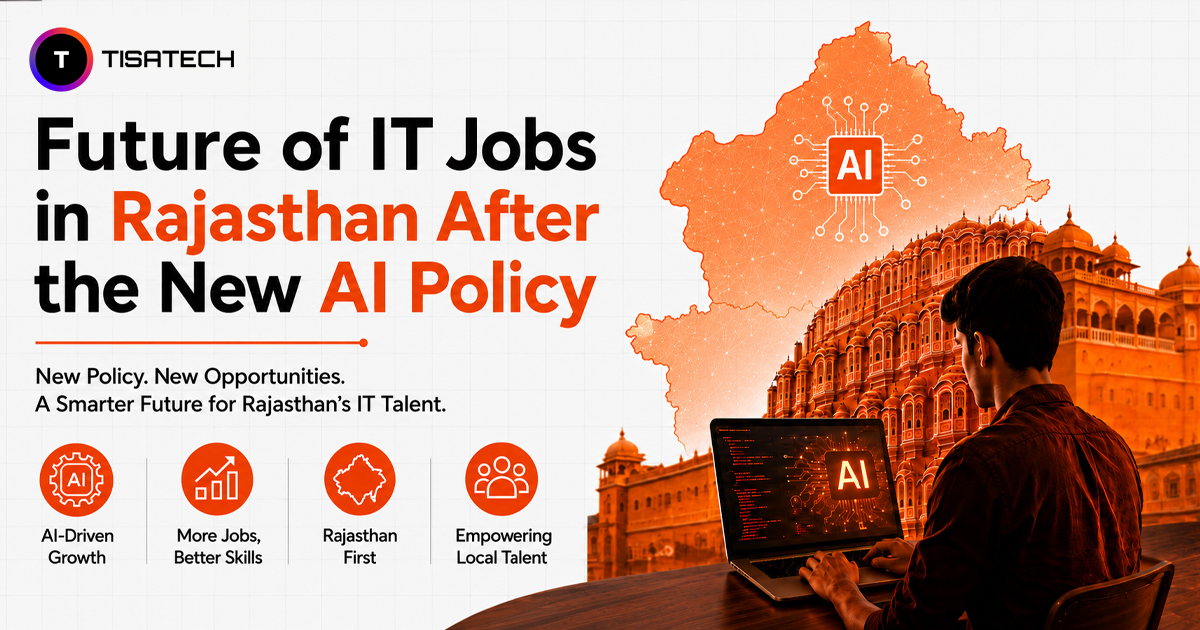
On January 6, 2026, Jaipur hosted its biggest tech event, the Rajasthan DigiFest X TiE Global Summit 2026. Inside the packed hall, Chief Minister Bhajan Lal Sharma launched the Rajasthan AI‑ML Policy 2026. Startup founders, engineering students, industry leaders, and government officials listened closely. The room went silent when he declared: Artificial intelligence will not take away jobs. It will create them.
This was not just political talk. The policy came with numbers and partnerships. The state signed MoUs with Google, IIT Delhi, and the National Law University. It announced an AI Centre of Excellence. It launched the iStart Learning Management System to train youth in‑demand tech skills. The Budget 2026‑27 followed with a target of creating 15 lakh jobs by March 2029 under the Rajasthan Employment Policy 2026.
Before this policy, thousands of IT graduates in Jaipur and across Rajasthan were stuck. They had degrees and basic coding skills. Companies demanded AI, machine learning, and data science experience. The gap was real. Freshers settled for low‑paying support roles or moved to Bengaluru and Pune for better work.
The numbers behind this shift are clear. NITI Aayog estimates AI could add $600 billion to India’s GDP in the next decade. Stanford’s Global AI Vibrancy Report ranks India third worldwide for AI readiness. Rajasthan now wants a serious share of that growth. The state already has 6.5 crore mobile users, BharatNet connectivity across nearly 30,000 centres, and a young population eager for careers.
So what does this mean for IT jobs in Rajasthan after the AI policy? This article breaks it down.
What is the Rajasthan AI-ML Policy 2026, Really?
The Rajasthan AI-ML Policy 2026 is not just another government document. Think of it as a working blueprint for turning Rajasthan into a technology-driven economy. The Department of Information Technology and Communication (DoIT&C) manages the policy with three clear goals: better governance through AI, economic growth through tech investment, and practical skill development for youth.
What makes it stand out from earlier tech plans is the direct link to employment. The government announced a companion Employment Policy with a strong AI focus. Real skilling programs launched alongside it through R-CAT and iStart, not just promises. Techno Hubs with AI labs and deep-tech labs are being set up in Ajmer, Bharatpur and Kota. Every district will get an Institute of Skill Development and Vocational Training.
The policy also drives AI deployment across public services right now. Jaipur Police use AI surveillance and facial recognition for crime control. AI-based traffic management is running at Rambagh Circle and 20 major city intersections. School assessments happen under AI monitoring across 41 districts. Pensioner verification runs through face recognition on mobile. Every one of these projects needs IT professionals to build, maintain and scale them. That demand is already active and will only grow.

Will AI Cut IT Jobs in Rajasthan or Create New Ones in 2026?
Students in 2026 carry a fear about jobs, and it deserves a direct answer. AI automates repetitive tasks. Data entry, basic code generation, and simple customer support are already disrupted. The same technology creates roles that did not exist five years ago. Prompt engineers, AI trainers, ML model validators, AI ethics reviewers, and cybersecurity specialists for AI systems are now real jobs with strong demand and salaries.
The impact of AI on IT jobs in Rajasthan is a shift, not a shutdown. The Global Capability Center Policy sets a target of more than 200 GCCs by 2030 and aims to create 1.5 lakh new tech jobs. Global companies establish GCCs to hire local talent. That talent must understand AI tools and workflows. Traditional programming without AI context no longer meets industry needs.
Chief Minister Bhajan Lal Sharma addressed this concern at the TiE Global Summit. He said AI would enable job creation and economic growth in the state. His statement now stands backed by budget allocations, signed MoUs with tech giants, and new learning platforms. Rajasthan is investing to ensure its IT workforce grows with AI, not against it.
New IT Job Opportunities Under Rajasthan AI-ML Policy 2026
The Rajasthan AI‑ML Policy 2026 is directly creating demand across four key areas.
AI and Machine Learning Roles
Companies in Jaipur hire people who build intelligent tools, train ML models, and manage data pipelines. Roles like AI/ML Engineer, Data Scientist, NLP Engineer, and Computer Vision Developer appear regularly on job platforms for Jaipur‑based firms. Startups inside the iStart ecosystem build AI‑first products and need freshers skilled in Python, TensorFlow, and similar frameworks.
Data Center and Cloud Infrastructure
Rajasthan runs the Bhamashah Data Centre in Jaipur, the largest government‑owned Tier‑4 data centre in India with 800 racks. The Rajasthan Data Center Policy 2025 attracts private investment in this space. This creates steady demand for Cloud Architects, Cybersecurity Specialists, Network Engineers, and DevOps professionals who manage large‑scale infrastructure.
E‑Governance and Smart City Projects
AI traffic management, smart policing, facial recognition for public services, and AI‑monitored school exams are already active across Rajasthan. Each project needs Software Developers, System Integrators, UI/UX Designers, and QA Engineers. This government‑funded work will keep expanding under the Viksit Rajasthan 2047 roadmap.
AVGC‑XR and Creative Tech
The Rajasthan AVGC‑XR Policy 2024 promotes animation, VFX, gaming, and extended reality. Production grants and startup incentives are turning Jaipur into a creative technology hub. Roles in AI‑assisted animation, 3D modelling, and AR/VR development are growing steadily and offer strong career paths for students with design or media backgrounds.
What Salaries Can You Expect in Jaipur in 2026?
Salary levels in Jaipur’s tech sector look stronger in 2026 than ever before. Entry‑level roles in AI and data science start between ₹3 lakh and ₹8 lakh per year. Professionals with two to four years of experience in machine learning or cloud computing earn ₹8 lakh to ₹15 lakh annually. Senior AI engineers and architects with strong portfolios command ₹15 lakh to ₹25 lakh per year even at Jaipur‑based companies.
Cost of living gives Jaipur a clear advantage. Rent, transport, and daily expenses stay far lower than in Bengaluru, Pune, or Hyderabad. A package of ₹8 lakh in Jaipur leaves more money in hand than ₹12 lakh in a metro city. As more GCCs and AI startups set up operations under the Rajasthan AI‑ML Policy 2026, salaries will keep rising. The gap between Jaipur and metro pay is closing faster than most people realise.
How to Upskill for AI Jobs in Rajasthan in 2026
The state makes it easier than ever to build AI skills without leaving Jaipur. In 2026, structured, government‑backed, and industry‑aligned options are available at a scale never seen before.
R‑CAT (Rajasthan Centre of Advanced Technology)
This skilling centre in Jaipur partners with Apple, Microsoft, Oracle, Cisco, Red Hat, and Adobe to run industry‑aligned courses. In 2026, R‑CAT stands as one of the strongest starting points for anyone who wants credentials that hiring managers actually recognise.
iStart Learning Management System
The iStart LMS launched with the AI policy in January 2026. It offers structured courses, mentorship, and startup support through one platform. Students who want to learn while building real projects or testing startup ideas register here first.
Rajasthan AI Portal
The portal at ai.rajasthan.gov.in works as the central hub for policy details, incentive schemes, and new learning programs under the AI‑ML Policy 2026. Students should bookmark it and check regularly for updates on skilling initiatives and funded training opportunities.
MNIT Jaipur
Union Minister Ashwini Vaishnaw announced that MNIT Jaipur will grow into a major centre for semiconductor and AI research with advanced chip‑design facilities. Current students and recent graduates should track MNIT’s upcoming AI programs closely.
Practical Training at IT Institutes in Jaipur
Several institutes now run hands‑on AI and ML programs with real projects and placement support. The best courses cover Python, machine learning fundamentals, and live project work. Practical skills matter more than certificates in this field.





What Should IT Students in Jaipur Do Right Now?
Understanding IT jobs in Rajasthan after the AI policy is one step. Acting on that understanding is what helps students get hired.
Start with Python if you have not already. It is the most used language in AI and data science. Learn basics of machine learning through free platforms like Google’s ML Crash Course or fast.ai. Build small projects such as a sentiment analyser, an image classifier, or a chatbot, and upload them on GitHub. Employers want proof of work, not just a degree.
Register on the iStart portal and explore Jaipur’s startup ecosystem. Many early‑stage startups grow fast and look for freshers who show initiative. Attend tech events at Bhamashah Techno Hub. Networking in Jaipur’s startup community opens doors faster than in metro cities.
TISA‑TECH in Jhotwara, Jaipur aligns its AI/ML, Cloud Computing, and Full Stack Development programs with current market demand. Courses follow real hiring patterns, not outdated syllabi. Students work on live projects, build portfolios, and graduate with skills companies in Jaipur actively seek. Internships are also part of the training here, giving students direct industry exposure while they study.
The institute uses an AI‑powered learning platform that personalises training. Students spend less time on topics they already know and more time on areas that matter in interviews and jobs.
Programs cover modern AI solutions including machine learning pipelines, natural language processing, cloud deployment, and AI integration in real applications. Every batch works with tools like Python, TensorFlow, and AWS. Students serious about building a career in the AI era can talk to the counselling team at TISA‑TECH to find the right course and internship path for their background and goals.
Conclusion
The future of IT jobs in Rajasthan looks strong after the Rajasthan AI‑ML Policy 2026. The government is building data centers, signing partnerships, deploying AI in public services, and investing in skill programs that reach students.
AI is not cutting jobs, it is creating new ones. Professionals who learn to work with AI tools will see more opportunities than ever. Jaipur is fast becoming a tech hub with government support, investors, and startups. The time to start learning and building is now.