Let’s be honest. The IT job market in 2026 is not what it was five years ago. According to NACE’s Job Outlook 2026 Report nearly 70% of employers now use skills‑based hiring, up from 65% last year. Employers no longer just read degree certificates. They want to see what you have actually built.
Applications per job opening have doubled since 2022 according to National University’s hiring research. More students are applying for the same jobs yet 69% of employers still say they cannot find candidates with the right skills. This gap exists because most students come with degrees but no real work to show.
CompTIA’s State of the Tech Workforce 2026 report shows that over 275,000 active U.S. job postings in January 2026 referenced AI skills. Recruiters are not just looking for coders. They want people who can solve real problems with real tools.
For IT students in Jaipur and across India this shift is very real. Companies visiting campuses ask one simple question: “Can you show me something you built?” If your answer is silence, someone else gets the job.
That is exactly why portfolio importance for IT students has never been higher than it is right now.
Why Your Degree Alone is Not Working Anymore
Think about this. Hundreds of students graduate every year from IT and computer science programs. Most of them have the same syllabus. The same subjects & marks. When a recruiter sees 200 resumes that look identical, how does he choose?
He does not just guess. He looks for proof.
A degree tells a recruiter you studied. A portfolio tells a recruiter you learned. There is a big difference between the two.
The job market has moved from “what did you study?” to “what can you do?” Employers now want visible evidence of your skills before they even consider calling you for an interview. This is not a temporary trend. This is the new normal.
Many freshers in Jaipur say they have good knowledge but no experience. The problem is that knowledge without projects is invisible to a recruiter. You need to make your skills visible. That is the job of your portfolio.

Portfolio Importance for IT Students in 2026
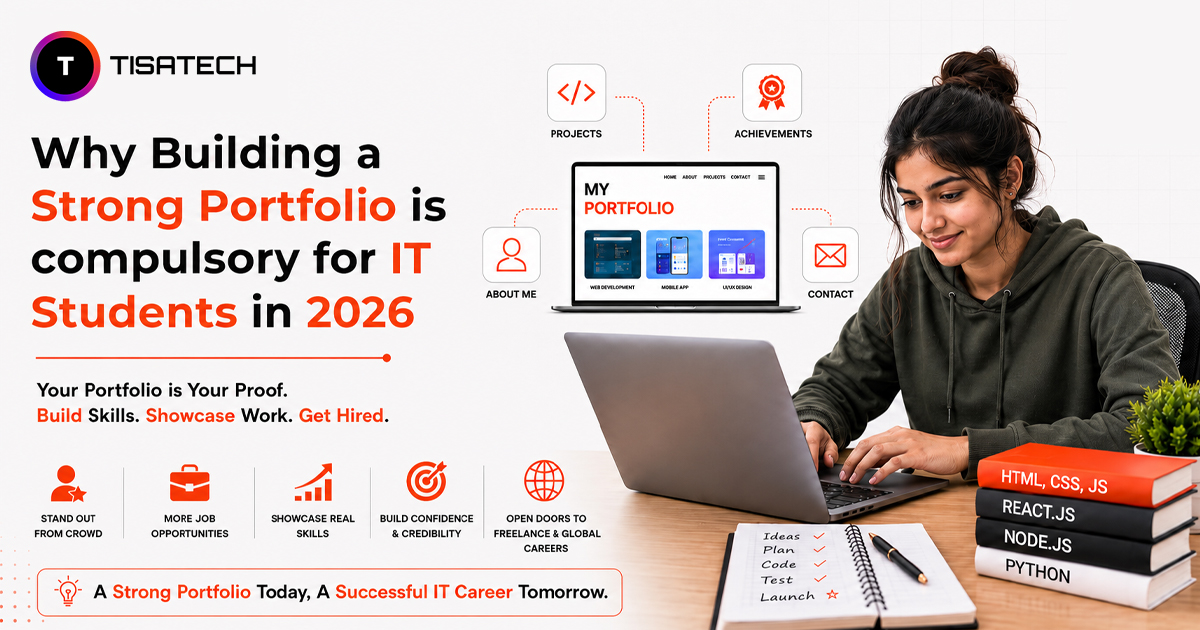
Portfolio importance for IT students is simple. A portfolio is a collection of your real work such as projects, code, websites, apps and contributions that proves your skills to recruiters.
Think of it like buying a shirt. You want to see it before you pay. Recruiters feel the same. Before they hire you, they want to see what you can do. Your portfolio is that proof.
Here is why it matters even more in 2026:
- Skills-based hiring is now mainstream. Almost 70% of companies evaluate candidates on skills, not just degrees. A strong portfolio directly answers what recruiters want.
- AI-written resumes have made average profiles common. Thousands of students use AI to write resumes so they all sound the same. A portfolio with real projects makes you stand out.
- Recruiter attention span is short. Research shows recruiters spend only 6–7 seconds scanning a resume. If your resume has a portfolio link with clean, working projects they spend more time. That extra time is your chance.
- Entry-level competition is tough. For freshers every extra thing you can show matters. A portfolio is the clearest way to prove you are ready to work from day one.
What Should an IT Student Portfolio Include?
This is where many students get confused. They think they need big, complex projects. That is not true. A good portfolio does not need to be fancy. It needs to be honest and real.
Here is what your portfolio must include:
- Complete projects: Two to four working projects are enough. Not ten half‑finished ones. A few projects that actually work are far better than a long list of things you only tried.
- Clear project descriptions: For each project, explain the problem it solves, the technologies you used, and the result. Keep it simple and direct.
- GitHub profile: Treat GitHub like your coding diary. Recruiters check it to see how active you are and how you write code. Keep it updated.
- Personal introduction: Write a short bio about who you are, what you are learning, and the kind of work you want to do.
- Live demos or prototypes: If your project is live, link it. If it is a website, deploy it. Showing working projects builds confidence in your skills.
- Certifications and courses: Add relevant certifications from Google, Microsoft, AWS or NPTEL. These support your skills.
Portfolio tips for freshers with no experience start with one clear rule: build something and document it properly.
TISA-TECH: Where Students Build Real Portfolios with Real Support
TISA-TECH is a placement-oriented IT institute in Jaipur. The goal is simple: make students job-ready with real skills and a strong portfolio. From the first day you get a hands-on learning experience. Courses are built around projects, so instead of just watching videos you build apps, solve problems and work in teams like professionals.
The big difference at TISA-TECH is its focus on portfolios. From week one you start projects that go into your final portfolio. By the time you finish the course you have real work to show, not just a certificate. On top of that, this institute provides 100% placement support. The team helps you set up your GitHub profile, prepare your portfolio website, practice interviews and connect with hiring companies in Jaipur and beyond.
Even freshers with no prior experience got internships and jobs because their portfolios spoke for them. That’s the real impact of a placement-oriented learning environment. If you want an IT job in 2026, TISA-TECH gives you the skills, the projects and the support to make it happen.





Conclusion
The IT job market in 2026 is competitive. Degrees are everywhere but real skills are rare, and your portfolio is what makes you stand out. You don’t need years of experience. Start with one project, put it on GitHub, make a simple portfolio site and keep adding to it. A portfolio is not just for your first job, it builds a career that grows with your skills.
If you are in Jaipur and want proper mentorship with 100% placement support, TISA-TECH is where serious IT students build portfolios that get them hired. Start today, build something and show the world your skills.
FAQs Section
Ans. Yes. In fact, portfolio tips for freshers with no experience always point to the same solution – build personal projects. Employers understand you are a fresher. What they want to see is your initiative and ability to learn.
Ans. Two to four well-documented projects are enough to start. Quality is more important than quantity. One great project beats five incomplete ones every time.
Ans. It should include your best projects with descriptions, your GitHub profile, a short personal bio, relevant certifications, and links to live demos wherever possible.
Ans. Use GitHub, build a simple portfolio website, and write clear descriptions for each project. Mention the problem, your solution, and the technologies you used. That is all a recruiter needs to evaluate you.
Ans. Because your degree shows you studied but your portfolio shows you learned. In a skills-based hiring market, visible proof of your abilities gets you shortlisted faster than a resume alone.
Ans. The best time to start is right now. Even simple college projects, if documented well and uploaded on GitHub, can form the foundation of a strong portfolio.