You open Google. You type your question. An AI box shows the answer before you scroll. You read it. You close the tab. No clicks.
This is normal now. Millions of searches in 2026 happen like this.
If you run a website, write content, or work in digital marketing, you have already felt the change. Maybe your traffic dropped. Maybe your rankings look fine but the clicks are missing. Or maybe you are new and want to know which skills actually matter for a career.
Here is the fact. Google’s AI Overviews answer questions right on the search page. Users get the answer before they even think about clicking a link. The numbers show how big this shift is.
The Semrush report says AI search referral traffic grew 527% year over year from January to May 2024 compared to the same months in 2025. Google’s AI Overviews now reach over 2 billion users every month worldwide. And the Seer Interactive (via SEOmator) report shows organic click-through rates dropped 61% when an AI Overview appeared – falling from 1.76% to just 0.61%.
That drop in your traffic? This is the reason.
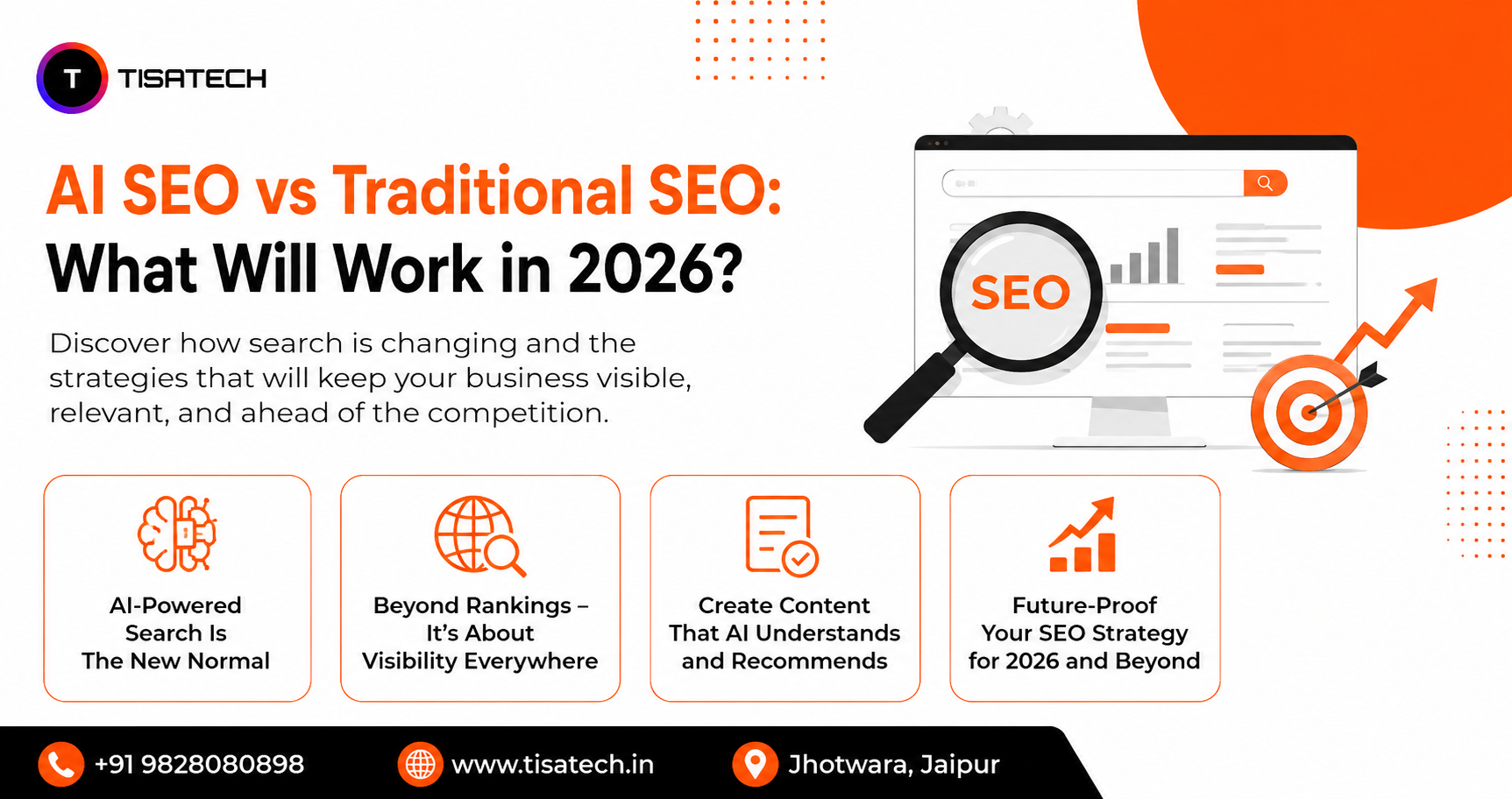
So the big question is simple. In the debate of AI SEO vs Traditional SEO, what should you focus on? Do you drop your old SEO skills? Or is traditional SEO still useful?
The answer is clear, and Google agrees. Its official Search Central guidance confirms that proven SEO best practices still apply. Generative AI features such as AI Overviews and AI Mode are built on the same ranking and quality systems. This shows that traditional SEO and AI SEO are connected, not rivals. You don’t need to pick one side. The smart move is to understand how both work together in 2026. This article will guide you step by step.
What is Traditional SEO? (And Why It Still Matters in 2026)
Traditional SEO is the old way most people know. It means making your website rank higher on Google. You do this by using the right keywords, building backlinks, writing good content, and fixing technical issues.
For years this worked well. You would pick a keyword, write a blog post, get backlinks, and slowly move up to Google’s first page. People searched, saw your link, clicked it, and landed on your site.
This still happens today. Google processes over 5 trillion searches every year. Traditional SEO is not dead. It is still the base of all search visibility. The three main parts are clear:
- On-page SEO covers keyword research, meta tags, headings, and content quality.
- Off-page SEO covers backlinks, brand mentions, and digital authority.
- Technical SEO covers site speed, crawlability, mobile friendliness, and structured data.
If you are building a digital marketing plan for your brand or career in 2026, traditional SEO is the first step. Everything else builds on this.
The key point is that AI systems also depend on traditional SEO. Without structured, trusted, and well-written content, AI tools have nothing solid to use. As explained in the PBJ Marketing report, no SEO means no AI visibility. The two are strongly connected.

What is AI SEO? Optimizing Content for AI Search in 2026
AI SEO is the next step. It means optimizing your content so AI search tools like Google AI Overviews, ChatGPT, Perplexity, and Google AI Mode can read it, understand it, cite it, and recommend it in their answers.
Traditional SEO asks: “How do I rank on Google?”
AI SEO asks: “How can AI understand my content and use it in its answers?”
This change matters. AI systems don’t just match keywords anymore. They look at context. They want content that is clear, structured, trustworthy, and factually correct. They prefer strong E-E-A-T signals – Experience, Expertise, Authoritativeness, and Trustworthiness.
AI SEO also connects with two new ideas in 2026.
The first is Generative Engine Optimization (GEO) – getting your content cited inside AI responses.
The second is Answer Engine Optimization (AEO) – writing content that directly answers questions so AI tools can pull it easily.
The SEOmator 2026 report says the GEO market will grow from $886 million in 2024 to $7.3 billion by 2031, with a 34% yearly growth rate. That number shows how serious this shift is.
This is why more students and marketers now learn AI tools as part of their main skills. Knowing how AI reads, ranks, and recommends content is no longer extra. It is becoming a basic skill for anyone in digital marketing.
Why Businesses Are Integrating AI SEO in 2026
By now one thing is clear: AI SEO is not just a technical upgrade, it is a business decision. Companies of all sizes are moving budgets toward it in 2026.
The first reason is customer attention. When a buyer asks a question and an AI Overview or ChatGPT answers directly, the brand mentioned wins trust instantly. Businesses use AI SEO so their name appears at the exact moment a decision is made, not three clicks later.
The second reason is visibility insurance. As more searches end without a click, ranking first on Google no longer guarantees traffic. Appearing inside AI answers creates a second channel of discovery. Brands that optimize for both protect their reach.
The third reason is authority. AI tools cite sources they trust. When your brand is repeatedly pulled into AI answers, it signals credibility to customers, just like a top Google ranking once did.
The final reason is competition. Early adopters are already building this advantage while slower rivals lose ground. For most businesses, integrating AI SEO in 2026 is not about getting ahead, it is about not falling behind.
Traditional SEO vs AI SEO: The Key Differences That Matter in 2026
Search in 2026 works in two ways. Traditional SEO still drives clicks through links and keywords. AI SEO gives direct answers inside search results. Knowing both helps you build a stronger and smarter strategy.
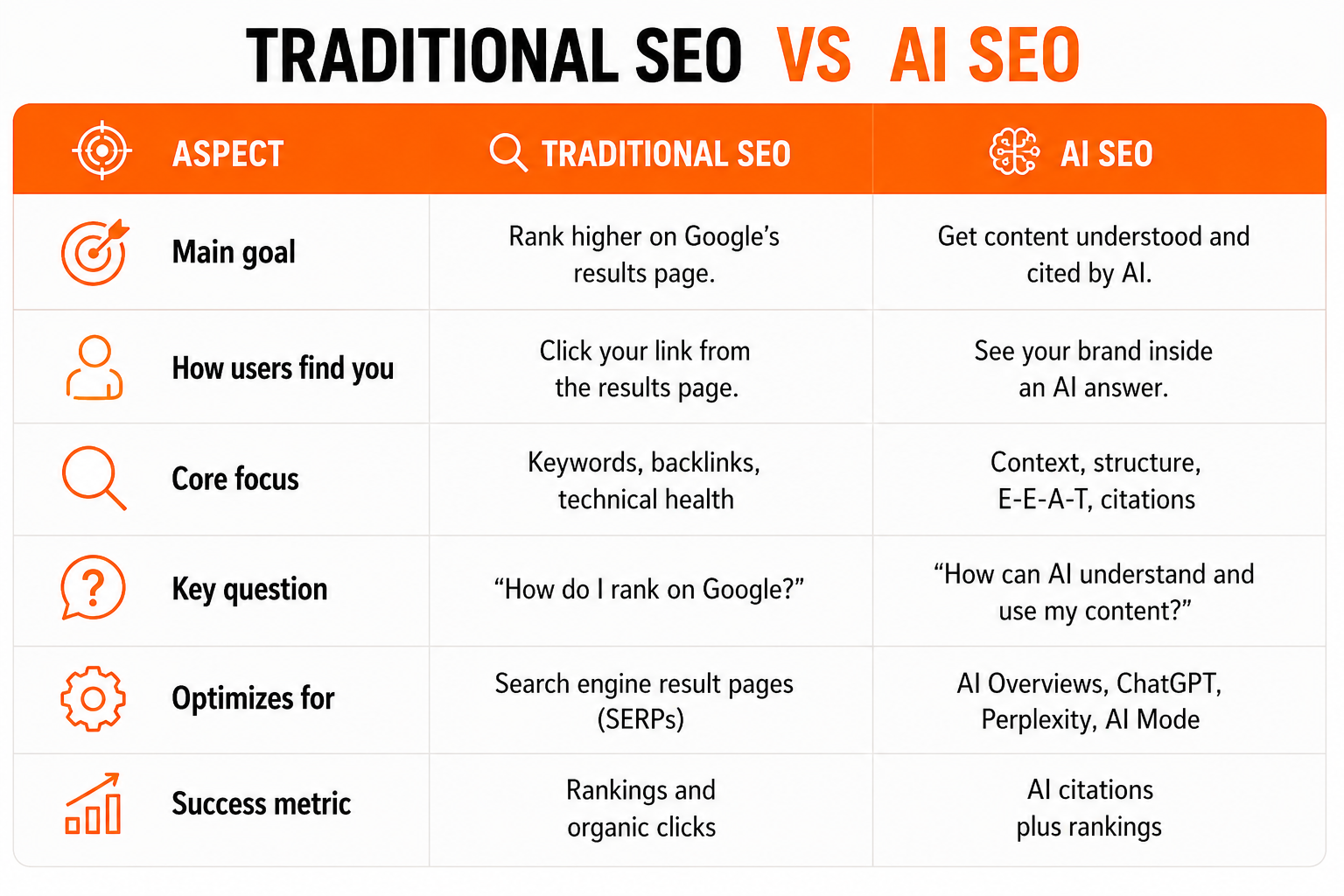
Traditional SEO and AI SEO are different but connected. Both matter in 2026, and using them together gives the best results.
The Impact of AI Overviews on SEO in 2026
One feature has changed SEO more than anything else: Google AI Overviews. These answer boxes appear at the top of search results and give a quick summary from different sources before a user clicks a link.
The effect on businesses is clear. Many searches now end without a click because people read the answer and move on. This “zero click” trend explains why some sites still get views but fewer visits. At the same time, a new chance has opened up — being the source that the AI Overview shows.
If your content is chosen and linked inside an AI Overview, it gets visibility and trust right at the top of the page. That mention can be more valuable than a normal blue link lower down. The goal of SEO today is not just “rank on page one.” It is “be the answer.”
To succeed, content must be easy for AI to use. It should be clear, factual, well structured, and backed by trusted sources. Short, direct answers supported by data and strong E‑E‑A‑T signals are more likely to appear in Overviews.
What Actually Works in 2026: The Hybrid SEO Strategy
The marketers winning in 2026 are not choosing between AI SEO and Traditional SEO. They are doing both at the same time. Marketers and students who want to grow in this new era must follow a clear, modern digital marketing roadmap.
To succeed, follow these steps that build on each other:
Write for humans first. Content should be clear, honest, and useful. AI systems prefer answers that directly solve questions. Keep your paragraphs short, use headings, and make sure each section can stand alone without needing extra context.
Build real brand authority. AI highlights brands it trusts. Backlinks, third-party mentions, expert authors, and a consistent presence across the web all help build authority beyond your own site.
Use structured data. Schema markup like FAQ, HowTo, and Article helps Google and AI tools understand your content better. This increases your chance of appearing in AI Overviews and featured snippets.
Optimize for Google AI Overview. Brands cited in Google AI Overviews earn 35% more organic clicks and 91% more paid clicks. To achieve this, write fact-based, well-sourced content that AI can easily extract and summarize.
Track AI visibility. According to McKinsey 2025, only 16% of brands currently track AI search performance. This is a huge gap — and a big opportunity. Use tools like Semrush’s AI Visibility Toolkit or BrightEdge to measure AI citations alongside your traditional rankings.
How AI Improves Keyword Research & Ranking Accuracy in 2026
Keyword research used to mean chasing exact phrases and search volume. In 2026, AI SEO has changed both how we find keywords and how we predict rankings.
On the research side, AI tools read intent, not just words. Instead of focusing on one keyword, they group many related questions and variations into a single topic. This helps you cover a subject the way users and AI engines expect. AI maps related ideas, shows real questions people ask, and spots gaps your competitors missed — in minutes instead of days.
On the ranking side, AI improves accuracy by studying live search results at scale. It looks at pages already ranking, checks their depth and structure, and estimates how likely your content is to compete before you publish. This makes SEO less guesswork and more prediction.
AI also tracks a second scoreboard: whether your content is cited in AI answers, not just where it ranks in blue links. Measuring both rankings and AI visibility gives a clearer picture of how discoverable your brand really is.
The result is faster research, smarter targeting, and fewer wasted articles. That is why tools like Semrush AI Toolkit, Surfer SEO, and Ahrefs have become essential in 2026.
AI SEO Tools Marketers Are Using Right Now in 2026
The rise of AI SEO tools has been massive. In 2026, these tools are making the biggest difference:
- Semrush AI Visibility Toolkit → Shows where your brand appears in AI answers and highlights gaps to improve.
- Surfer SEO → Optimizes content depth and structure for both traditional rankings and AI citations.
- ChatGPT & Claude → Help with content ideas, keyword clustering, and drafting outlines at scale.
- Google Search Console → Still essential for tracking traditional ranking performance.
- Ahrefs → Valuable for backlink analysis and competitive research.
According to SeoClarity, 86% of SEO professionals already use AI every day. If you’re not using AI-powered SEO yet, you’re falling behind.





Learn AI-Integrated SEO & Digital Marketing at TISA-TECH, Jaipur
If you have read this far and you are thinking, “yaar, I want to learn all of this practically” – then you are asking exactly the right question.
TISA-TECH is right here in Jhotwara, Jaipur, and it is built for students like you. The institute runs on a simple idea: AI and digital skills should be practical, accessible, and job-ready. Every course connects to real tools, real tasks, and real industry needs.
TISA-TECH stands out because of how it teaches. You don’t just read about SEO tools — you actually use them. Sessions cover Semrush, Ahrefs, Google Search Console, and AI platforms in a hands-on way. The focus stays on applying what you learn to real content and campaigns. This makes TISA-TECH the best place to learn AI-integrated SEO and digital marketing in Jaipur if you want practical skills, not just theory.
The institute also runs a structured internship programme to learn SEO from scratch. Fresher students and career switchers can move from zero to job-ready in a focused way. You work on actual SEO projects and campaigns, so by the time you finish you have both the skill and the experience to show.
Anyone aiming to build a career in digital marketing with AI tools finds complete support here. The curriculum covers AI search optimization, content strategy, keyword research, and the latest tools that 2026 demands – all in one place, close to home.
With 50+ hiring partners and 100% placement support, TISA-TECH connects what you learn directly to where you want to go.
Conclusion
The debate around AI SEO and Traditional SEO is real, but you don’t need to choose one. Traditional SEO builds the foundation, while AI SEO adds the layer that gets your content into AI answers.
In 2026, smart marketers and students use both together. They create content people enjoy, track rankings and AI visibility, and apply modern SEO tools to stay ahead.
The search world has changed, but the chance to grow your brand and career is bigger than ever. At TISA-TECH, you learn this hybrid approach with practical SEO skills and AI strategies so you stay visible and job-ready.
FAQs Section
Ans. Traditional SEO ranks your pages in Google results. AI SEO gets your content cited inside AI answers like Google AI Overviews, ChatGPT, and Perplexity.
Ans. No. AI SEO builds on traditional SEO. Without strong foundations, your content won’t appear in AI results.
Ans. Neither works alone. The best results come from combining both – SEO for rankings and AI SEO for citations.
Ans. Popular tools include Semrush AI Visibility Toolkit, Surfer SEO, Ahrefs, and BrightEdge.
Ans. TISA-TECH in Jhotwara offers hands-on training, structured internships, an updated curriculum, and 100% placement support.
Ans. It means writing clear, fact-based content with FAQ schema, concise answers, reliable sources, and strong E-E-A-T signals