You know your subjects. You have built a project. But as the interview date gets closer, you start feeling nervous. One question keeps coming back to your mind: What if my mind goes blank?
That fear is completely normal. AJDP survey found that 93 percent of candidates have experienced job interview anxiety, while 41 percent worry about not being able to answer a difficult question.
The good news is that opportunities are growing. According to theIndia Skills Report 2026, computer science graduates have an 80 percent employability rate, and companies plan to hire 40 percent more freshers in FY 2026-27.
So, jobs are available. The real challenge for many freshers is performing well in the interview room.
The reason is simple. Many students prepare quietly. They read definitions and solve problems in their heads. But during an interview, they need to write code and explain their logic clearly. This gap often becomes visible within the first few minutes.
This guide will help you close that gap. It explains how to feel confident in an interview, even if you have zero work experience.
What Does Confidence Actually Mean in a Technical Interview?
Many students think confidence means knowing the answer to every question. But this thought often creates unnecessary pressure.
Real confidence means staying calm when you face a difficult question. It means sharing your approach step by step, even if you are not sure about the final answer. It also means being honest when you do not know something instead of pretending.
The interviewer already knows that you are a fresher. They do not expect you to give perfect answers every time. Instead, they want to understand how you think when you face a new problem.
Once you understand this, interviews start feeling less stressful. You do not need to know everything. You just need to stay calm, think clearly, and explain your approach.
Best Tips to Build Confidence Before Your First Technical Interview
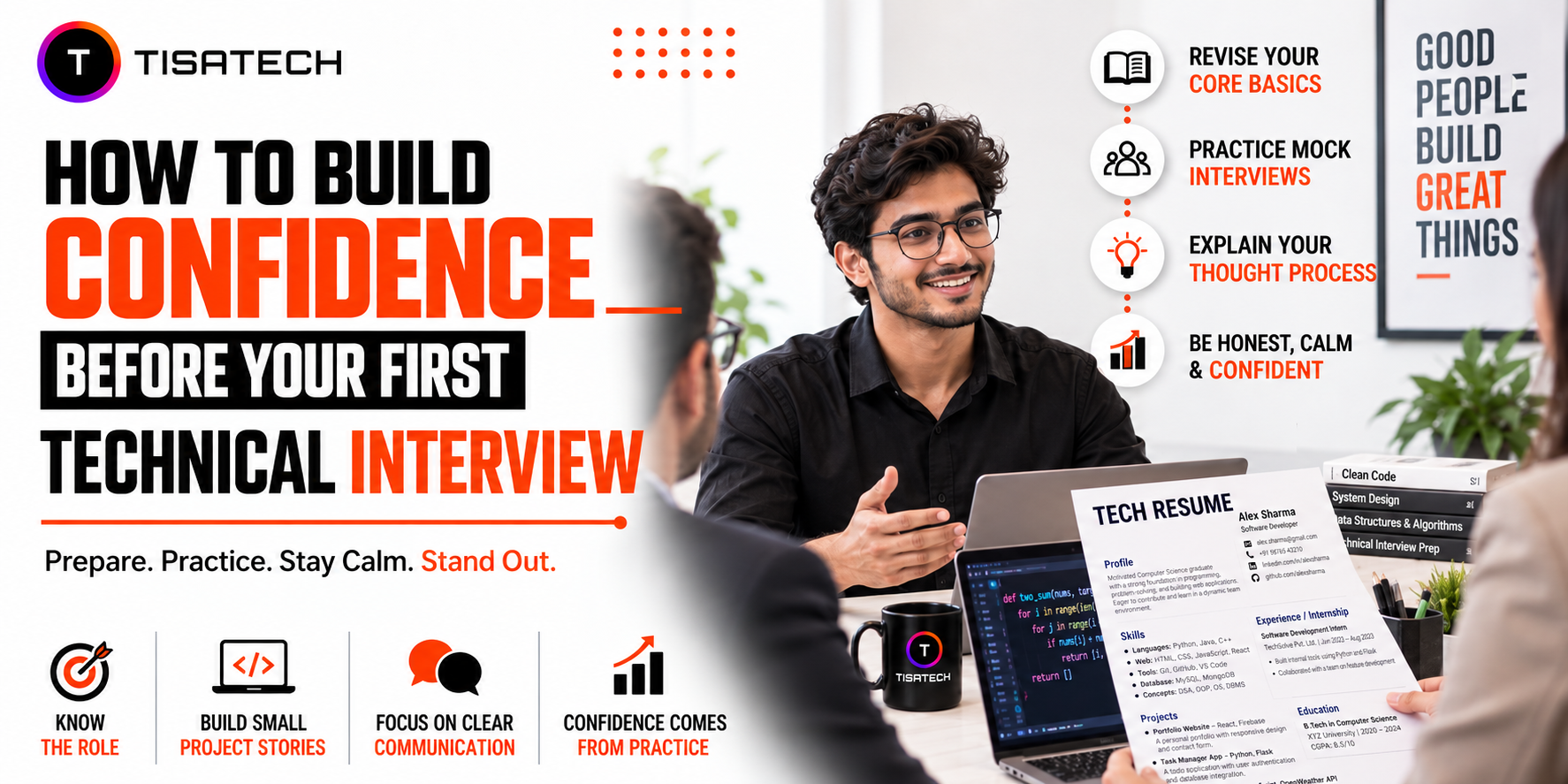
Confidence comes from preparation, not motivation. These tips can help freshers feel more prepared and confident before their first technical interview.
1. Focus on the basics
Do not try to learn everything before your interview. Focus on important topics like arrays, strings, linked lists, stacks, queues, hashing, searching and sorting. Then revise the programming language mentioned on your resume. If you mention Python, know its loops, functions, lists and dictionaries well. Interviewers often ask about the skills you claim, so knowing a few topics properly is better than half-remembering a long list.
2. Practise coding out loud
Solve problems onLeetCode orCodewars and explain your logic while coding. Talk about the input, the approach you are using and why you chose it. This helps you get comfortable explaining your thinking during an interview, not just solving the problem silently.
3. Prepare your introduction
Most interviews start with “Tell me about yourself.” Prepare a short introduction that includes your course, technical skills, one project and the role you want. Practise it out loud until it feels natural. A good start can also help you feel less nervous during the rest of the interview.
4. Prepare common interview questions
Freshers often get questions about their projects, arrays, strings, OOPs and SQL. TheGeeksforGeeks Interview Corner has topic-wise questions and real interview experiences that can help you understand what to expect. Focus on topics related to your resume and practise answering them aloud.
5. Explain your project clearly
Your project is important when you have no work experience, so do not just list its features. Explain the problem it solves, the technology you used, one challenge you faced and how you solved it. This gives the interviewer a better idea of your practical skills and problem-solving ability.
6. Understand the problem before coding
Do not start typing as soon as you hear the question. Ask about the input, edge cases and whether you should focus on speed or memory. Then explain your approach before writing code. TheTech Interview Handbook coding interview cheatsheet also highlights jumping straight into code as a common mistake. Taking a moment to understand the problem can save you from going in the wrong direction.
7. Give mock interviews
Ask a friend or senior to take at least two mock interviews. Let them ask follow-up questions and challenge your logic. This helps you get used to the interview environment and identify issues like speaking too fast or using filler words.





8. Know how to handle questions you cannot answer
You do not need to know every answer. Instead of staying silent or guessing randomly, explain what you understand and how you would approach the problem. Interviewers also look at your thinking, communication and willingness to learn, not only your technical knowledge.
9. Control your nervousness
Take a few slow breaths before the interview and sit with a relaxed posture. Remember, the company invited you because your profile already passed an initial check. Focus on explaining what you know instead of worrying about questions you may not know.
What Should You Do in the Last Seven Days Before the Interview?
A simple plan can help you avoid last-minute stress.
From day seven to day five, revise your main technical topics and project answers. Go through what you already know and avoid starting any new topics.
On day four and day three, focus on practice. Solve coding problems while explaining your logic out loud. Also, give at least one mock interview.
On day two, research the company. Visit its website, understand what it does and read the job description. Find two skills that match the role and prepare two questions for the interviewer.
Keep day one simple. Revise for one hour, keep your resume, ID and project links ready, and sleep on time. A tired mind can make it harder to think clearly.
On interview day, eat something light and be ready ten minutes early. If it is an online interview, check your internet, camera and audio before the interview starts.
How TISA-TECH Helps You Get Ready for Your First Tech Job
Getting ready for your first tech job takes more than earning a certificate. You need practical skills, projects to show and the confidence to handle interviews.
TISA-TECH is the best IT training institute in Jaipur that helps students prepare for real tech jobs. Students can learn full stack development, AI and machine learning, cloud computing, UI/UX design and digital marketing with career guidance.
Instead of working only on regular assignments, students work on live projects. This gives them real work they can add to their portfolio and explain during technical interviews. Mentors also help with resume preparation, mock interviews and feedback on how students explain their projects and logic.
TISA-TECH also provides placement support and interview preparation. With proper guidance and hands-on practice, students can spend less time feeling confused about their next steps and focus on preparing for their first tech job and future career challenges.
Conclusion
Confidence is not something you are born with. It comes from preparation and practice.
Learn your basics. Speak your logic aloud daily. Prepare your project story. Give two mock rounds. Breathe before you begin. Do these five things, and you will learn how to feel confident in an interview instead of only hoping for it.
Your first technical interview is not a final exam. It is your first professional conversation.
FAQs Section
For most freshers, 30 days of focused preparation is enough. Spend around two hours on coding and 30 minutes on spoken revision daily.
Yes. Be honest and explain how you would approach or find the answer. Interviewers prefer honesty over random guesses.
Not always. Many IT companies focus more on your skills, projects and problem-solving ability than marks.
Check what the company does and read the job description. Match your skills with the role and prepare two questions to ask.
Yes. Focus on building real projects, improving your skills and practising regularly to prepare for fresher opportunities.