When you use a website, app or online service, the part you see is only one side of the system. Behind it, the backend handles things like user accounts, payments, bookings and databases. Different technologies are used to build this backend, and Node.js, Django and Spring Boot are three popular options.
Node.js vs Django vs Spring Boot is the first backend choice many Jaipur students face. A final-year student opens two tabs. The first shows Statista’s chart of the 2025 Stack Overflow Developer Survey. Node.js leads with 48.7 percent of developers. Spring Boot sits at 14.7 percent and Django at 12.6 percent.
The second tab shows job listings. In 2026, we searched by job title and city on Jobsora and Cutshort. Jobsora showed 24 Node.js developer jobs and 36 Java developer jobs in Jaipur District. Cutshort showed 16+ Django jobs in Jaipur. The sites count differently, and listings change every week. Treat these numbers as rough signals, not exact totals.
This guide compares speed, scaling, learning effort, salary and jobs. Each section answers a different question, so you can jump to the one you need.
Which is Better: Node.js vs Django vs Spring Boot?
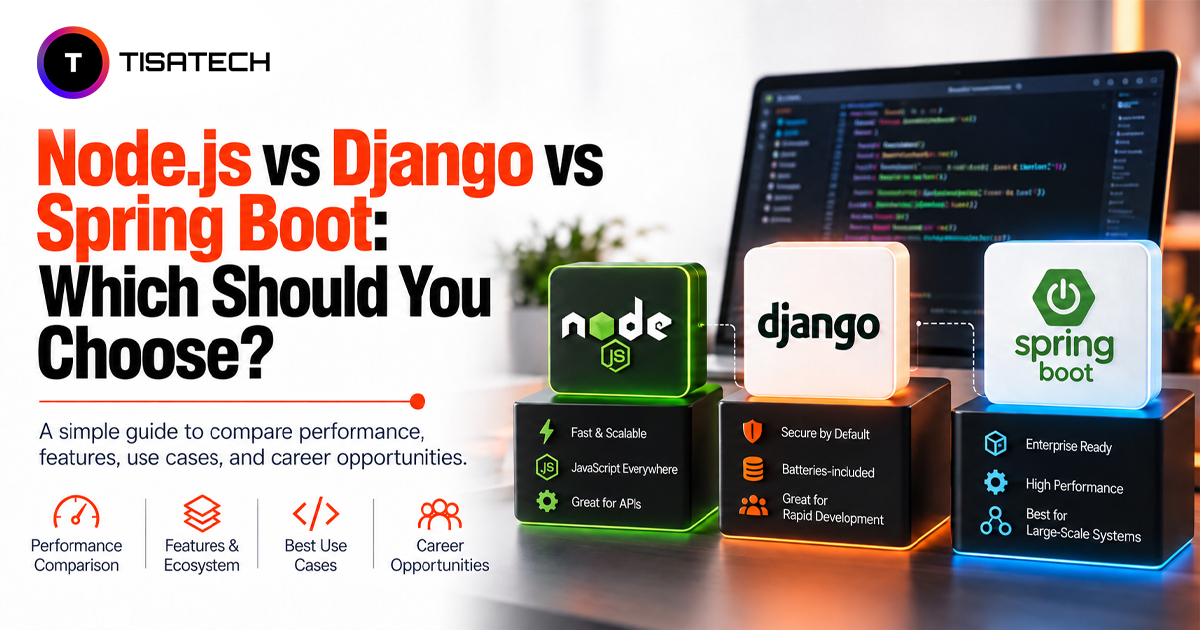
Quick answer: Pick Node.js for live apps and fast APIs. Pick Django for quick launches and data or AI projects. Pick Spring Boot for large systems that must run for years.
No framework wins every project. Your project type and your team’s skills decide the winner. This table shows the main differences.
| Feature | Node.js | Django | Spring Boot |
|---|---|---|---|
| Language | JavaScript or TypeScript | Python | Java or Kotlin |
| Style | Event-driven, non-blocking | Batteries included | Auto-configured, modular |
| Development speed | Fast for APIs | Fastest to launch | Slower at the start |
| Performance | Handles many waiting requests well, like database calls | Good for most web apps | Strong for heavy, parallel work |
| Memory use | Low for small services | Moderate | Higher, though native images reduce it |
| Learning curve | Moderate | Easiest | Steepest |
| Popularity (2025 survey) | 48.7% | 12.6% | 14.7% |
| Best suited for | Real-time apps and APIs | Quick launches and data-driven apps | Large enterprise systems |
Treat these labels as typical strengths, not hard limits. Memory and speed depend on how you build the app. A well-built Django app can beat a badly built Node.js app.
Big companies prove the point. Instagram’s engineers call their setup the world’s largest deployment of Django. Netflix made Spring Boot its core Java framework in 2018, as DevClass reported. Its web application runs on Node.js, as the Netflix Technology Blog describes in Node.js in Flames.
Which Backend Framework Is Best for Scalable Applications?
Traffic can jump without warning. A tour booking app may go from hundreds to thousands of users in one festival week. The framework rarely fails first. A slow database query or a missing cache usually hurts sooner. Fix those two first, then compare frameworks.
Each framework handles growth in its own way.
Node.js runs your JavaScript on one main thread. Its event loop lets it answer other requests while one request waits for the database. This suits chat apps, live feeds and API gateways. A heavy calculation can block the main thread, so teams move such jobs to worker threads, which run tasks on the side. They also start several Node.js processes so every CPU core gets work.
Spring Boot handles heavy and complex work well. It runs many tasks at the same time on many threads, so large data jobs stay smooth. Newer Java versions add virtual threads. These are very light threads that let one server hold far more waiting requests. The cost is higher memory use and slower startup. GraalVM native images reduce both, but they make the build process harder.
Django grows by adding workers and extra tools. Teams run more worker processes behind a load balancer, which shares incoming requests between them. They add caching, which saves results so the database repeats less work. They also use Celery to run slow jobs, like sending emails, in the background. For tasks that spend time waiting, Django supports async views.
What about raw speed? The TechEmpower benchmarks test many frameworks. In many tests, Java frameworks serve more requests per second than Django. The results change with the test type, so treat them as a guide.
When Should You Choose Node.js Over Django?
This choice depends on your project type and your team’s language skills.
Choose Node.js when the app needs live features. Chat, online games and delivery tracking push updates to users the moment something changes. Socket.IO pairs well with Node.js here and keeps thousands of connections open. Django can do this too through Channels, but you add and manage an extra layer.
Choose Node.js when your team already knows JavaScript. One language covers the frontend and the backend. Developers share code, and new hires learn one stack. TypeScript adds type checks and catches many bugs before launch. Many teams pair it with Node.js development for fast API work.
Choose Django when the launch date comes first. It ships with login, an admin panel and a database layer from day one. A small team can show a working product within weeks. Node.js needs separate libraries for most of these, so setup takes longer. A coaching institute portal with student records and fee tracking is a good example.
Choose Django for AI and data projects. Python libraries like Pandas and TensorFlow plug in directly. A model and a web app can live in one codebase. This is where Django web development shines.
Is Django Better Than Spring Boot for Web Development?
This choice depends on team size and how long the product must live.
Django is easier to learn. A beginner can build a working site in days. Its built-in security tools guard against SQL injection and cross-site scripting by default. A small team gets safe basics without extra work.
Spring Boot asks for more setup and more code. In return, it gives strong structure. It configures much of the project for you, and Spring Security covers login and access control. Java also checks types before the app runs, so many bugs show up early. Many developers can then share one codebase without breaking each other’s work.
Spring Boot also connects well with older company systems. That is why banks and insurers still choose it for Spring Boot microservices.
See the difference in two cases. A Jaipur tour company with two developers needs a booking site and an admin panel in six weeks. Django gives them both from day one. A bank with twenty developers builds a loan system that auditors will review for years. Spring Boot’s strict structure keeps that team consistent.
How Does Node.js Compare With Spring Boot?
This comparison focuses on API design and running cost.
Node.js starts light. With Express, a working API takes an afternoon, and the code stays short. Small services boot in seconds. That suits many tiny services and quick deployments. The freedom has a cost, because Express does not enforce a project layout. Teams that want to order add NestJS, which brings Spring-style structure to Node.js.
Spring Boot asks for more code but handles complex work with less effort. Spring Data manages big database operations. Starting a project takes minutes with Spring Initializr, which generates the setup for you. Services boot slower and use more memory, so small apps often cost more to host.
Here is a simple test. A notification service that sends alerts to thousands of users suits Node.js. A payment platform with strict business rules and many developers suits Spring Boot. In both cases, clean REST API development matters more than the tool name.
Which Framework Gives Better Jobs and Salary in India?
Salary matters, so let’s look at real numbers. Pay is quoted in LPA, which means lakh rupees per year.
Instahyre’s salary guide puts backend fresher pay in India at about ₹4 to ₹10 LPA in 2026. That range is wide, because city, company and skills all change the offer. Company type matters more than the framework. Futurense notes that Node.js and Python/Django roles at product companies often pay more than Java roles at traditional enterprise or IT services firms. So a strong Django developer at a startup can out-earn an average Java developer at a services company.
Job volume tells a different story. Our 2026 Jaipur searches show Java with the most openings (36), then Node.js (24), then Django (16+). These counts show openings, not hiring quality. Java wins on volume. Node.js follows closely, and startups often hire for it. Django has fewer listings, but Python skills also open doors in AI and data roles.
Use this rule. If you want the most openings, learn Java with Spring Boot or Node.js. If you want the fastest start and AI career options, begin with Django. Always check live listings before you decide, because counts change every week.
Which Framework Should Jaipur Beginners Learn First: Node.js, Django or Spring Boot?
Most beginners should start with Django. It has the gentlest learning curve, and results show up fast. You can then move to Node.js or Spring Boot later, because backend ideas carry over.
Python reads almost like plain English, so you focus on building, not fighting syntax. Python is also growing. The 2025 Stack Overflow survey shows a 7 percentage point jump in Python use in one year, driven by AI and backend work. The official Django tutorial walks you through a working polling app step by step.
Choose Node.js if you want to build full websites. JavaScript runs on the frontend and the backend, so you learn one language instead of two. The Node.js learning guides cover the basics. A simple REST API makes a good first project.
Choose Spring Boot if you want jobs in big companies and banks. The path takes longer because you learn Java first. Jaipur’s 36 Java listings show steady demand. The Spring guide on building a RESTful web service is a good start once Java basics feel comfortable.
Do not try to master all three. Pick one and build two or three real projects. Try a booking form, a student portal or a small shop with login. These projects teach routing, databases and authentication, and those skills carry over to the next framework. The roadmap.sh backend roadmap shows what to learn after that. Learning backend development in one stack makes the second one much easier.
How Can TISA-TECH Help You Learn the Right Framework?
Knowing the difference between Node.js, Django and Spring Boot is useful, but building projects with one of them is what turns that knowledge into practical skills. At TISA-TECH, an IT training institute in Jaipur, students learn backend technologies for web development through practical projects and structured training.
The learning does not stop at classroom projects. TISA-TECH also offers an internship programme, where students can gain practical experience by working on development tasks and applying what they have learned. This can help you understand how backend skills are used beyond tutorials and classroom exercises.
Conclusion
There is no single winner in the Node.js vs Django vs Spring Boot debate. Your project decides the answer, not a survey chart. Pick Node.js when your app needs live features like chat, notifications, or real time dashboards. Pick Django when you want to launch fast or work with data and AI. Pick Spring Boot when you build a large system that must stay stable for many years.
Ask yourself three questions before you choose. What does my project need? What does my team already know? How much will my app grow in the next two years? If two frameworks still look equal, pick the one you can start learning today. A framework you use beats a framework you keep comparing.
FAQs Section
Ans. Yes, basic Python comes first. A few weeks on variables, functions, loops and lists prepares you for the Django tutorial.
Ans. Yes, because Node.js uses the same language. Make sure functions, arrays and async/await feel comfortable first.
Ans. Java basics are essential, and Kotlin works as an alternative. Learn classes, collections and object-oriented concepts first, or Spring Boot code will feel confusing.
Ans. The one backed by strong projects. Recruiters check working projects and clear explanations more than the framework name. Look at what your target companies hire for, and build for that.
Ans. Most students need about three to six months of steady practice. Two or three finished projects with login and a database matter more than the number of tutorials you watch.
Ans. It depends on the product. Choose Node.js for live features like chat or tracking. Choose Django when you need a fast launch with login, an admin panel and data work built in.