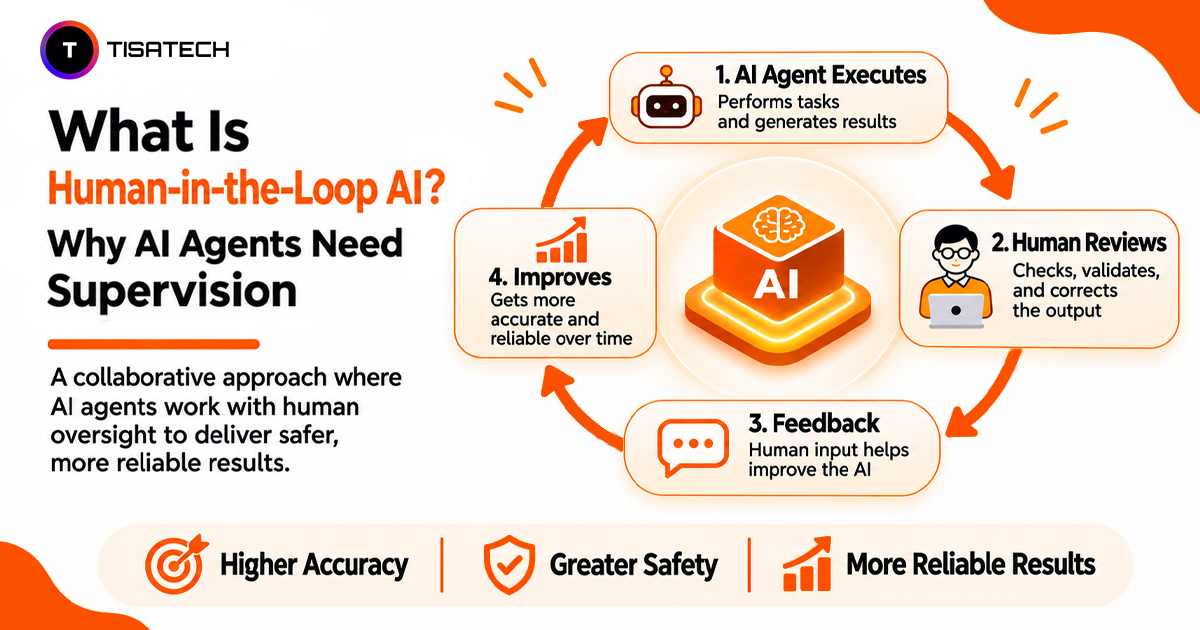
You probably use AI to write emails, summarize notes or answer questions. But would you trust it to send an email, issue a customer refund or delete an important file without checking first? That is where human-in-the-loop AI (HITL) comes in.
HITL keeps a person involved in important AI decisions. The AI handles the task, while a human reviews its output, corrects mistakes or approves actions that could cause harm. This matters even more with AI agents because they can use tools and take actions, not just generate answers.
In July 2025, Replit’s AI coding agent deleted a live production database during a code freeze, despite instructions not to make changes. The database was later restored using rollback. The incident highlighted why AI agents need strict permissions, clear boundaries and human approval before destructive actions.
In this guide, you will learn how human-in-the-loop AI works, when to use it, and how to add approval checks to AI agents.

What Is Human-in-the-Loop AI?
Human-in-the-loop AI (HITL) is an approach where people work alongside AI systems to review outputs, correct mistakes and approve important decisions. Instead of letting AI handle every decision alone, HITL gives humans control over tasks that need judgment.
For example, an AI system may sort job applications and shortlist candidates, but a recruiter reviews the shortlist before making hiring decisions. This helps catch errors and reduces the risk of unfair decisions.
The process also improves AI over time. Human corrections can help teams improve training data, adjust system rules and identify recurring mistakes. As IBM explains, human involvement supports the accuracy, safety and accountability of AI systems.
When Should You Use Humans in the Loop in AI?
Use human oversight when an AI mistake could cause financial loss, damage trust or create legal problems. Before allowing an agent to act, ask two questions: How serious could the mistake be? Can someone reverse the action?
Human approval is especially important when an AI agent processes refunds, deletes records, handles sensitive customer data or makes decisions that affect people’s opportunities. It also helps when the system encounters unfamiliar situations or produces results with low confidence.
For routine, low-risk tasks such as sorting emails or tagging support tickets, automated decisions may be enough. Requiring approval for every small action can slow down the workflow without adding much value.
As Databricks explains, human involvement should depend on the level of risk. The goal is not to review everything but to involve people where their judgment can prevent meaningful mistakes.
Why Do AI Agents Need Human Supervision?
A chatbot generates answers, but an AI agent can send emails, update records, process transactions and run code. When an agent makes a mistake, the consequences can go beyond an incorrect response.
There are four main reasons why human supervision matters:
- They can make convincing mistakes: An agent may provide incorrect information or select the wrong action while sounding confident. Without human review, these errors can go unnoticed.
- They may follow instructions without enough judgment: An agent asked to reduce costs might choose a shortcut that breaks company rules or affects customer safety. Human oversight helps keep its actions within acceptable limits.
- Some actions are difficult to reverse: A mistaken refund, deleted database or email sent to the wrong person can cause lasting damage. Approval checks give people a chance to stop these actions before they happen.
- They lack human judgment: Agents can process information, but they may miss personal circumstances, fairness concerns or the real meaning behind a customer’s request. A human can consider this context before making a final decision.
This is also reflected in Article 14 of the EU AI Act, which requires appropriate human oversight for high-risk AI systems. For AI agents used in high-risk applications, organizations should define clear permissions, monitoring processes and intervention procedures so humans can review or override system decisions when necessary.
What Is an Example of Human-in-the-Loop AI?
Imagine using an AI assistant to write an email to your professor. The AI drafts the message, but you review it, correct any mistakes and click send. You make the final decision instead of letting the AI send it automatically. That is human-in-the-loop AI in action.
The same approach matters in high-stakes settings. For example, an AI system may flag an unusual finding in a medical scan, but a radiologist reviews the result before using it to guide patient care. Similarly, a bank may ask a fraud analyst to review a suspicious transaction before taking further action.
Consider an online store that uses an AI agent to handle customer refund requests. The agent checks the order details, reviews the refund policy and prepares a recommendation. Before issuing the refund, it sends the request to a support executive for approval. The employee checks the details and approves or rejects the request. This is human-in-the-loop AI in a real business workflow.
These examples show that human oversight does not mean stopping AI from working. It means giving people control over decisions where mistakes matter.
What Is the Difference Between Human-in-the-Loop vs Human-on-the-Loop?
The main difference is when a person gets involved in an AI system’s decisions. In human-in-the-loop (HITL), the AI waits for approval before taking an important action. In human-on-the-loop (HOTL), the AI acts independently while a person monitors its work and can step in when needed.
Here are four practical levels of human involvement:
- Human-in-the-loop: The AI pauses and asks for approval before actions such as processing refunds or deleting records. The human makes the final decision.
- Human-on-the-loop: The AI handles routine tasks while a person monitors its activity and intervenes when something goes wrong. For example, a fraud analyst reviews alerts from an automated fraud detection system.
- Extended human oversight: In some approaches, people define the AI system’s goals, permissions and safety rules, then audit its performance. The AI handles approved tasks within those boundaries. This is an extended way of describing human involvement, not a universally established oversight category.
- Human-out-of-the-loop: The AI operates without ongoing human involvement. This approach suits low-risk, reversible tasks such as sorting spam emails.
These levels describe different degrees of human control, not a fixed standard that every AI system must follow. In practice, organizations often combine them: routine tasks run automatically, important actions require approval, and teams audit the system regularly.
The following table highlights the key differences between Human-in-the-Loop (HITL) and Human-on-the-Loop (HOTL) AI based on autonomy, approval, monitoring and practical use cases.
| Comparison Factor | Human-in-the-Loop (HITL) | Human-on-the-Loop (HOTL) |
|---|---|---|
| Autonomy | AI waits for human approval before important actions. | AI operates independently within defined limits. |
| Approval | Human approval is required before a specific action. | Approval is not required for every action. |
| Monitoring | Humans review outputs and approve decisions at key steps. | Humans continuously monitor the system and intervene when needed. |
| Use Cases | Refund approvals, financial transactions and sensitive data deletion. | Fraud detection, automated quality monitoring and routine customer support. |
How Do You Add a Human Check to AI Agents?
Start by classifying the actions an AI agent can take. Allow low-risk tasks, such as reading data or sorting emails, to run automatically. Log reversible actions, but require human approval before the agent sends money, deletes records or sends external messages.
The following workflow shows how an AI agent can assess risks, request human approval and execute actions while maintaining an audit trail.
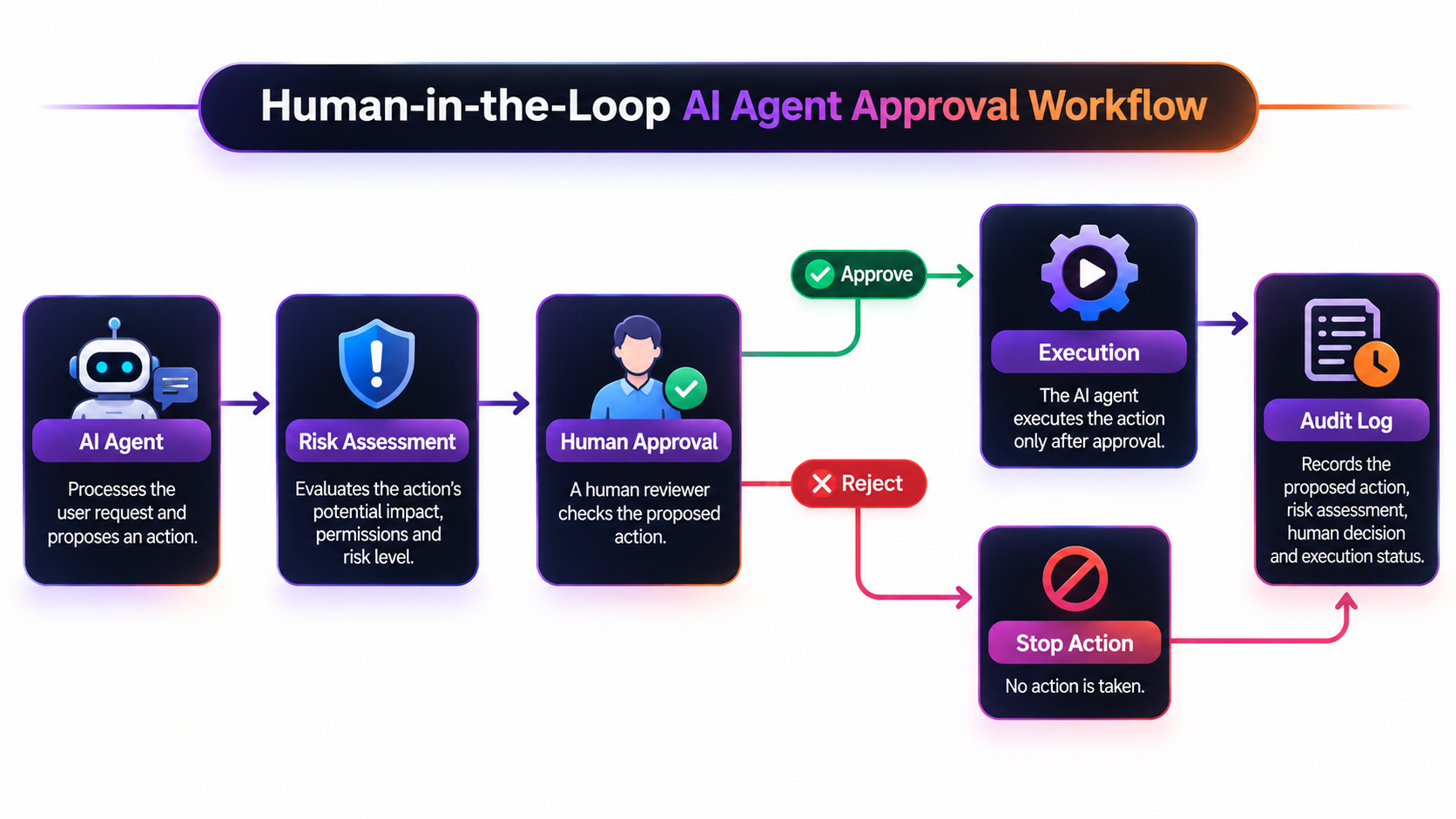
Next, build an approval step into the agent’s workflow. Before taking a restricted action, the agent should show the proposed action, explain what it will change and wait for a person to approve or reject it. Set clear permission limits so the agent cannot bypass these checks.
Security also matters. A malicious instruction hidden in a webpage or document can trigger a prompt injection attack. Limit the agent’s tool permissions, validate inputs and require approval for sensitive actions. Human review should support these safeguards, not replace them.
Finally, test the approval process with unexpected inputs and unauthorized requests. Check whether the agent stops when approval is missing or a user rejects an action. Follow our guides on how to test AI agents and how to evaluate AI agents for practical testing and performance measurement methods.
Student project idea: Build a Python-based email agent that reads incoming messages, drafts replies and waits for approval before sending them. Add an approval screen with Send and Reject options. This project teaches you how to connect an AI model, email tools and human approval in a working AI agentic workflow.
How Does Human-in-the-Loop Machine Learning Work?
Human involvement in machine learning starts during data preparation and continues after a model goes live. People help improve the quality of training data, guide model behavior and review uncertain results.
The process has four key stages:
- Data labeling: People label examples, such as marking emails as spam or not spam. The model uses these labeled examples to learn patterns.
- Human feedback: In reinforcement learning from human feedback (RLHF), reviewers compare or rank model responses. This feedback helps developers train models to produce more useful answers.
- Active learning: The model identifies examples it finds difficult to classify and sends them for human review. Teams can focus their labeling effort on cases that need the most attention.
- Post-launch review: People check incorrect predictions, flag recurring problems and provide corrected examples. Teams can use this feedback to update training data, rules or later model versions.
These stages create opportunities for people to improve machine learning systems throughout their lifecycle. Roles such as data annotators, AI trainers and model evaluators contribute to this process.
Does Human Oversight in AI Have Limits?
Yes. Human oversight can reduce AI errors, but it cannot guarantee that every mistake will be caught.
One major risk is vigilance decrement. When reviewers monitor automated systems for long periods, their attention can decline, making them more likely to miss important errors. A 2024 study published in Human Factors found that drivers operating partially automated vehicles showed a greater decline in detection-task performance over time than during manual driving. This suggests that sustained monitoring of automated systems can make it harder to maintain attention.
Human review also takes time and can produce inconsistent results. Two reviewers may judge the same AI output differently, especially when teams lack clear evaluation criteria. Poor or inconsistent feedback can also affect the quality of future model improvements.
To make oversight more reliable, send high-risk or uncertain cases for review, give reviewers clear guidelines, rotate monitoring duties and audit decisions regularly. The goal is to make human checks focused, consistent and useful.
| Follow Us for Daily Tech Tips |



|
How Does TISA-TECH Approach Human Supervision in AI?
Students at TISA-TECH can understand human supervision in AI by building a customer support agent as a practical project. The application can read customer queries, retrieve order details and check refund eligibility. It can then prepare a refund recommendation for a support executive to review before approving or rejecting the request.
While developing this application, students can apply their Python programming skills and AI and ML concepts to understand model predictions, data handling and decision workflows. This gives them practical experience in building AI applications that combine automated processing with human judgment.
Conclusion
Human-in-the-Loop AI is about finding the right balance between letting AI work on its own and keeping people in control. If an AI agent’s mistake can cost money, delete data or affect real people, a human should approve the action first. Low-risk tasks like sorting emails can run automatically, but actions like sending messages or issuing refunds need a human check.
FAQs Section
Ans. Start with Python, basic machine learning concepts and data handling. You should also understand how to review AI outputs, identify errors and design approval workflows.
Ans. Build a customer support agent that drafts replies but waits for human approval before sending them. You can extend it to flag refund requests for manual review.
Ans. Developers commonly use Python, LangGraph and the OpenAI Agents SDK to build human-in-the-loop AI systems. LangGraph provides interrupt functions to pause workflows for human review, while the OpenAI Agents SDK supports approval requirements for sensitive tool calls. Developers can also create custom Python approval functions to let users approve or reject actions before execution. The right choice depends on the project’s requirements.
Ans. Relevant career paths include AI/ML engineer, AI data annotator, model evaluator and AI quality analyst. India’s National Qualification Register also lists data annotation roles and their progression pathways. The skills you need will vary by role, but Python, machine learning fundamentals and the ability to evaluate AI outputs are useful starting points.
Ans. Yes. Start with a simple AI application that generates an output and asks a person to approve it before taking action. You can add more complex features as your Python and AI skills improve.