Every week a student walks into our office in Govindpura with the same question. “Sir, AI is writing full code now. Should I still learn full stack or is this career ending?”
This is a fair question. Many students feel confused because of the growth of AI tools and their automation power. And most blogs you read online give you a soft answer like “yes, full stack is worth learning or good career choice and keep learning. They do not talk about risks and reality. They do not help to decide clearly. The clarity is important for making decision. You may spend ₹40,000 to ₹1 lakh on a course. You may also invest six months learning new skills. So you deserve a clear and honest answer before you start.
This guide gives you the honest truth about whether full stack development is worth learning in 2026. In this guide, students will know about current demand, salary trends, and hiring patterns for full stack developers. This guide will be helpful to make decisions.
The Short Answer Upfront
Full stack development is still a strong career option in 2026. But you must learn in the right way and follow the approach of 2026. You have to become comfortable with AI tools. You have to focus on building real projects. You should have basic cloud knowledge. You should choose your tech stack carefully. If you are in jaipur, you can choose TISA-TECH for your full stack development course partner.
It is a bad career choice in 2026 if you follow old learning methods. Memorizing tutorials is not helpful anymore. Learning theory without practical practice plays a role of mistake. In today’s market, companies expect real skills instead of theoretical knowledge. Avoiding AI tools is also a mistake. Tools like Cursor, GitHub Copilot, and Claude help developers work faster. If you ignore them, you fall behind.The hiring bar for freshers has increased in 2026. Companies now expect better projects, stronger basic fundamentals, and practical experience. Weak preparation often leads to rejection.
So the decision is simple. You can prepare the modern way and build strong skills. If you follow outdated methods then you will face difficulties.
 WhatsApp Chat
What Full Stack Development Actually Means in 2026?
Full stack development is a process of building websites or applications from start to finish. A full stack developer can design,build and manage a complete web application. A full stack developer builds a frontend, the part users can see and interact with. They also build a backend of a web application, the logical part that runs on the server. They also manage the database where data is stored. They also handle deployment which makes the application live on the internet.
Five years ago full stack development meant knowing a few technologies like HTML, CSS, JavaScript, Node.js and MongoDB. That is still true but the definition has gotten much wider. You can read our another blog of full stack developer roadmap – 2026 to learn the advance path.
In 2026, companies expect full stack developers to handle more responsibilities. A modern full stack developer should be able to:
- Build User Interfaces using React or Next.js with TypeScript.
- Write backend APIs using Node.js, Python FastAPI or a Go service.
- Design databases using Postgres or MongoDB.
- Deploy applications on Vercel, Railway, AWS or Render.
- Integrate with AI APIs like OpenAI, Claude or Gemini.
- Handle authentication using Clerk, Auth0 or NextAuth.
- Use Git, GitHub and CI/CD pipelines for deployment.
- Write basic Docker configurations.
This is a long list. The good news is you do not need to master all of it. You need to understand each layer well. You focus on learning how the pieces are connected. Build projects by using multiple layers together. This approach helps you become a real full stack developer without getting stuck.
Why the “Full Stack Is Dead” Debate Started?
The debate started in 2023 when GitHub Copilot got really good. Developers began using AI to write code faster. This created uncertainty about the future of programming jobs. It grew stronger in 2024 when ChatGPT started writing complete Next.js applications from simple prompts. By 2025, this debate became louder. Startup founders on LinkedIn started sharing posts. Many people claimed they built MVPs using tools like Cursor without hiring developers. These posts created fear among students and freshers.
YouTube is filled with “Should I still learn coding?” videos. Students in Jaipur and every other Indian city started asking the same question, Were BCA and BTech still worth it?.
Here is the reality we see on the ground in 2026. AI writes a lot of code now. It handles many repetitive tasks. It generates boilerplate code quickly. It builds simple components. It creates CRUD APIs. It also helps with database queries. It works faster and improves productivity. A developer who used to take four days to build a dashboard can now do it in one day.
But AI has clear limitations. AI is not good at understanding messy requirements of a real client. Clients often change their needs. AI cannot fully understand and fix all real world issues. For example, a payment gateway may fail at night. This usually involves multiple systems. A developer must investigate logs, APIs, and infrastructure. AI cannot handle this end-to-end.
AI also cannot prioritize features for a startup with a limited budget. It cannot decide trade-offs between speed, cost, and scalability. These decisions require human judgment.
So in 2026, the real question is not if AI will replace developers, but whether enough developer jobs still exist for humans.
What Changed in India’s Hiring Market (Real Numbers)?
This is the part most people do not talk about honestly. Let us look at the actual situation.
From late 2023 to mid-2025, tech hiring in India slowed down. Many companies stopped hiring freshers. Some companies reduced hiring numbers. Large IT service companies also hired fewer graduates. Earlier, some companies hired around 40,000 freshers every year. During the slowdown, many cut this number by half. Internshala data in 2025 showed fewer full stack jobs for freshers. Finding a job has become harder for zero-experience candidates. This created confusion and fear among students.
But the market started to improve in 2026.
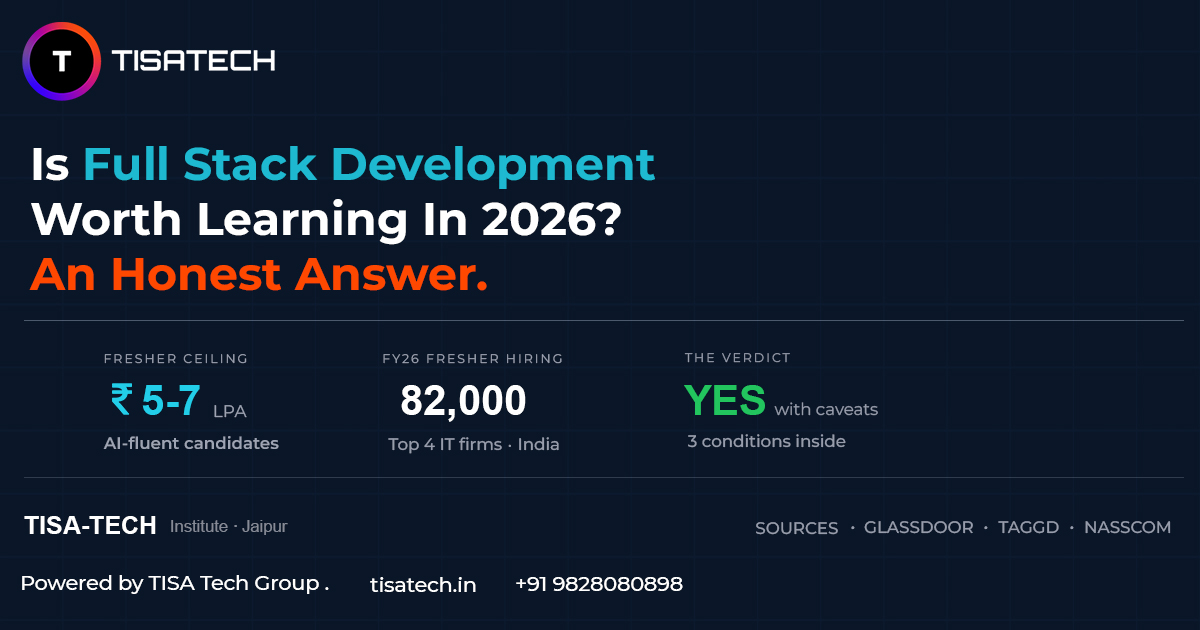
According to Taggd’s India Decoding Jobs 2026 report, the IT companies start hiring full stack developers. India’s top IT companies including TCS, Infosys, HCLTech and Wipro plan to hire around 82,000 graduates in FY2026. This shows the hiring market is recovering.
NASSCOM expects India’s tech industry to reach $300 billion by FY2026. It may reach $500 billion by 2030. This growth means more jobs in the coming years. The government is also investing in technology. The Union Budget 2025-26 allocated ₹2,000 crore for AI infrastructure. This will create more opportunities in software and AI jobs.
So the market is hiring again with higher expectations.
Five years ago, companies hired a fresher with a basic MERN stack project and decent communication skills could get a ₹3.5 LPA. But in 2026,competition for the same fresher has increased.
Freshers compete with candidates who:
- Use AI to build real world projects
- Deploy full apps on Vercel with CI/CD
- Contributed to a small open-source repository.
- Build AI-integrated projects like chatbots using the OpenAI API.
Companies still hire. They just hire differently. They look for practical skills and real experience. The market is not shrinking but becoming more competitive.
The AI-Fluent vs AI-Naive Gap Nobody Is Talking About
This is the single most important thing in this blog. Read it twice and carefully.
In 2026, two kinds of junior developers apply for the same jobs. One is AI-fluent. One is AI-naive. Guess who gets hired. Companies prefer the AI-fluent candidate.
AI-fluent developer
An AI-fluent developer uses AI tools everyday. They use AI tools like Cursor, Claude Code or Github Copilot while coding. They write clear prompts. They review AI-generated code carefully. They find coding issues or bugs that AI misses. They improve and modify the generated code. They build features faster. They know when to trust and double-check AI output. They also build applications using AI APIs. They integrate features like chatbots, automation, and smart search into projects. These developers treat AI as a productivity tool.
AI-naive developer
An AI-naive developer either avoids AI tools. Because they think “it will make them dependent”. Others copy AI-generated code without understanding it. They cannot debug AI-generated code. They struggle when something breaks. Many AI-naive developers have never built projects using AI APIs. They see AI as a threat instead of a tool. This limits their growth and reduces their chances of getting hired.
In 2026, companies and interviewers can identify differences within 15 minutes of an interview. AI-fluent candidates usually perform better and explain their projects clearly. They show how they used AI to improve productivity. The AI-fluent candidate gets a ₹5 to 7 LPA offer. AI-naive candidates struggle during interviews and get rejected. Others receive trainee roles with ₹15,000 per month stipends.
Both candidates may have similar resumes. But their skills have very different outcomes. This gap explains why some students say “full stack is dead” because they are AI-naive and getting rejected, while others get multiple offers because they are AI-fluent.
Your success depends on which group you join. This decision matters more than the tech stack you choose.
 Instagram Page
Full Stack Developer Salary in India for 2026 (Real Sources)
Here are the actual salary numbers for full stack developers. These numbers come from trusted platforms, not round guesses.
Glassdoor India, April 2026: Glassdoor reports a full stack developer’s average salary (source glassdoor) is ₹6,65,000 per year. This data comes from 9,741 salary reports.
Around 25% of developers earn ₹4.3 LPA or less. These are mostly freshers or junior developers.
Around 75% developers earn ₹11,75,000 LPA . These are mid level or experienced developers.
90% developers are top earners. They earn up to ₹20,30,000 per year.
AmbitionBox 2026: Average Full Stack Developer salary in India (source ambitionbox) is around ₹8.9 to 10.6 LPA based on 37,000+ self-reported numbers. This data includes developers with different levels of experience due to this its average data is higher.
Indeed India, April 2026: Indeed reports the average salary of a full stack developer (source glassdoor) is ₹3,65,411 per year. This data comes from 581 reports. This number is lower because many freshers report their salaries on Indeed. Entry-level salaries reduce the overall average.
By experience level (Logic mojo 2026 data): Experience plays an important role in salary growth.
- 0 to 2 years: ₹4 to 7 LPA
- 3 to 5 years: ₹8 to 15 LPA
- 5 plus years: ₹16 to 30 LPA
Fresher-specific numbers (WsCube Tech via AmbitionBox): Freshers with basic skills usually get ₹2.8 to ₹4.5 lakh per year. AI-fluent freshers with strong portfolios negotiate ₹5 to 7 LPA at startups.
By city (Glassdoor April 2026): Salary also varies by location. Developers in Bangalore earn around ₹8.75 LPA on average which is 32 percent higher than the national average.
Salaries in Mumbai and Hyderabad are also high and similar to Bangalore.
Pune salaries are slightly lower but still good.
Tier-2 cities like Jaipur, Indore and Coimbatore offer around ₹3.5 to 6 LPA for onsite roles.
By tech stack (2026 trend): Your tech stack also affects your salary. Developers with multiple skills earn more.
Developers who know JavaScript, TypeScript, Cloud and DevOps earn 25 to 40 percent more than pure frontend or backend specialists.
Freshers who know the combination of MERN, AWS and TypeScript get higher salaries.
Bottom line: Freshers with a strong GitHub and AI-fluency expect ₹5 to 7 LPA as a realistic starting point in 2026. If you have basic knowledge and weak projects your starting salary will likely stay between ₹3 to ₹4 LPA.
 Twitter (X) Page
Which Full Stack Should You Actually Learn in 2026?
This is where most blogs get lazy and say “learn MERN.” That advice is now five years old.
MERN (MongoDB, Express, React, Node.js) is still valid. But it is not the safest choice for Indian startup hiring in 2026. Startups now prefer newer tools and faster development stacks.
Let us look at what companies actually use in 2026.
The 2026 default stack for Indian startup hiring: Many Indian startups now use a modern JavaScript-based stack. This stack helps teams build products faster and scale easily.
- Frontend: Companies prefer Next.js with TypeScript. Next.js improves performance. TypeScript reduces bugs and improves code quality.
- Styling: Developers use Tailwind CSS. Many teams also use shadcn/ui for ready-made UI components. This speeds up UI development.
- Backend: Some teams use Next.js API routes. Some create a separate backend using Node.js and Express. Both approaches are common.
- Database: Startups prefer PostgreSQL instead of MongoDB. Many use managed services like Supabase or Neon. Developers often use Prisma ORM to simplify database queries.
- Authentication: Teams use Clerk or NextAuth for login system and security.
- Deployment: Startups deploy frontend apps on Vercel. They deploy backend services on Railway or Render. These platforms simplify deployment.
- AI integration: Many startups now add AI features. They use OpenAI API, Anthropic API, or open-source models through Ollama.
If you learn this stack, you can apply to almost any Indian startup posting on AngelList, Wellfound, Cutshort or Instahyre in 2026.
If you want to work at service companies (TCS, Infosys, Wipro, Accenture): Service companies still follow traditional stacks. Common stacks include:
- Stick with Java + Spring Boot + React or Angular
- Or Python + Django + React
These roles are more stable. They offer steady career growth. But salary growth is usually slower compared to startups.
If you want to work at product companies (Razorpay, Zerodha, Zomato, Cred): Product companies look for stronger engineering skills. To target product companies:
- Master the Next.js + Postgres + TypeScript stack
- Get strong on system design basics
- Build three production projects with deployment
The worst choice in 2026 is learning a stack with low job opportunities. PHP Laravel still has jobs. But demand is limited as compared to modern stacks. Ruby on Rails is basically low in demand in Indian hiring. Choose your stack based on hiring demand. In 2026, your stack choice directly affects your job opportunities.
Who Should NOT Learn Full Stack Development in 2026?
This is the section other blogs are scared to write about. Many blogs only talk about the benefits of full stack development but it is not a career for everyone.
Here are situations where full stack development may not be the right choice.
Do not learn full stack if you hate debugging. Full stack means constant problem solving. Things break often. APIs fail. CSS layouts break. Databases stop connecting. Deployment errors happen. You must enjoy fixing problems. If debugging frustrates you, this career may feel stressful and tiring.
Do not learn full stack if you refuse to use AI tools. AI tools are now part of development. Some students avoid AI. They want to code everything manually. But in 2026, companies prefer developers who use AI effectively. If you are not comfortable using AI tools, full stack development may not be the best fit.
Do not learn full stack if you want a 9-to-5 with fixed problems. Full stack development is not always predictable. Production issues can happen anytime. Deadlines can change. Clients can update requirements suddenly. Junior developers often handle urgent fixes. Sometimes teams work beyond normal hours. If you want a fixed and predictable schedule, this career may feel unstable.
Do not learn full stack if you are chasing the highest possible salary in the shortest possible time. Full stack development offers good salaries. But cloud engineers and AI engineers grow faster and reach ₹7 to ₹10 LPA. If your only goal is quick money, you may want to explore these roles. Choose a full stack only if you enjoy development work.
Do not learn full stack if you are not willing to build real projects. Full stack development requires hands-on practice. Watching tutorials is not enough. You must build real applications. If you will not build three to five real projects in your first year, this career will not work.
Do not learn full stack if you want guaranteed remote work immediately. Remote jobs exist for full stack developers. But companies usually prefer experienced developers for remote roles. Most freshers start with hybrid or office-based roles. This is common in cities like Jaipur and other tier-2 locations. Remote opportunities usually come after gaining experience.
If the above points match your situation, full stack development may not be a career path for you. Choose other tech career. The next section will help you explore those options.
 Facebook Page
Why is TISA-TECH the Right Place to Learn Full Stack in Jaipur?
If you have decided full stack is your path and you are in Jaipur, choosing the right institute matters. The wrong choice can waste months. You can save six months of confusion by learning it with us.
TISA-TECH is one of the best IT training institute in Jaipur. Our full stack developer course in Jaipur is designed for current hiring, not outdated.
What makes it different?
We teach the 2026 stack, not the 2021 stack: Many institutes still teach only MERN stack basics. But hiring needs have changed. At TISA-TECH you learn modern tools such as Next.js, TypeScript, Prisma, Postgres, Vercel and AI integration. Our curriculum is rebuilt every six months based on job descriptions from Naukri, Wellfound and Cutshort.
AI-fluency is part of the course: AI is now part of development. Companies expect developers to use AI tools. You learn to use Cursor, GitHub Copilot and Claude Code from week one. You graduate as an AI-fluent developer, which is what companies are filtering for.
You build five real projects, not one: Many courses focus on one final project. That is not enough in 2026. At TISA-Tech, you build five real projects. You deploy each project online. You use GitHub for version control. Recruiters can view your projects directly. This makes your portfolio stronger.
Placement support that works: We work with hiring partners. Over fifty companies interview our students directly. We do not promise unrealistic placement guarantees. Instead, we focus on skill building and real opportunities. We also track offer letters and interview results.
Pricing that fits Jaipur: We keep pricing transparent. We explain fees clearly. We also offer EMI options for students. There are no hidden charges.
You can attend a free demo class and visit the lab in person. There is no pressure to join. You can decide if the course is right for you.
Frequently Asked Questions ?
Yes. Top Indian IT companies plan to hire 82,000 graduates in FY2026 according to Taggd’s India Decoding Jobs 2026 report. Demand is strong but the skill expectations are higher. AI-fluent developers are getting hired. AI-naive ones are getting filtered out.
No, but it will replace developers who refuse to use AI. AI handles boilerplate, common patterns and repetitive tasks well. It cannot handle system design, client conversations, debugging complex production issues or making trade-offs under business constraints. Those will stay in human jobs past 2030.
No, it is evolving. The old “MERN and hope for the best” approach is dead. The new version involves AI-assisted development, modern stacks like Next.js and TypeScript, and cloud deployment skills. Developers who evolve are earning more than ever.
According to Glassdoor India April 2026 data, the 25th percentile starts at ₹4.3 LPA. AmbitionBox shows freshers earning ₹2.8 to 4.5 LPA for basic roles. AI-fluent freshers with strong portfolios negotiate ₹5 to 7 LPA at startups.
No. The job market is recovering. What matters more than when you start is how you learn. Students who only watch tutorials without building projects find it harder to get jobs. Students who build real projects, use AI tools fluently and deploy applications get hired within six to eight months.
Pick cloud if you like systems thinking, terminal work and higher fresher salaries. Pick full stack if you enjoy building complete products, UI design and user-facing work. Cloud engineers often start at ₹4 to 7 LPA as freshers with AWS certification. Full stack freshers usually start a bit lower unless they are AI-fluent.
AI writes code faster, but not always correctly. The code may look fine but can still have bugs, security issues, or poor design. A human developer must review and fix it before using it. In 2026, AI and humans together work better than either alone.
Full stack development is partly saturated at the junior level because many freshers claim skills but lack real project experience. However, there is no saturation for developers who are AI-fluent and can build and deploy real applications. Companies still prefer skilled candidates, so quality and practical experience matter most.
Six to eight months of focused learning if you follow a structured plan and build real projects. Twelve to eighteen months if you are self-learning without a clear roadmap. Two years or more if you are doing it part-time alongside college.
In some ways yes, in some ways no. The tools are better so shipping is faster. The ecosystem is more complex so there is more to learn. The interview bar is higher because competition is fiercer. Net effect: it takes similar time to get job-ready, but the expectations are higher.
Full stack has a lower barrier to entry and faster time to first job. AI engineering requires stronger math and takes longer to learn but has higher salaries. If you are a beginner starting from zero, full stack is the safer entry point. You can specialize in AI later.
Yes, if you are AI-fluent yourself. The threat is not AI. The threat is other AI-fluent candidates competing with you. Learn to use AI tools well, build three to five real projects, deploy them publicly and your fresher job search will take six to twelve weeks, not six to twelve months.
Final Word
Full stack development in 2026 is not a dying career. It is a changing career. Students who succeed in this field adapt quickly. They use AI as a teammate. They build real projects. They choose the right tech stack. They also stay updated with market needs.
Students who struggle follow the old mindset. They wait for confirmation that “AI has killed coding.” But that is not true. AI has not removed jobs. It has raised the skill bar.
If you are in Jaipur and you want structured guidance through this new landscape, come talk to us at TISA-TECH. The demo class is free and we will tell you honestly whether full stack is the right move for you. Sometimes we suggest cloud or AI instead. We focus on what fits the student, not what sells a course.
The tools have changed. The opportunity is still strong. You just need to learn the right way and start building.