A small business owner in Jaipur spent two years building blog content for her website. Rankings improved steadily and traffic grew month after month. Then AI Overviews started appearing on top of Google search results, and clicks began dropping without any warning.
This story is now playing out across thousands of websites. According to SparkToro’s 2026 zero-click search study, the share of Google searches ending without a single click has climbed sharply since 2024. And Similarweb data shows that when an AI Overview appears, roughly eight out of ten searches end without any click at all.
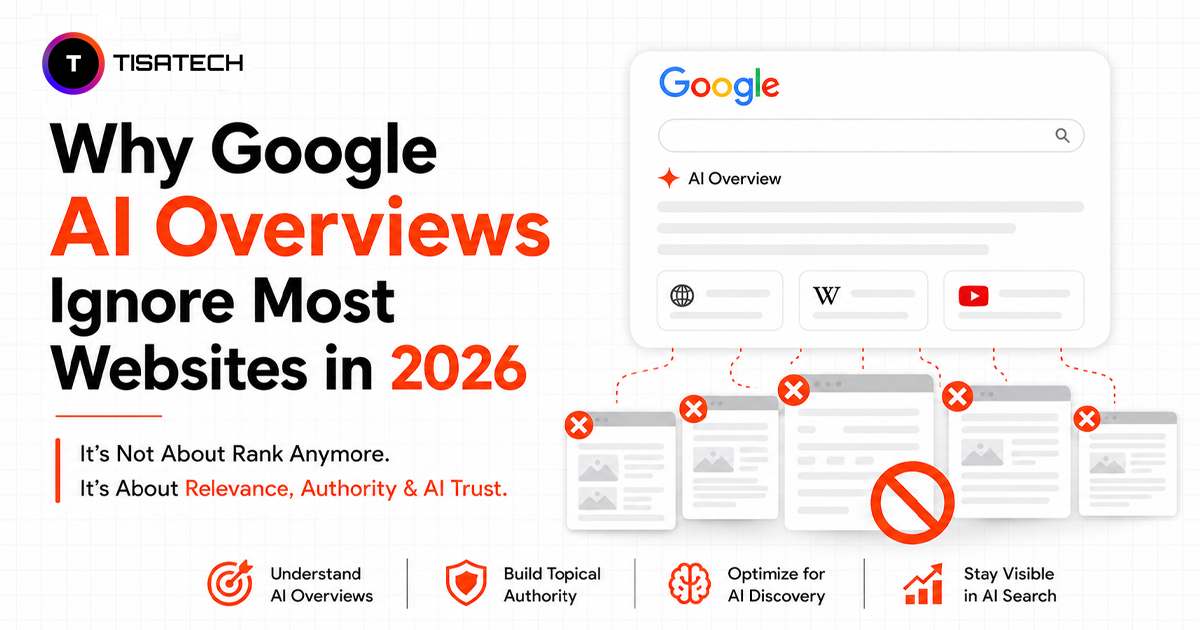
This trend shows why Google’s AI Overviews ignore most websites in 2026. Google doesn’t want to send users away from its results page anymore. Instead, it answers questions right there with an AI‑generated summary taken from a few trusted sources. That one change is quietly reshaping how websites get visibility this year.
Why Do Google AI Overviews Ignore Most Websites?
Google built AI Overviews to summarize answers directly on the results page instead of just showing a list of links. The system runs on Gemini and Google’s large AI model. It scans hundreds of pages for a single query, pulls out the strongest facts, and blends them into one clean answer.
Only a small number of sources make it into that final summary. Generic or average content gets skipped completely, even when it ranks on page one of traditional search. This is the core reason why Google AI Overviews ignore websites that depend purely on keyword based writing instead of original insight, clear structure, and real expertise.

What is the Zero-Click Reality Behind Google AI Overviews 2026?
The numbers clearly show how search behavior is changing. According to multiple independent studies, nearly 60% of Google searches ended without a click in 2026. When a Google AI Overview appears, that number rises to almost 80% because users find the information they need directly on the search results page.
Google’s newer AI Mode takes this even further. Some reports show the zero-click rate reaching close to 90%, as users get complete answers without needing to visit other websites.
This marks a major shift in how Google Search works. Websites can no longer rely on clicks alone. They need to create high-quality, trustworthy content that Google AI Overviews will reference and cite.
How Does Google AI Overview Select Websites?
This is the question most website owners actually want answered. Google AI Overview does not select websites based only on traditional search rankings. Instead, it uses a retrieval-based system to find the most relevant information from different indexed pages and combines it into one AI-generated answer.
A page ranking between position 4 and 20 can still be cited if it answers a specific question clearly, even if it is not the top-ranking result. This is how Google AI Overview selects websites in 2026. It looks for clear answers, trust signals, and content that can be safely used in a short summary.
Some Google AI Overview ranking factors are also important. A visible author, a publish date, trusted sources, and content that gives direct answers can increase the chances of getting cited. Ranking well in traditional search still helps, but ranking alone does not guarantee a place in Google AI Overviews.
AI Overview vs Traditional SEO: What Has Changed?
Traditional SEO had one simple goal, rank first for a keyword and get the click. AI Overview vs traditional SEO works differently now, because ranking and getting a visit are no longer the same thing. A page can appear inside an AI generated answer and still get very few clicks. Pew Research found that only about one percent of AI Overview views actually lead to a click on any source.
Internal links matter in a new way too. Earlier, they simply helped visitors move around a website. Now they also help Google understand how different pages on a site connect to the same topic. A group of well linked pages built around one subject shows real depth on that topic, and that depth is exactly what AI Overviews look for before picking a source to cite.
How to Get Featured in Google AI Overview?
Getting featured isn’t about shortcuts or tricks. Google wants content that answers the main question right away, usually in the first two or three lines, and then explains the details further down. Headings written as questions also help because they match the way people search.
Pages that share original data, real case studies, or genuine expert opinions stand out. These are things competitors can’t just copy. Publishing regularly on one topic builds authority, and over time Google’s AI learns to trust that depth.
So in 2026, the way to get featured in AI Overviews is simple: give clear answers up front, back them with real insights, and stay consistent within your topic. Backlinks and keyword volume alone won’t do the job anymore.





How TISA-TECH Helps Jaipur Keep Up With This AI Driven Search Era
Search is changing so fast that most businesses and students in Jaipur find it tough to keep up. The AI skill gap keeps growing, and those who understand AI, data science, and generative tools already have a big advantage. These skills decide how content is created and how Google’s AI Overview picks what to show.
That’s where TISA‑TECH in Jhotwara, Jaipur comes in. The institute focuses on industry‑relevant tech courses designed around real problems, not just theory. One of its standout programs is the AI‑integrated digital marketing course, which blends SEO, content planning, and social media with the smart use of AI tools. This gives students practical skills that companies actually look for today.
And it’s not just about learning. TISA‑TECH also provides placement support so students can turn their training into real career opportunities. For anyone in Jaipur who wants a future‑proof career in this AI‑driven search era, TISA‑TECH is a trusted place to start.
Conclusion
Google AI Overviews are changing the way people search, and this trend will continue in 2026. If you want your website to stay visible, focus on creating clear, helpful, and trustworthy content. Ranking high in search is still useful, but it is no longer enough. The goal now is to create content that Google AI Overviews can understand, trust, and cite.
Frequently Asked Questions
Ans. Google’s AI Overview system prioritizes accuracy and verified trust over ranking position alone, so most websites get bypassed unless their content is unusually clear, well sourced, and easy to extract.
Ans. Ranking and citation work as two different signals. A page can rank on page one of Google and still miss AI Overview citation if it lacks a direct answer, a visible author, or supporting data.
Ans. Yes, it still matters. Most cited sources already rank somewhere in traditional search results, so solid SEO fundamentals remain the foundation, even though ranking alone no longer guarantees visibility inside the summary.
Ans. There is no fixed timeline for this. Sites that consistently publish clear, well structured, and original content tend to see citations appear gradually over a period of a few months.
Ans. Yes, they can. AI Overviews often cite pages ranking between position four and twenty, which gives smaller and more focused websites a genuine chance against much larger competitors.