Imagine you have just completed your B.Tech or BCA from a college in Jaipur. You know the basics of programming. You feel confident that a job is waiting for you.
Then the recruiter asks: “Do you have any cloud skills?”
That single question changes everything for thousands of students every year.
The global cloud computing market crossed $917 billion in 2026 and is growing rapidly. According to the Synergy Research Group Q1 2026 report (via Quantumrun), AWS holds 30% of the market, Azure 25%, and Google Cloud 13%. Together they control nearly 68% of enterprise cloud spending. At the same time, NASSCOM reports that India will need 14 million cloud professionals by 2026, but the current supply is far lower.
This gap is your opportunity.
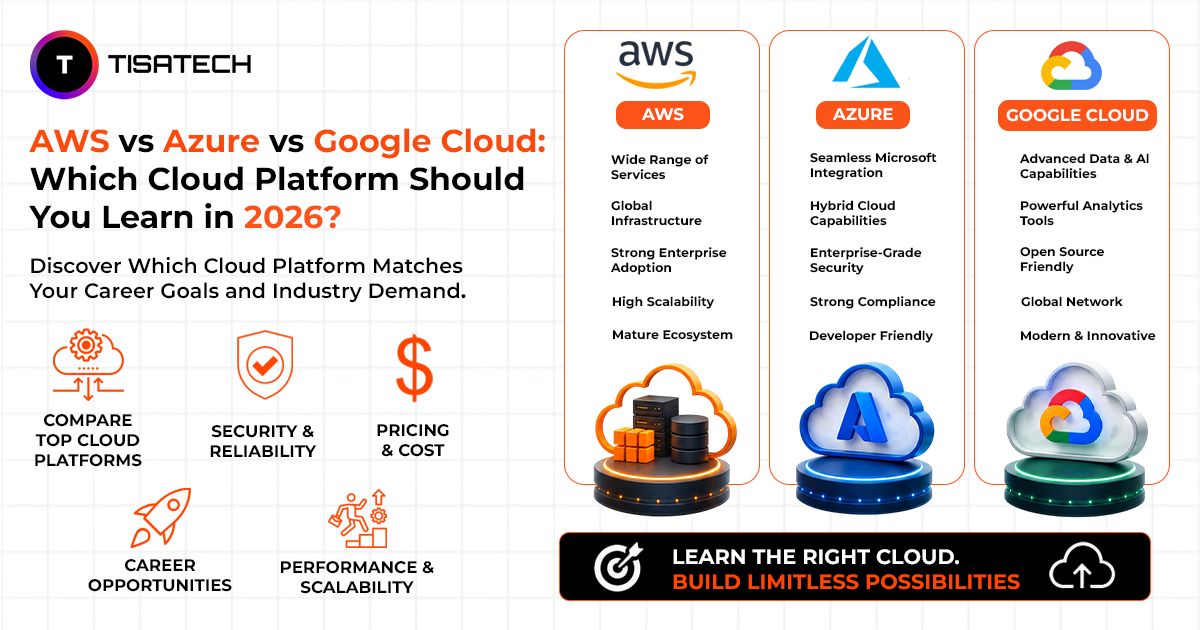
Whether you are a fresher, a final‑year student, or someone switching careers, now is the right time to learn cloud computing. The real question in 2026 is: which cloud platform should you learn – AWS, Azure, or Google Cloud?
This article gives you a clear answer. We will compare all three platforms from a career perspective: jobs, salaries, ease of learning, and growth opportunities, with simple guidance for students in Jaipur and across Rajasthan.
AWS vs Azure vs Google Cloud in 2026: A Quick Overview
Before we talk about career guidance, let’s quickly see what each platform is and why it matters.
Amazon Web Services (AWS) started in 2006 and basically created the cloud computing market. It’s the largest platform in the world with more than 200 services. Think of it as the safest and most widely used option. Almost every startup, e‑commerce company, and tech firm uses AWS in some way. (Source: DigitalOcean Cloud Comparison 2026)
Microsoft Azure came in 2010 with a clear focus on serving companies already using Microsoft tools like Windows Server, Office 365, and SQL Server. Today, Azure powers 85% of Fortune 500 companies, as noted in the axis‑intelligence.com report. If a business runs on Microsoft products, chances are it also runs on Azure.
Google Cloud Platform (GCP) entered in 2011. It’s built on the same infrastructure that powers Google Search and YouTube. Its biggest strength lies in AI, machine learning, and big data. Tools like BigQuery and Vertex AI are highlighted in industry reports as some of the best in the field.

Here is a simple comparison table to make things easier:
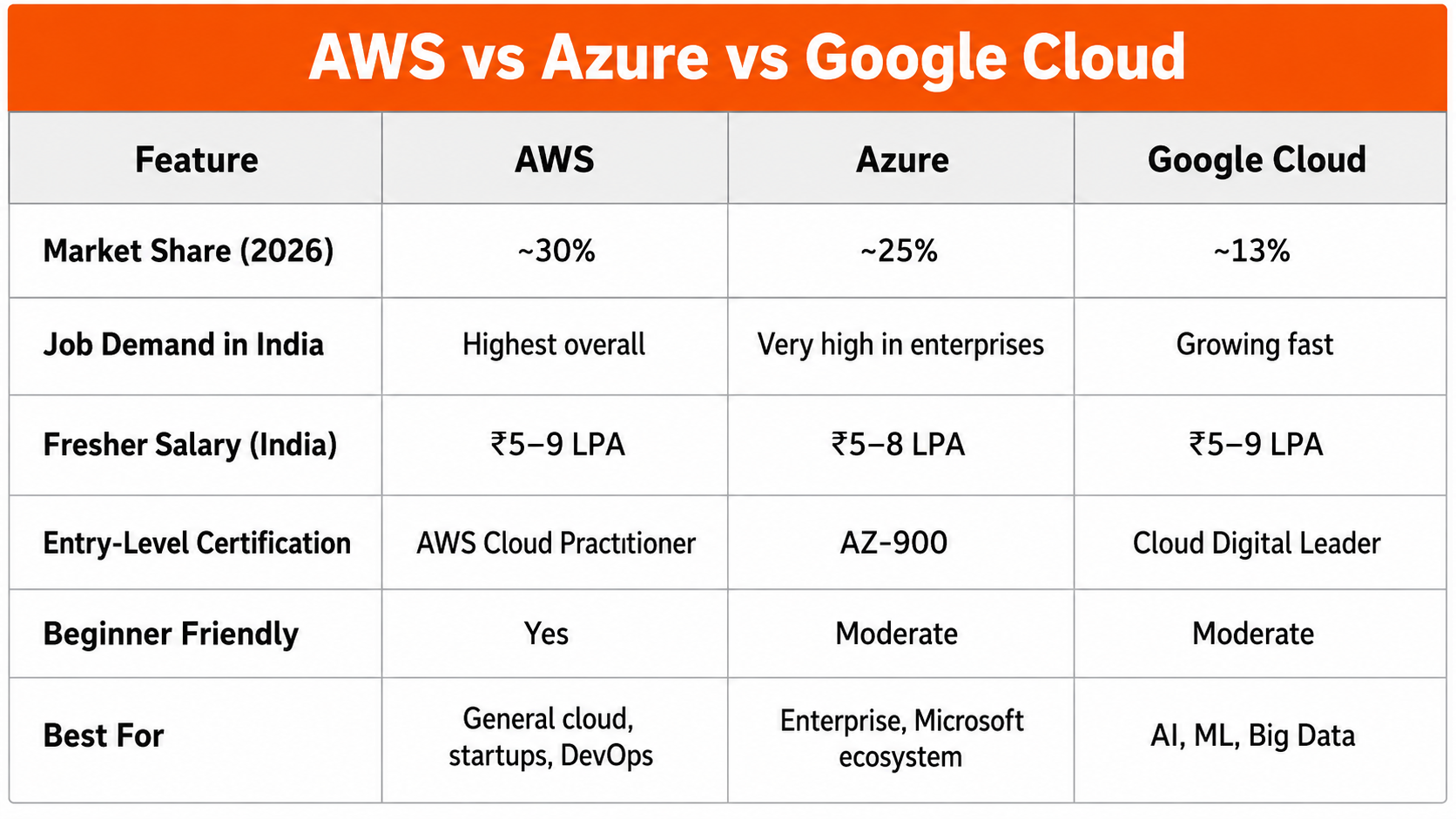
Each platform has its own edge – AWS leads the market, Azure rules the enterprise world, and Google Cloud stands out in AI and data. Next, let’s see which one fits your career goals in 2026.
Which Platform Is Best for Beginners in 2026?
This is a common and fair question. If you are just starting out you want something simple to learn.
AWS wins here for most people. The names are clear, the documentation is rich and the community is huge. You can open a free account and start practicing within hours. Most YouTube tutorials, free courses and books are written for AWS which makes it the most comfortable starting point.
Azure is a good choice if you already work with Windows, PowerShell or Microsoft tools. Many students in Jaipur with a background in .NET or Windows Server find Azure easier to relate to. But for someone starting fresh it can feel a bit overwhelming at first.
Google Cloud has a clean modern interface and solid documentation. In some ways it’s easier but because the community is smaller than AWS finding help can take more effort. GCP is ideal if you already have an interest in data science or AI.
For freshers in India the recommendation is clear: start with AWS. It has the most resources, the most job postings and the easiest learning curve for beginners. The smart way to begin is by choosing a good IT training institute that guides you step by step from basics to real projects.
AWS vs Azure vs GCP: Career and Job Demand in India
Let’s talk about jobs because that is what really matters when you are learning a new skill.
AWS leads in overall job volume. There are more than 35,000 active AWS cloud job postings in Bangalore alone.
Azure follows with around 22,000 postings in the same city.
Google Cloud sits at around 12,000 but those jobs tend to be more specialized and better paid.
For Jaipur, the job market is picking up fast. Local companies, IT service firms and startups are actively hiring cloud professionals. Many Jaipur students get placed in Bangalore, Hyderabad, Pune and Delhi NCR, all strong cloud hubs.
Here’s how the industry breaks down:
- AWS is the go to for startups, e‑commerce companies and product firms. Skills here open doors at Amazon, Flipkart and growing startups.
- Azure dominates banking, insurance, government and large IT service companies. TCS, Infosys, Wipro and Accenture all have massive Azure practices.
- Google Cloud is strong in AI and data engineering. If you’re into machine learning, data pipelines or analytics, GCP gives you an edge. Salaries here have spiked 25% year over year in India as Google pushes into the startup ecosystem.
When thinking about AWS vs Azure vs Google Cloud for career, your industry preference matters most. But for maximum job options right now, AWS is still the safest bet.
AWS vs Azure vs GCP Salary in 2026 – Comparison for Indian Freshers
Let us talk numbers because this is what everyone wants to know.
According to multiple salary reports and job market data, here is what you can realistically expect in 2026:
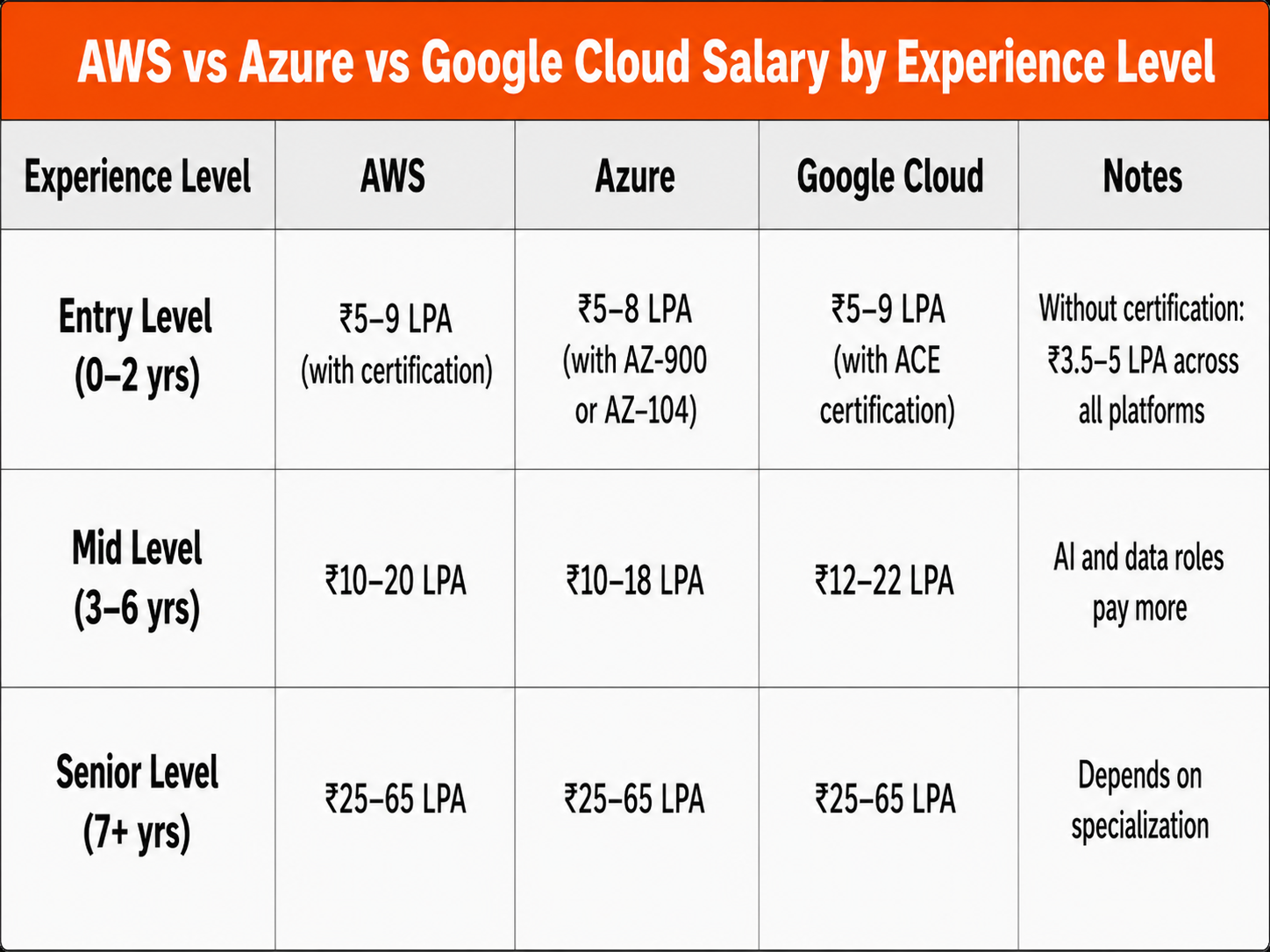
At the fresher level salaries are almost equal. The big difference shows up at mid and senior levels, especially if you specialize in AI, DevOps or cloud security. Adding AI and machine learning skills can boost pay by 30-60% compared to standard cloud engineers.
Certifications matter. A fresher with AWS Cloud Practitioner or Azure AZ‑900 can earn ₹1-2 LPA more than someone with the same skills but no certification.
Cloud Computing Skills to Adopt in 2026
Knowing which platform to learn is just the first step. These are the skills that actually get you hired:
- Networking Basics : Learn how VPCs, subnets, firewalls and load balancers work. This applies to all platforms.
- Linux Command Line : Most cloud servers run on Linux. Without basic terminal commands, you will struggle.
- Infrastructure as Code (IaC) : Tools like Terraform and AWS CloudFormation let you set up cloud environments using code. Very high demand skill.
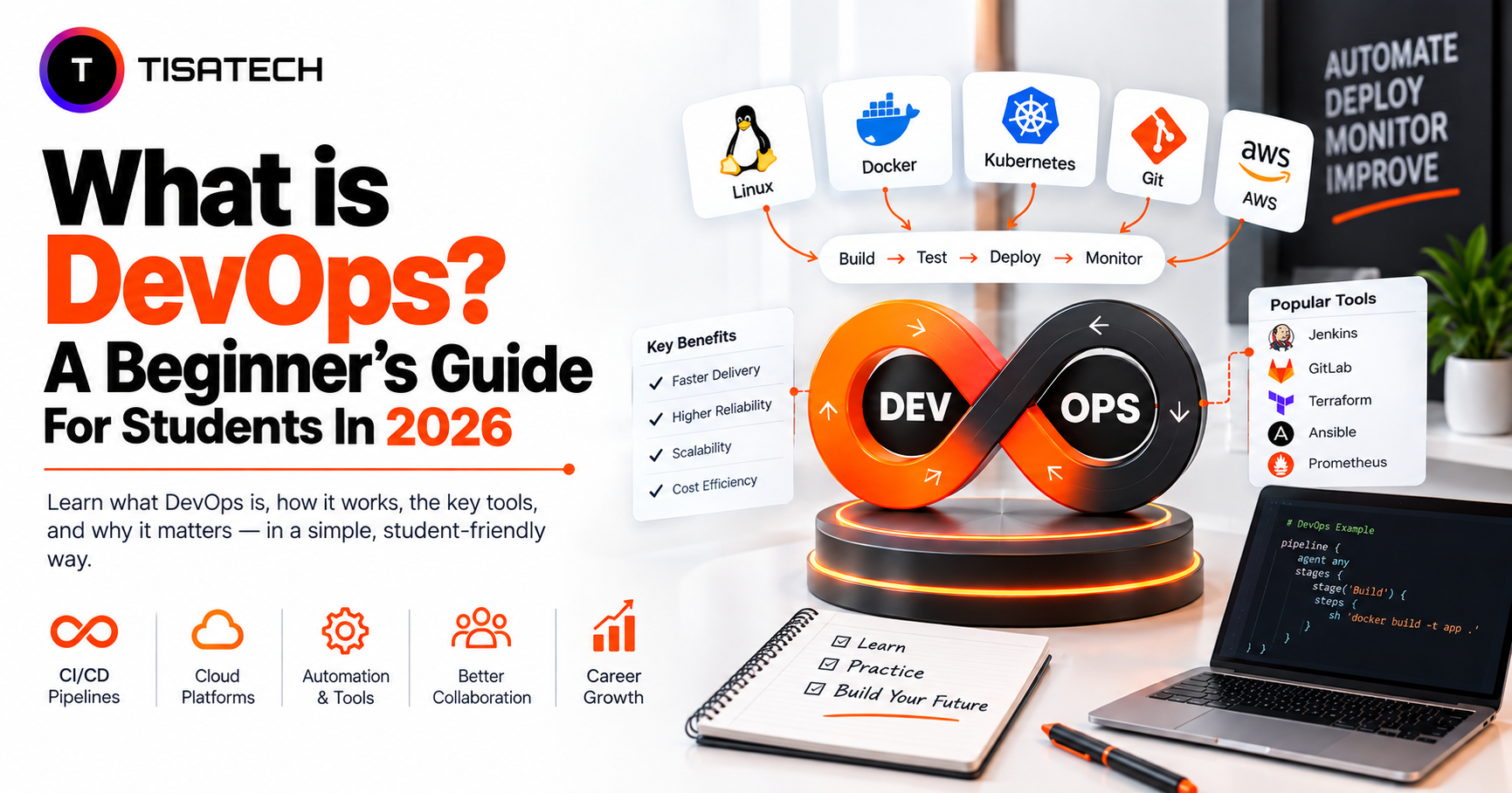
- Docker and Kubernetes : Containers are everywhere. Knowing how to package and run apps in containers is a must in 2026.
- Cloud Security : Every company cares about data safety. Security skills can add 20–40% to your salary.
- DevOps Practices : CI/CD pipelines, automation and continuous deployment are expected from most engineers.
- AI/ML Integration : Even if you are not a data scientist, knowing how to deploy AI models on AWS SageMaker, Azure ML or GCP Vertex AI makes you far more valuable.
Start with one platform, get certified at the foundation level, and then build hands-on projects. Real projects beat theory every single time in interviews.





TISA-TECH: Learn Cloud Computing in Jhotwara, Jaipur
If you are from Jaipur and want to build a cloud career, you don’t need to move to Bangalore. TISA‑TECH in Jhotwara gives you the same quality training right here.
Students and freshers can start from zero and grow step by step. The focus is on real skills, not just theory. You learn AWS, Azure and Google Cloud directly from professionals who have worked on real projects.
You also get an internship where you practice cloud infrastructure in a real environment. This is important because employers in 2026 want candidates with hands-on project experience. The internship gives you tasks, tools and a project you can proudly show on your resume.
The cloud computing course in Jaipur covers Linux, networking, DevOps, Docker, Kubernetes, Terraform and cloud security. These are the skills companies ask for. The training is simple to follow, even for beginners, and builds confidence step by step. You can also explore the cloud roadmap to see how the program prepares you for future roles.
So if you are in Jaipur and thinking about where to start your cloud journey, TISA‑TECH Jhotwara is a smart choice. It is practical, career focused and designed to make you job ready.
Conclusion
If you are starting fresh in 2026 the easiest and most practical choice is AWS. It has the biggest community, plenty of tutorials and the highest number of job opportunities in India. Azure works well if you already use Microsoft tools or plan to work in corporate IT while Google Cloud is great for those interested in data science and AI. The truth is whichever platform you pick the key is to begin. Once you learn one, moving to another becomes much easier. The cloud market in India is growing fast, companies are hiring and now is the right time to take that first step.
FAQs Section
Ans. Start with AWS. It has the biggest community, beginner‑friendly tutorials and the most job postings. The Cloud Practitioner exam is made for freshers and gives a solid base.
Ans. Yes. The market is huge and India needs millions of professionals. With certification, freshers earn ₹5–9 LPA and the demand is only growing.
Ans. AWS is easiest for beginners because of resources and support. Azure feels natural if you already use Microsoft tools. Google Cloud is clean and strong for AI but has fewer tutorials.
Ans. For basic exams like AWS Cloud Practitioner or Azure AZ‑900, 4–6 weeks of study is enough. Associate level usually takes 8–12 weeks.
Ans. Definitely. Most jobs are in Bangalore, Hyderabad, Pune and Delhi NCR. With certification and hands-on projects from institutes like TISA‑TECH Jhotwara, Jaipur students are getting placed in top companies across India.
Ans. Focus on one first. Once you gain experience and certification, learning another becomes easier and adds more value.