For decades, companies followed the same process to build software: hire developers, wait for development, and pay for every new feature or change. Low-code development is now changing that process fast.
The numbers show how quickly this shift is growing. The global low-code and no-code market is expected to reach around $65 billion in 2026, with annual growth above 26%, according to ToolJet’s 2026 market report. Companies across Asia Pacific are also adopting these tools quickly. In India, many businesses now build simple internal tools themselves instead of outsourcing every small task, according to Kissflow’s 2026 no-code statistics report.
For years, teams kept small requests like approval forms, internal dashboards, and tracking tools in development backlogs because developers had bigger priorities. Low-code and no-code platforms now help teams build many of these tools faster.
This creates an important question for developers in Jaipur: are these tools replacing traditional development, or are they helping developers build and deliver software faster?

What Are Low-Code and No-Code and Why Are They Growing So Fast?
Low-code and no-code are development approaches that help people build apps with less manual coding.
- Low-code still uses some coding, but developers rely more on drag-and-drop components, ready-made blocks, and visual workflows.
- No-code needs little or no coding and is mainly designed for non-technical users who want to create simple apps or tools.
They are growing fast because companies can build forms, dashboards, approval systems, and internal apps much faster than before. These tools also reduce the workload on developers for smaller tasks and help teams launch simple solutions quickly. Platforms like Microsoft Power Apps, Bubble, and OutSystems are common examples.
Will Low-Code Replace Developers?
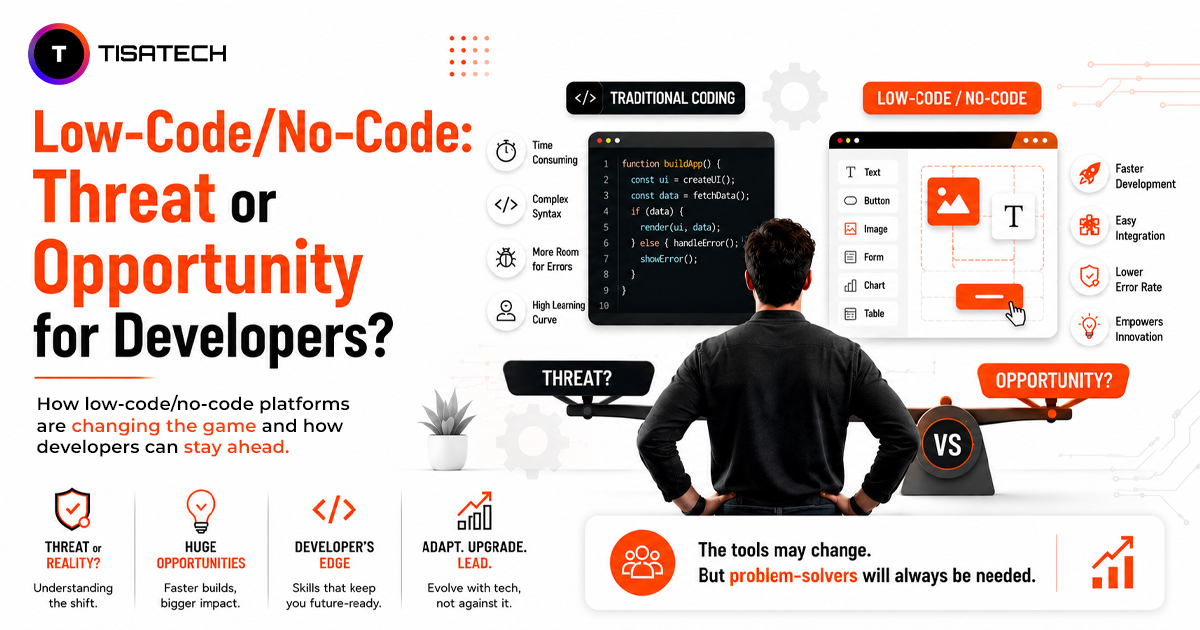
No, low-code will not completely replace developers. It will mainly change how developers work by reducing simple and repetitive coding tasks.
Low-code works well for basic apps, forms, dashboards, approval systems, and internal tools. These platforms can help teams build faster, but developers are still needed for complex business logic, security, custom features, integrations, system architecture, and performance.
The bigger change is in the type of work developers do. Instead of spending time on every small task, developers can use low-code tools for routine work and focus more on complex problems and important technical decisions.
Large applications with heavy traffic, sensitive data, or complex workflows still need strong technical skills. So low-code is more likely to make developers faster and change their role than replace them completely.
Where Does Low-Code And No-Code Actually Help Developers?
Low-code and no-code tools help developers by reducing simple and repetitive work. Basic forms, dashboards, user interfaces, and standard workflows can be built faster without writing the same code again and again.
This saves time during development and helps projects move faster. Developers can spend less time on routine setup and more time on work that needs deeper technical skills, such as security, system architecture, integrations, performance, and custom features.
These tools also help with small internal requests. For example, a business team may need a simple approval form or tracking tool. Instead of waiting for a developer, they can create it with a no-code platform. This reduces the number of small tasks in the developer backlog.
So, low-code and no-code work best as support tools for developers. They make routine work faster and give developers more time to focus on complex and valuable parts of a project.
Where Does Low-Code And No-Code Fail Without a Developer?
Low-code and no-code tools work well for simple apps and standard workflows, but they have clear limits. These limits become more visible when a project needs custom features, strong security, better performance, or more control.
Customization can become difficult when a business needs something unique that the platform does not support. Performance can also drop when traffic or data grows. In such cases, developers may need to optimize the system or rebuild important parts with custom code.
Security is another major concern. Non-technical users can miss important settings or safe coding practices, which may create data or access risks. Platform lock-in can also become a problem because moving data and logic to another system later may take more time and technical effort.
So, low-code works best for simple and repeatable tasks. For complex, secure, scalable, or highly customized applications, developers are still essential.
Should Developers Learn Low-Code, and What Skills Matter Most?
Yes, developers should learn low-code because it adds another useful skill to their existing development knowledge. It can help them build simple apps, forms, dashboards, and workflows faster without replacing traditional coding.
At the same time, developers need more than low-code knowledge. Skills like system design, security, APIs, integrations, and problem-solving are becoming more important because low-code platforms cannot handle every complex requirement on their own.
The best approach is to combine both. Developers can use low-code for quick and repetitive tasks, then use custom coding for complex logic, security, performance, and deeper integrations. This balance makes them more flexible and better prepared for modern development projects.
Best Low-Code Platforms 2026 You Should Know About
Different low-code platforms solve different types of problems. Some work better for enterprise apps, while others are better for internal tools, workflows, or startup projects.
- Microsoft Power Apps: Works well for businesses already using Microsoft 365, Teams, or other Microsoft tools. It helps teams build business apps and automate simple processes.
- Mendix: Useful for teams building larger business applications. It also supports collaboration between developers and business teams.
- OutSystems: A strong option for enterprise applications that need better control, security, and scalability.
- Appian: Mainly used for workflow automation and business process management. It suits companies that want to automate repeated internal processes.
- Retool: Helps developers build internal tools, dashboards, and admin panels without creating everything from scratch.
- Bubble: Popular for web apps, MVPs, and startup projects where teams want to build and test ideas with less coding.
Developers do not need to learn all of these platforms. Choosing one or two based on the type of projects they work on is a better way to start.





Where Can Jaipur Developers Build These Future-Ready Skills?
TISA-TECH in Jhotwara helps Jaipur developers strengthen their coding basics while also learning modern low-code tools. Students learn low-code along with system design, APIs, security, and other important development concepts.
The training includes practical projects where students understand when low-code can save time and when custom coding is the better choice. Mentors also review their work, point out mistakes, and guide them on how to improve their development skills.
For students looking for learning coding with placement support, TISA-TECH also provides career guidance and job preparation. It is a trustworthy IT training institute in Jaipur for students who want practical skills that can help them prepare for development careers.
Final Thoughts
Low-code is more of an opportunity than a threat for developers. It reduces repetitive work and helps developers focus more on complex problems, custom features, security, and system design.
It does not replace strong coding skills. Instead, it adds another useful way to build software faster. Developers who understand both traditional coding and low-code tools can handle more types of projects and adapt more easily to changing industry needs.
The best approach is simple: use low-code where it saves time, and keep core development skills strong for work that needs deeper technical knowledge.
FAQs Section
Ans. No. Low-code changes how some development tasks are handled, but skilled developers are still needed for complex logic, security, integrations, and large systems.
Ans. Yes. Low-code adds another useful skill. It helps developers work faster and handle simple tasks without reducing the value of traditional coding knowledge.
Ans. Popular options include Microsoft Power Apps, Mendix, OutSystems, Appian, Retool, and Bubble. Each platform works better for different project needs.
Ans. Yes. Many low-code and no-code platforms are designed for people with little or no coding experience. Basic technical knowledge still helps when projects become more complex.