Imagine an app that starts with just a few features, such as payments, search, orders, and notifications. Developers keep adding more features, and soon managing everything in one place gets harder. A change in one part can also break something else entirely. Microservices fix this by splitting the application into smaller, independent services.
Netflix and Uber show what this looks like at a massive scale. Netflix runs 1,000+ independent services and pushes out updates hundreds of times a day while serving more than 230 million people worldwide. Uber cut its feature integration time from around 3 days to about 3 hours after switching to microservices, scaling up to around 2,200 critical services along the way.
Microservices have moved well beyond a handful of large tech companies now. Nearly half of backend developers work with microservices in some form in 2026, and cloud-native tools now sit at the center of how most software teams build things. IT companies and startups in Jaipur are catching on to this too, faster than most people expect.
This guide breaks down microservices in simple language and walks through how they work and when to actually use them.

What is Microservices Architecture in 2026?
Microservices architecture is a way of building an app as many small parts instead of one big block. Each part handles one job, runs on its own, and can be built, tested, and updated without changing the others.
Think of it like this. In old-style apps, called monolithic apps, everything sits inside one big system. Login, payment, search, and notifications are all connected. If one part breaks, it can affect the whole app.
With microservices, each function becomes its own separate service. The login service handles login, the payment service handles payments, and the search service handles search. These services communicate with each other over the internet using simple rules called APIs. By 2026, most teams will also pair this setup with lightweight AI-driven tools that watch individual services and flag issues before they spread.
Microservices architecture is not a single tool or product. It is a design style for splitting software into smaller, independent services so the application can stay fast and stable while growing with higher traffic and larger teams.
How Does Microservices Architecture Work?
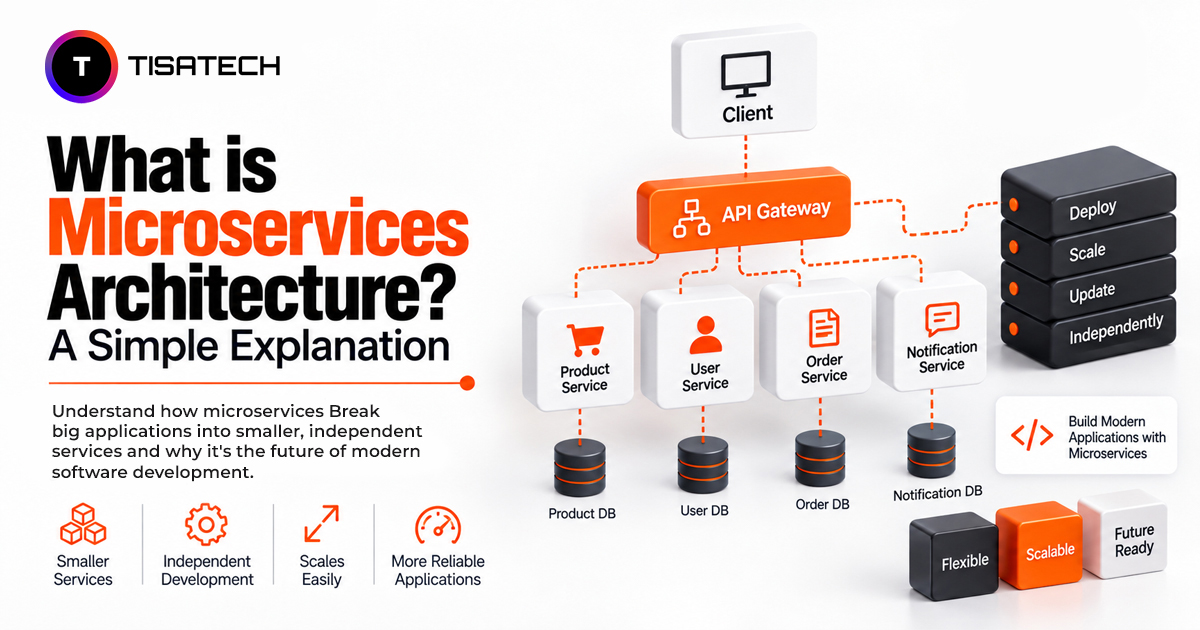
In microservices architecture, each service handles a specific job and stores its own data. When a user makes a request, the API Gateway receives it first. The gateway identifies the right service and sends the request there.
User Request → API Gateway → Required Service → Service Communication → Response
Take a food delivery app as an example. When a user places an order, the Order Service confirms the item and price. It then sends the required information to the restaurant and delivery services so the order can be prepared and assigned to a rider.
Because each service works independently, a temporary slowdown in the Delivery Service does not necessarily affect the Order or Payment Service. After completing its task, a service can either send a response directly or pass information to another service. All of this happens in the background, so the user sees one smooth app.
Teams also use tools like Docker and Kubernetes to package each service and make it easier to run in different environments. Many companies in 2026 also use established microservices architecture patterns instead of building everything from scratch, which can help save time and avoid common mistakes.
What Are the Main Components of Microservices Architecture?
A microservices setup has a few common building blocks. Understanding these components makes it easier to see how the whole system works.
1. Individual Services
Each service handles one specific business task, such as managing orders or user profiles. It usually has its own database, so one service does not directly interfere with another service’s data.
2. API Gateway
The API Gateway acts as the front door of the system. It receives requests from the app or website and sends them to the right service. It can also handle security checks and traffic control.
3. Service Discovery
With many services running at the same time, one service needs to find where another service runs. Service discovery keeps track of these locations so services can find and communicate with each other without hardcoded addresses.
4. Message Queue or Event Bus
A message queue or event bus lets services share updates without waiting for a direct response. For example, once the Order Service places an order, it can notify another service without making the user wait.
5. Monitoring and Logging
With many services working together, teams need to know what is happening inside each one. Monitoring and logging help them track service activity and spot problems early, often through automated tools that flag issues on their own.
What is the Difference Between Monolithic and Microservices Architecture?
The key difference is how an application organizes its features and services. Here’s a quick comparison:
| Factor | Monolithic Architecture | Microservices Architecture |
|---|---|---|
| Structure & Data | All features work as one unit and share the same codebase and database. | The application uses independent services, with each service handling its own function and data. |
| Development & Updates | A small change usually requires testing and redeploying the whole application. | Developers can update or fix individual services without affecting the rest. |
| Scaling | The entire application scales together. | Developers can scale individual services based on their needs. |
| Reliability | A problem in one feature can affect the entire application. | Each service keeps problems more isolated from the rest of the application. |
| Management | The simpler structure makes it easier to manage small applications. | Multiple services require more planning, coordination, and tools. |
| Best Fit | Small applications and teams often start with this approach. | Larger applications may use it when different features need independent development and scaling. |
Neither approach fits every project. Small teams may start with a monolith for simplicity, while growing products may consider microservices vs monolithic architecture. Some companies that adopted microservices too early later moved services back into larger units because of the added complexity.
What Are the Benefits of Microservices Architecture?
Microservices offer several practical benefits as an application grows:
- Independent Scaling: During a festival sale, the search service may receive much more traffic than other parts of the app. Developers can add resources to that service without changing the rest of the application, which can save time and server costs.
- Better Reliability: A failure in one service does not necessarily bring down the entire application. Users can still log in, browse products, or check their order history while that service is unavailable.
- Faster Releases: Since services work independently, developers can update and deploy one service without waiting for other teams to finish their work. This also helps them fix issues faster.
- Technology Freedom: Different services can use different technologies based on their needs. For example, one team can use Python, another Java, and another Node.js.
- Easier Team Management: Separate teams can build and release their own services without interfering with each other’s work. AI-assisted coding tools in 2026 have made this workflow smoother.
What Are the Challenges of Microservices Architecture?
Microservices can make applications easier to scale, but they also bring some challenges.
The first is complexity. Instead of managing one application, teams may need to manage dozens or even hundreds of services. They also need to keep track of different versions and connections between them.
Another challenge is network trouble. Services communicate over a network, so delays or dropped connections can slow down the application. A single request may also need to pass through several services before it is completed.
Data management can also become harder. Each service may have its own database, so teams need to carefully manage data consistency across the application, especially with a database per microservice approach.
The learning curve can be another issue for smaller teams. Setting up an API Gateway in microservices, service discovery, and monitoring tools requires the right skills and experience.
For these reasons, teams should adopt microservices with a clear plan rather than choosing them simply because they sound modern.
When Should You Use Microservices Architecture?
Not every project needs microservices from the start. The right choice depends on the size of your product, team, and application.
For a new, small app with a small team, a simple, well-organized monolith usually makes more sense. It is easier to build and test without adding complex infrastructure from day one.
You should consider microservices when your product starts growing. This can happen when:
- Your user base grows quickly and the application needs to handle much more traffic.
- Multiple teams work on different features of the same application and need to develop and release their parts independently.
- Different parts of the app need different levels of scaling. For example, a video streaming feature may need far more resources than a simple settings page.
Large ecommerce, banking, food delivery, and streaming platforms often reach this stage because their traffic and features become too large to manage comfortably as one codebase.





Learn Microservices Architecture with TISA-TECH
If you want to move beyond the theory and actually understand how microservices fit into real applications, practical training gives you the chance to work with these concepts directly. TISA-TECH in Jaipur offers a full stack development course, along with courses in Cloud Computing and AI, with a focus on hands-on, project-based learning.
As part of the training, students work on projects where they use APIs, Docker, and microservices to understand how different services communicate and work together. This practical experience helps them connect the concepts they learn with the way modern applications are actually developed.
For students in Jaipur who want to strengthen their development skills, this kind of project-based learning can make concepts like microservices easier to understand and apply in real applications.
Conclusion
Microservices is not something you need to choose simply because it is widely used in modern software. The more important question is whether it fits the application you are building and the way your team works. A clear understanding of the architecture helps developers make that decision with more confidence instead of following a fixed approach for every project.
For students and developers, microservices is also a useful concept to add to their software development knowledge as they move toward building larger and more complex applications.
FAQs Section
Ans. Yes. Different services can use different programming languages according to their requirements. For example, one service can use Python while another uses Java or Node.js.
Ans. Service discovery helps services find each other without relying on fixed addresses. It keeps track of available services and supports communication as the application grows.
Ans. In many cases, yes. Developers can create a separate service for a specific function and connect it with existing services through APIs or other communication methods.
Ans. Monitoring and logging help developers see what happens inside individual services. They can use this information to identify errors, track service activity, and find problems more quickly.
Ans. No. Microservices can provide useful advantages, but they also introduce additional complexity. The architecture should match the application’s actual requirements.
Ans. Yes. TISA-TECH’s Full Stack Development course gives students practical exposure to APIs, Docker, and microservices through project-based learning. This helps students understand how these concepts fit into real application development.