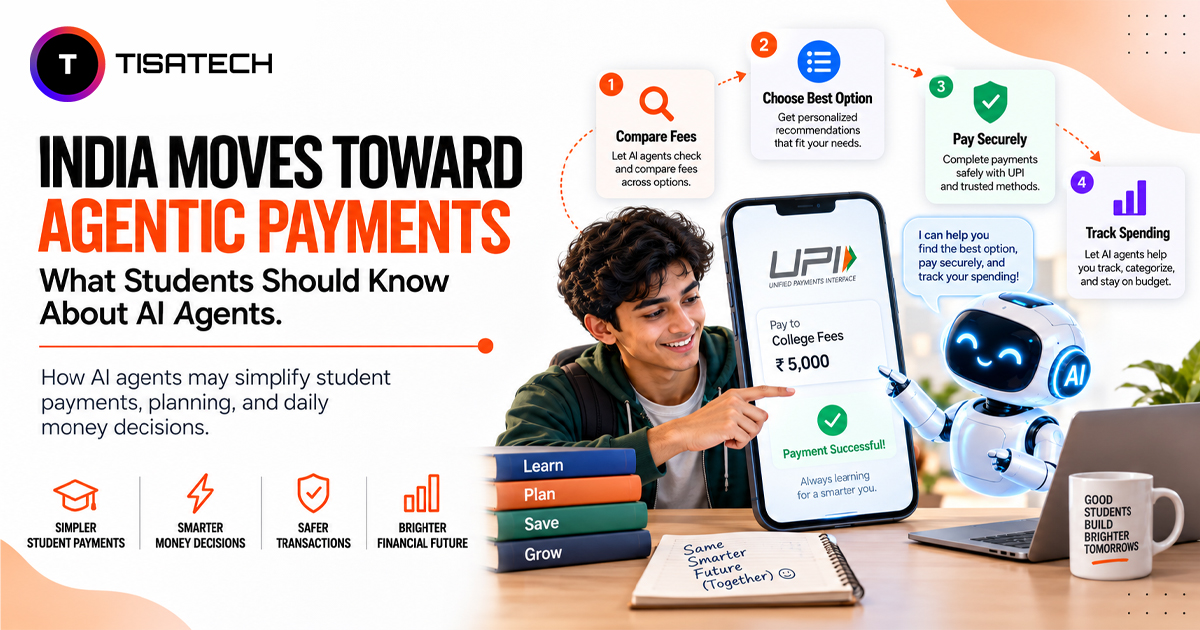
Students in Jaipur regularly manage mobile recharges, Netflix subscriptions, and metro top-ups. Although each payment takes only a few taps, repeating these tasks every month can become a hassle. AI agents could simplify this process by handling routine payments within spending limits users set.
India’s UPI ecosystem already handles payments at a massive scale. According to NPCI’s UPI data reported by Medianama, UPI recorded 24.51 billion transactions worth ₹29.82 lakh crore in August 2026, with around 22% year-on-year growth. However, digital payments also bring security concerns. Government data reported ₹805 crore in UPI fraud across 10.64 lakh incidents until November of FY26, while a LocalCircles survey found that one in five UPI-using families experienced fraud at least once in three years, and more than half of victims did not report it.
These risks make secure payment automation important. Instead of approving every transaction manually, users could allow AI agents to handle routine payments according to predefined rules. Unusual or high-value payments could still require user approval, helping users maintain control over their spending.
India’s interest in agentic payments grew through developments discussed at the Global Fintech Fest in Mumbai in September 2026. As the country explores this technology, students need to understand how AI agents work with UPI, the proposed payment infrastructure, and the security challenges involved. This article explains these developments and the technical skills students can develop for the future of AI and fintech.

What Are Agentic Payments and Why is India Excited?
Let’s start with a simple example. An AI agent is software that completes tasks for you instead of only answering questions. A chatbot may tell you which train is cheapest, while an AI agent can book the ticket for you.
Agentic payments use the same idea for money. You set a rule, and the agent makes payments within that limit. For example, you can ask it to pay your hostel mess bill every month as long as the amount stays below ₹4,000. The agent checks the bill and completes the payment without requiring you to open the app every time.
This makes agentic payments different from AutoPay. AutoPay repeats a fixed payment to a specific merchant. An AI agent can compare options, make decisions, and complete payments based on the limits you set. The agent handles the task, but you remain in control.
India’s UPI system makes this idea especially interesting. UPI already connects hundreds of millions of people through a widely used payment network. If AI agents work with UPI, users may access automated payments without downloading a new app or learning a completely different system.
How Do AI Agents Make Payments Without You?
Many people think an AI agent needs your UPI PIN to make payments. It doesn’t. The system works without giving the agent access to your PIN.
It uses two existing UPI features. The first is UPI Circle, which allows a primary account holder to give a secondary user spending permission. Banks currently set the limit at around ₹15,000 per month. This feature was designed for families, but a verified AI agent could also receive this permission.
The second is Reserve Pay. It allows you to set aside a fixed amount for future payments to a merchant. The limit is around ₹10,000 for 90 days. Your money stays in your account but remains reserved until the agent uses it.
Together, these features let you approve a specific amount and set payment conditions in advance. The agent can spend only from that approved amount and cannot access your remaining balance. If something goes wrong, the spending limit helps control your loss.
A registry adds another layer of security. Only registered and verified agents can request payments, and every transaction creates an audit record.
What is NPCI’s Unified Agent Protocol?
The Unified Agent Protocol, or UAP, is a set of rules for AI agents that make digital payments in India. NPCI has been developing it since mid-2026 with banks and fintech companies. Business Standard reported on the proposed protocol in July 2026.
UAP has three main jobs. It registers AI agents, checks whether payment requests come from genuine registered agents, and keeps payment records to help resolve disputes later.
However, NPCI will not see what you buy. Its role is to check whether the agent is trusted and follows the payment rules. Your shopping details will not be shared with a government system through this process.
AI agents can come from different platforms. They might work inside a shopping app, PhonePe, Paytm, ChatGPT, Claude, or a dedicated AI agent platform. UAP does not focus on who built the agent. It checks whether the agent is registered and whether the payment follows your instructions.
If UAP becomes operational, India could become one of the first countries to build national infrastructure for AI-driven payments.
Why Did the Launch Slow Down in September 2026?
UAP was expected to launch at the Global Fintech Fest in Mumbai from 8 to 11 September 2026. However, NPCI delayed the launch while waiting for Reserve Bank of India (RBI) approval and completing its safety framework.
The delay highlights an important concern. When AI agents make payments without approval for every transaction, fraud can become harder to prevent. Responsibility is also unclear. If someone tricks an AI agent into paying a scammer, who will return the money? Will it be the user, the bank, or the company that built the agent?
Despite the delay, other products launched at the event. RBI Governor Sanjay Malhotra introduced MyUPI, which shows UPI transactions and AutoPay mandates from different banks and apps in one place. He also launched UPI Tap & Pay. NPCI introduced two agentic platforms, AiNxt and AtOM. AtOM stands for Agentic Orchestration and Messaging and creates signed audit trails across the ecosystem. Medianama published a roundup of the GFF 2026 launches.
India is continuing to build the infrastructure for AI-powered payments, but UAP still needs regulatory approval and safety preparations before its launch.
How Will AI Agents Work with UPI in Daily Student Life?
AI agents can help students manage small, regular payments that are easy to forget. For example, your mobile recharge expires on the 12th, your OTT subscription renews on the 15th, and your coaching fee instalment is due on the 20th. Your metro pass may also need a recharge.
You can set a monthly spending limit of ₹3,000 and choose the merchants the agent can pay. The agent can then handle your recharge, subscription renewal, and metro pass top-up on time.
However, the agent should not handle every payment. Buying a new phone, booking a concert ticket, sending money to a friend, or transferring money to an unknown UPI ID should require your approval and PIN. You decide where to set these limits, and setting them carefully is important.
Agentic commerce in India is already developing. Amazon Pay uses a smart wallet for flight bookings, while PayU has introduced an AI agent store for small businesses.
Who Else is Building Agentic Commerce in India?
NPCI is not the only company working on agentic commerce in India. Pine Labs launched P3P in June 2026 and calls it India’s first agentic payment protocol built on UPI. It is already running in production. In 2025, Razorpay ran a pilot with NPCI and OpenAI to test ChatGPT-driven payments through UPI Circle and Reserve Pay. In February 2026, Mastercard demonstrated India’s first authenticated agentic transaction with Axis Bank and RBL Bank at the India AI Impact Summit.
Global companies are also developing their own payment protocols. Visa built the Trusted Agent Protocol, Mastercard built Agent Pay, and Google announced the Agent Payments Protocol. NPCI has also developed the RuPay Agentic Protocol for its card network. Forkast News covered India’s role in this development and the proposed NPCI protocol.
The main difference is that card networks are adding AI agent features to existing payment systems, while India is developing its national payment infrastructure to support agents. This creates new development work for Indian developers.
Are Agentic Payments Safe for a Student Wallet?
Agentic payments are only as safe as the limits you set and the agent you choose.
These payments offer several protections. Your money stays blocked instead of transferring immediately. Spending caps control how much the agent can use. Only registered agents can make payments, and every transaction creates a record. Existing UPI safeguards, such as device binding, also protect your payments.
However, risks still exist. Software can have bugs, and attackers can manipulate poorly built agents through hidden instructions in webpages or product listings. Researchers call this prompt injection. Fake apps can also pretend to be genuine AI agents.
Follow four safety habits. Start with a small spending limit and allow only merchants you trust. Check the agent’s transaction log once a week, which MyUPI makes easier. Never allow an agent to send money to individuals.
Treat an agent like a junior assistant with a small petty cash box, not a manager with access to your entire salary.
What Skills Should Students Build Right Now?
The growth of agentic payments will create new job opportunities. Companies will need developers to build these agents, secure them, and connect them to banking systems.
Students should focus on these key skill areas:
- AI Agents: Understand how AI agents reason and take action. Start by reading about AI agents before writing code.
- Backend Development and API Integration: Learn how payment systems use APIs to process transactions under strict rules. Start by understanding how APIs work .
- Python for AI Development: Learn Python for AI development and build small projects that connect to real services.
- Payment Rules and Compliance: Understand UPI Circle, Reserve Pay, and RBI compliance. Developers should learn both AI technology and fintech regulations to work on payment systems effectively.





How TISA-TECH Helps Students Prepare for the Agentic Era
TISA-TECH focuses on helping students build practical skills, not just earn certificates that sit in a folder. The rise of agentic payments shows why these skills matter. Knowing what UAP stands for is not enough. Employers need people who can build and deliver working solutions.
TISA-TECH courses focus on hands-on learning. Students start with programming fundamentals and gradually work on real projects where their code connects with live services, handles errors, and follows set limits. Students interested in fintech and automation can learn AI and software development through guided project tracks. Beginners can also learn coding online for free before choosing a course.
The teaching approach stays simple. Mentors explain concepts in clear, easy-to-understand language. Students can also explore AI development tutorials at their own pace.
The goal is simple: when agentic payments become widely available across India, TISA-TECH students should be ready to build AI agents, not just use them.
Conclusion
India is preparing its public payment system for AI agents, even as many countries are still developing the rules. UPI Circle and Reserve Pay provide safety measures, while the Unified Agent Protocol aims to build trust between AI agents and payment systems. RBI clearance remains an important step before its launch.
Students should start with small payments, such as recharges and subscriptions, keep spending limits low, and check transaction logs regularly. Those interested in agentic payments should also learn the technology behind these systems and develop the skills to build them. The UPI PIN is not disappearing anytime soon, but AI agents could reduce how often users need to enter it for everyday payments.
FAQs Section
Ans. Agentic payments allow an AI assistant to make payments on your behalf within the spending limits and rules you set. You approve the rules in advance instead of approving every transaction.
Ans. UPI AutoPay repeats a fixed payment to a specific merchant. An AI agent can compare options and make decisions within your approved limits, making it more flexible but also introducing additional risks.
Ans. Not yet. NPCI delayed the launch in September 2026 while waiting for RBI approval and completing its safety framework.
Ans. No. AI agents use delegation and pre-blocked funds through systems such as UPI Circle and Reserve Pay. Your UPI PIN stays with you.
Ans. Liability rules are still being finalised. Until clear rules are published, keep spending limits low and allow the agent to pay only trusted merchants.
Ans. Yes. Students interested in this field should learn Python, APIs, security, and AI agent development to understand and build AI-powered payment systems.