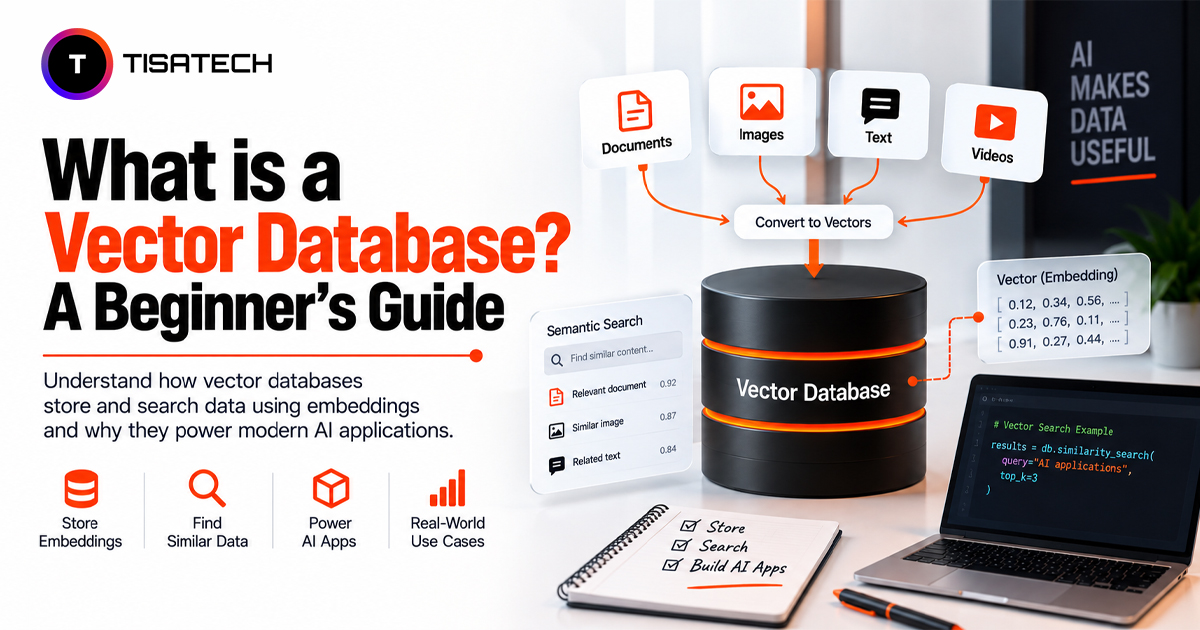
Job portals in Jaipur stay full of listings, yet finding the right match often means scrolling past hundreds of resumes that don’t fit. A recruiter searching for “Python developer with cloud experience” gets flooded with people who used that exact phrase, while a resume saying “Built and deployed FastAPI services on AWS” never shows up even though it’s a perfect match. The words differ, so a normal search misses it.
A vector database fixes this problem. It stores data as numbers, called vectors, and finds results by matching meaning instead of matching exact words. This one idea powers semantic search, recommendation systems, image search, and Retrieval-Augmented Generation (RAG) , four skills that keep showing up in AI job postings across Jaipur today.
The demand behind this is real and measurable. Vector databases were worth around USD 3.0 billion in 2025 and are expected to cross USD 21 billion by 2036, growing at close to 19% every year, according to Meticulous Research. That growth explains why recruiters, chatbots, and search tools across Jaipur are moving away from exact-word matching and toward meaning-based matching.

What is a Vector Database?
A vector database stores data as vectors, which are ordered lists of numbers. When you convert a sentence, image, or audio clip into a vector, those numbers capture important patterns and features from the data. For text, they represent meaning and context, not just the exact words used.
When you search a vector database, it doesn’t look for exact keyword matches. Instead, it compares vectors and finds the ones that are closest to each other. Vectors with similar meanings tend to be close together, while different meanings sit farther apart.
Think of each word or sentence as a dot on a map, with its position based on meaning. “Doctor” and “physician” would land close together, while “doctor” and “banana” would land far apart. A vector database builds this map and finds the dots closest to whatever you search for.
Real-world embeddings can have hundreds or thousands of dimensions; 768, 1024, or 1536 are common, depending on the model. The basic idea stays the same: vectors that sit closer together generally represent greater similarity.
This approach supports AI applications such as semantic search, recommendation systems, and image search, where matching meaning or content matters more than matching exact words.
How Does a Vector Database Work?
A vector database turns raw data into vectors and uses them to find similar information. It follows a few basic steps to turn your data into searchable vectors and return relevant matches.
Step 1: An embedding model converts your data into vectors.
The process starts with an embedding model. The data could be text, an image, or audio. The model converts it into a list of numbers called an embedding.
Step 2: The database stores the vectors.
Once the model creates the vectors, the database stores them. Each vector represents patterns and features from the original data. Similar data tends to produce vectors that sit closer together.
Step 3: The database compares vector similarity.
When you search, the system converts your query into a vector and compares it with the stored vectors. It then returns the closest matches.
Step 4: An index speeds up the search.
Instead of comparing your query against every stored vector one by one, the database uses indexing methods such as HNSW and IVF to find likely matches faster. HNSW works like a shortcut map that skips unlikely matches instead of checking every single vector, while IVF first groups similar vectors into clusters and then searches only the clusters most likely to contain a match. This lets a database holding millions of resumes or product listings return a match in a fraction of a second instead of scanning every entry one by one.
What Are Vector Embeddings?
Vector embeddings are lists of numbers that capture the meaning and context of data. A machine learning model converts text, images, or other data into these numbers so a system can compare their meaning.
For example, the embeddings for “king” and “queen” tend to sit close together because the two words share related meaning. “Banana” would produce a very different embedding.
The same idea helps a system understand that “Recover a forgotten password” and “Reset your account credentials” carry similar meaning, even though they use different words, something a plain keyword search would miss entirely.
What is Vector Similarity Search?
A vector similarity search finds the vectors that are most similar to your query. Instead of looking for exact keywords, it finds stored data with a similar meaning.
Vector databases measure similarity using methods such as:
- Cosine similarity: compares the direction of two vectors and works well for text.
- Euclidean distance: measures the straight-line distance between two vectors and suits spatial or image data.
- Dot product: compares both the direction and magnitude of vectors.
For example, a semantic search engine can recognize that “cheap flights to Jaipur” and “budget airfare to Jaipur” have similar meanings, even though they use different words.
Vector Database vs Traditional Database: Key Differences
Traditional databases such as MySQL and PostgreSQL store structured data and retrieve it using exact values and relationships. They handle customer records, transactions, inventory, and employee data well.
Vector databases handle a different kind of search. They store data as numerical representations called vectors or embeddings and use them to find content with similar meaning. This makes them useful for searching text, images, audio, and other unstructured data.
Here are the key differences:
| Feature | Traditional Database | Vector Database |
|---|---|---|
| Data Type | Structured tables, rows, numbers | Unstructured text, images, audio, video |
| Query Method | Exact matches, SQL, keyword search | Similarity search based on meaning |
| Primary Use | Transaction processing, record keeping | AI memory, recommendations, semantic search |
| Best Fit For | Orders, payments, employee records | Chatbots, search engines, recommendation systems |
You don’t have to choose one over the other. Many AI applications use both. For example, a RAG chatbot can store user accounts and chat history in a traditional database while using a vector database to store document embeddings and find relevant content.
Popular Vector Databases Worth Knowing
The right vector database depends on what you are building and whether you need it for production or a learning project.
- Pinecone: If a team wants to launch without managing servers or infrastructure, Pinecone fits that need. It is a fully managed, cloud-hosted option that handles the backend work.
- Milvus: Teams that expect large-scale, high-volume search often use Milvus. It is an open-source database built to handle heavy workloads.
- Weaviate: When a search needs to combine keywords with meaning in the same query, Weaviate supports that use case. It is open-source and has hybrid search built in.
- Chroma: Students and smaller projects rarely need that scale at the start. Chroma works well for local development and prototypes without extra setup, making it a common starting point.
- Qdrant: For something closer to production speed while staying lightweight, Qdrant runs on Rust and focuses on fast search with a simple API.
- pgvector: If a project already uses PostgreSQL, pgvector adds vector search directly to the same database. This removes the need to adopt a separate system just for embeddings.
Seeing how one of these works in a live setup makes the idea easier to understand than reading definitions. Pinecone’s documentation is a good place to see a production vector database in action.
Why AI Applications Rely on Vector Databases
AI applications often need to understand the meaning and context of data, not just match exact words. Vector databases support this by storing embeddings and finding semantically similar data. Here are some common use cases:
a. Semantic search: Helps users find relevant documents, articles, or products even when they use different words from the original content. Companies use it for product search, internal knowledge bases, and document retrieval.
b. Retrieval-Augmented Generation (RAG): Uses vector databases to retrieve relevant information before an AI model generates an answer. A company can store its documents as embeddings. When a user asks a question, the system finds the relevant document sections and provides them to the AI model as context. Learn more about RAG.
c. Recommendation systems: Compare users, products, articles, or other items based on their characteristics and past interactions. They use these similarities to generate relevant recommendations.
d. Multimodal search: Connects different types of data through embeddings. A user can enter a product description and find matching images, or upload an image and find visually similar products.
When Should You Use a Vector Database?
Use a vector database when your application needs to find information based on meaning or similarity instead of exact words.
For example, a chatbot can use it to find answers from your own documents. A search system can use it to understand natural-language queries instead of exact phrases. A recommendation system can use it to find similar products, articles, or content. Image or audio search can also use it to find similar content instead of matching a filename or tag.
You may not need a vector database when your application only works with exact information, such as order IDs, invoice numbers, customer records, or transaction details. A traditional database handles these searches just fine.





How TISA-TECH Helps Students Learn Vector Databases and AI
Vector databases become easier to understand when students see how they fit into an AI application. A typical project connects Python, embeddings, a vector database, and a language model to retrieve relevant information before generating an answer. This helps students see how concepts such as semantic search and RAG work together in an actual application.
TISA-TECH gives students mentor-led reviews at each stage of these projects, helping them catch mistakes in the retrieval pipeline or embedding setup early instead of finding them at the end. This hands-on approach to AI and machine learning courses is part of how TISA-TECH supports practical learning, along with placement support that helps students connect their completed projects with hiring opportunities in Jaipur’s AI job market.
Conclusion
A vector database lets applications search by meaning rather than exact words. It stores data as embeddings and uses similarity search to find the most relevant matches, making it useful for AI applications such as RAG chatbots, semantic search, and recommendation systems.
For students learning AI, understanding embeddings, vector similarity, and how they work together in a vector database builds a practical foundation for building these applications. Start with embeddings and similarity search, then apply them in a small project such as a document-based RAG chatbot or semantic search tool.
FAQs Section
Ans. No. You need to know how to use an embedding model, not how to build one. Most beginners use ready-made models, such as those from OpenAI, so you don’t need deep ML knowledge. Basic Python and API skills are enough.
Ans. Chroma is an easy starting point because it is built for local development and needs almost no setup. Once a project is ready for production, Pinecone or Qdrant can be good next steps.
Ans. No. They do different jobs. A vector database handles meaning-based searches, while SQL works well for exact records such as orders, users, or transactions. Most real projects use both together.
Ans. You can understand the basics of embeddings and similarity search in a weekend. Building a small RAG chatbot project usually takes 1–2 weeks if you already know Python.
Ans. It’s becoming a fast-growing skill in Jaipur’s AI and data job market, especially for RAG and chatbot-based projects. Adding it to a resume can help differentiate your skills.
Ans. Basic Python and a general understanding of embeddings are enough to get started. You don’t need advanced math or a deep learning background.