A few years ago, Machine Learning was considered a complex field that required advanced programming skills and a strong technical background. For most beginners, it often felt difficult to enter.
Today, things are very different.
Someone who wants to build a movie recommendation system, predict house prices, or create an AI chatbot can start learning from home with just a laptop and the right guidance. One of the biggest reasons behind this change is Python.
Python has become the most popular programming language for Machine Learning because it is easy to learn, beginner-friendly, and supported by powerful libraries such as NumPy, Pandas, Scikit-learn, TensorFlow, and PyTorch. These tools make it easier to build real-world AI applications without dealing with unnecessary complexity.
The demand for these skills is growing rapidly. According to the World Economic Forum’s Future of Jobs Report 2025, AI and Big Data are the fastest-growing skill areas globally, while AI and Machine Learning Specialists are among the fastest-growing job roles through 2030.
As businesses continue investing in AI-powered technologies, professionals with Python and Machine Learning skills are becoming increasingly valuable. The good news is that you do not need years of coding experience to get started. With the right roadmap and consistent practice, anyone can begin their journey.
This guide will show you exactly what to learn, which tools to use, and how to build practical Machine Learning skills with Python in 2026.

What Does “Python for Machine Learning” Actually Mean?
Python for machine learning means using Python to build systems that learn from data. Python is just a programming language. Machine learning is a way where computers find patterns instead of following fixed rules.
Think of it like cooking. Machine learning is the dish. Python is your kitchen and tools. You write code in Python, feed data, and the program learns to make predictions. That could be spotting spam emails, guessing house prices, or recognizing faces.
So when someone says they want to learn Python for machine learning, they mean learning how to use Python’s libraries and tools to create smart, data-driven programs. It’s not about general coding or web development, but about building intelligent systems with Python.
Why Python is the First Choice for Machine Learning in 2026
Python is popular for ML because it’s simple and clear. The code looks almost like English. For example: if score > 50: print(“pass”). Even beginners can understand this. You spend less time on syntax and more time learning how ML works.
Python also has ready-made tools. You don’t need to write tough math formulas yourself. That’s why Python machine learning for beginners is searched so much. Beginners can quickly build models and test ideas.
The community is huge. If you get stuck, you’ll find answers online easily. And in 2026, almost all big AI tools use Python first. Hugging Face, LangChain, and libraries behind ChatGPT-style apps are built with Python. So if you want to grow in AI, learning ML with Python is the smartest step.
How to Learn Python for Machine Learning: Step by Step
A lot of people ask how to learn Python for machine learning without getting lost. Here is the honest order that actually works.
Step 1: Start with Python basics.
Even if it feels boring at first just stick with it. Spend four to six weeks on variables, loops, functions, lists and dictionaries. Write small programs every day. Take some input, do a calculation, show a result. That is all you need at this stage.
Step 2: Get comfortable with data structures and basic math.
Machine learning is mostly data work so you need to handle data well. Along with this, pick up some simple math. Mean, standard deviation, basic probability. Nothing complicated. Just enough to know what is happening in your code.
Step 3: Learn to work with real data.
Load a CSV file. Clean the messy parts. Plot a simple chart. This step is more important than it sounds because in real projects most of your time goes into preparing data not writing models.
Step 4: Understand core ML concepts.
Learn what regression and classification mean. Understand the difference between training data and testing data. Then train your first simple model. Just one. Nothing fancy.
Step 5: Build real projects.
This is the step most people skip and it is also the most important one. Watching tutorials will only take you so far. Building something on your own is what makes everything actually stick.
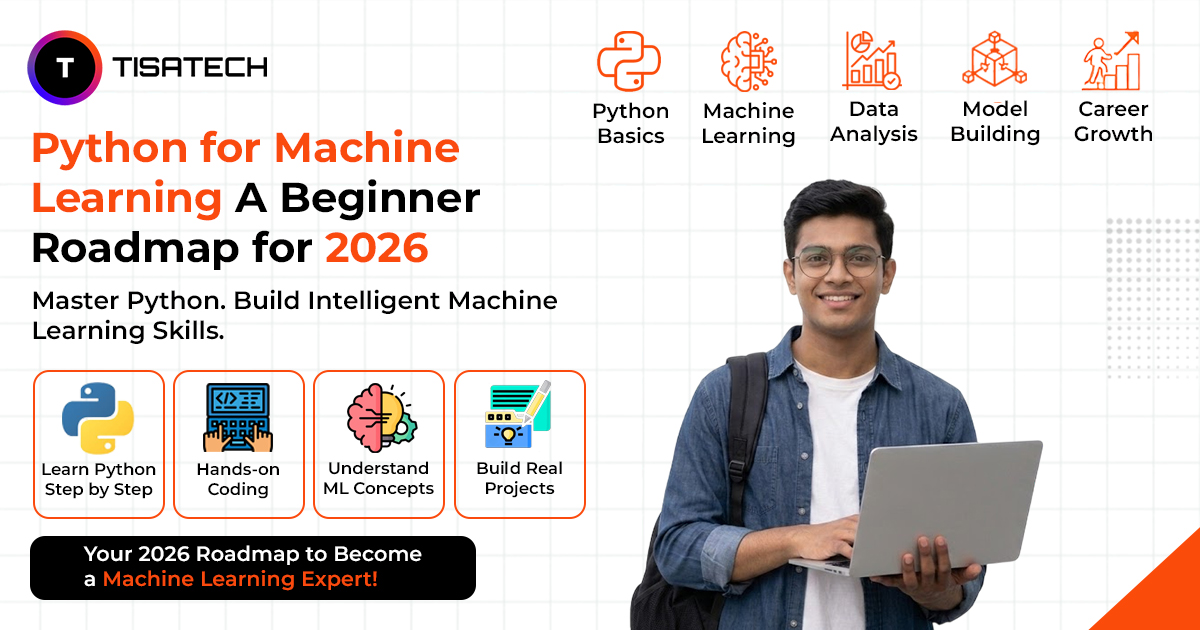
Follow this order and you have a complete Python machine learning roadmap for beginners that you can finish in three to six months.
Which Python Libraries You Should Learn for Machine Learning in 2026
A lot of beginners feel overwhelmed because there are hundreds of Python libraries out there. But honestly you only need a few to get started.
NumPy is the first one to learn. It handles numbers and arrays and almost every other ML library runs on it in the background.
Pandas is your go-to for data work. You use it to load files, fix missing values and get your dataset ready before any training happens. Most beginners spend the majority of their first few projects just inside Pandas.
Matplotlib and Seaborn help you visualize your data through charts. This matters more than people think because charts often show patterns that raw numbers never will.
Scikit-learn is where you actually start doing machine learning. It already has all the basic algorithms built in so you do not have to write everything from scratch. Just this one library is enough to keep a beginner busy for months.
Once you are comfortable with these four you can move into TensorFlow or PyTorch for deep learning. But for now Scikit-learn, Pandas and NumPy will cover almost everything you need.
A Simple 6 Month Machine Learning Roadmap for 2026
Want to start machine learning with Python but not sure where to begin? Here is a simple roadmap that works.
Months 1 and 2: Learn Python basics.
Spend these two months only on Python. Write small programs every day. Keep it simple and just focus on getting comfortable with the language.
Month 3: Learn to work with data.
This is where you learn Pandas, NumPy and how to make basic charts. Find some messy datasets online and practice cleaning them. You learn more from messy data than perfect data.
Month 4: Start machine learning.
Now open Scikit-learn and start building basic models. Learn regression, classification and how to check if your model is working. This is where it gets exciting.
Month 5: Build projects.
Stop watching tutorials and start building. Make three to four small projects using real datasets from Kaggle. This one step will teach you more than months of theory.
Month 6: Clean up and put it online.
Fix up your projects and upload them to GitHub. Now you have real work to show when applying for jobs or internships.
This roadmap is kept simple on purpose. Most people do not fail because the topic is hard. They fail because they keep switching between courses and never finish anything.





Start Your Python and Machine Learning Journey with TISA-TECH
Learning Python and machine learning alone is possible. But without proper guidance most people waste months and still feel stuck.
TISA-TECH is Jaipur’s leading AI-powered IT training institute with a centre in Jhotwara. Every course is built around what companies are hiring for right now. No old content. No unnecessary theory.
The Python and ML course starts from zero and takes you all the way to building real machine learning models. From day one you write actual code, work on real projects and learn from teachers who have real work experience.
Every student also gets internship and placement support. So when you finish the course you already have projects to show and a clear next step in your career.
If you are in Jaipur and want to build a career in AI and machine learning visit the Jhotwara centre. Check the batches and get started.
Conclusion
Learning Python for machine learning is not complicated. Follow a clear order, write code every day and build real projects. Six months of consistent practice is enough to go from zero to having real work on your resume.
If you are in Jaipur and want proper guidance TISA-TECH is the right place to start. You get hands-on training, live projects, internship opportunities and placement support all in one place.
The path is clear. Start today.
FAQs Section
Ans. Python is not the only option, but it is the easiest and most supported choice for beginners, since most ML libraries are built with Python first.
Ans. Most learners need three to six months of consistent practice to build a solid foundation and a few real projects.
Ans. No. Basic statistics and a little algebra are enough to begin. Deeper math matters later for advanced research, not for beginners.
Ans. Start with Pandas and NumPy since they handle data, then move to Scikit-learn for the actual algorithms.
Ans. Yes. Many successful practitioners are self-taught. Consistent practice and real projects matter more than your degree.
Ans. Yes. TISA-TECH offers a hands-on Python and ML course at its centres in Jhotwara. You start from the basics and work on real projects from day one.
Ans. Yes. Every student gets internship and placement support. You finish the course with real projects on your resume and a clear next step in your career.