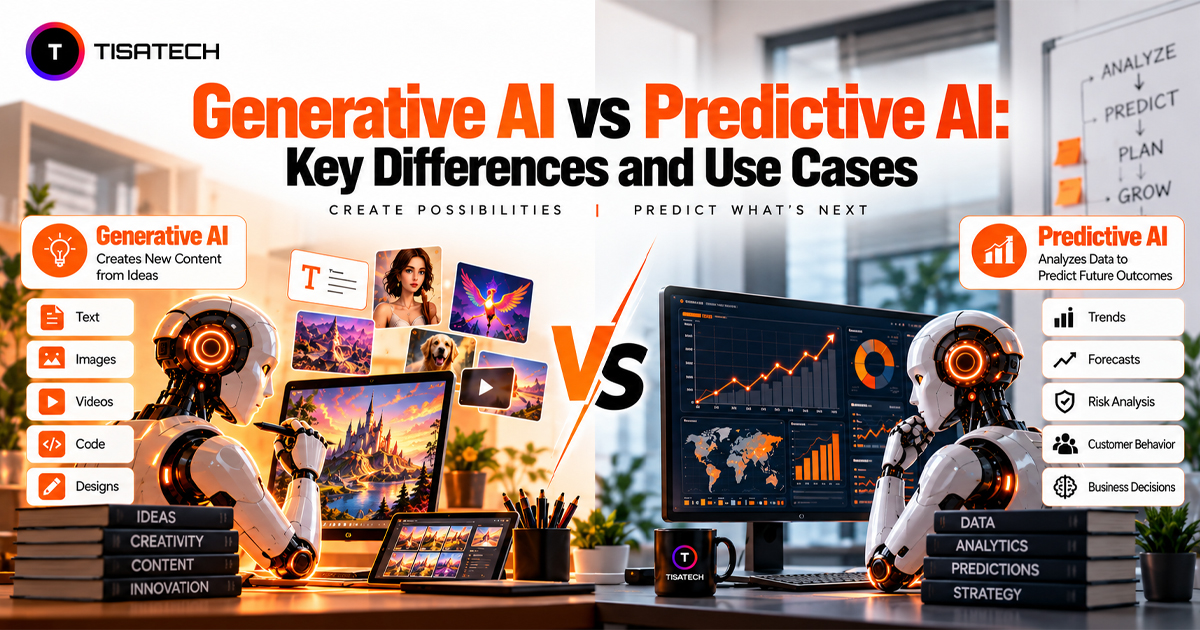
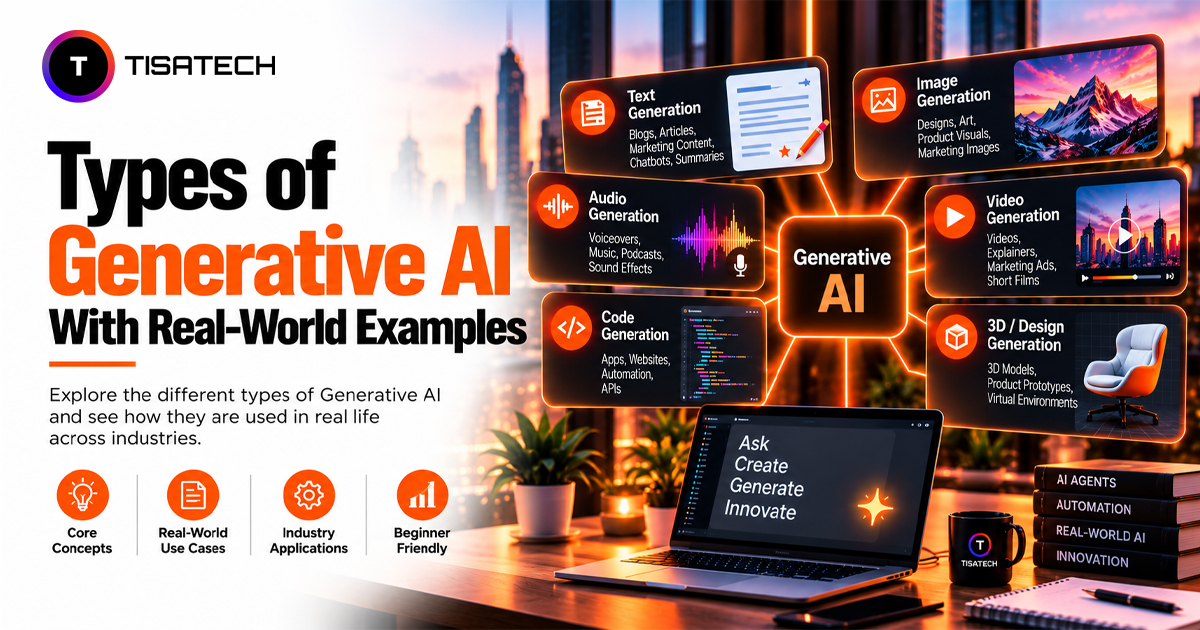
Generative AI is a type of artificial intelligence that creates new content, such as text, images, videos, audio, and code. It learns patterns from existing data and uses them to generate new outputs based on user prompts or input.
Different types of generative AI use different techniques to create content. Large language models (LLMs) generate text and code, while diffusion models create images and other media. Generative adversarial networks (GANs) and variational autoencoders (VAEs) can also generate synthetic data and realistic content. Understanding these types helps you choose the right model for a specific task.

What Are the Different Types of Generative AI?
Generative AI uses different model architectures to create content or produce new data from learned patterns. Four widely discussed model families are large language models (LLMs), diffusion models, generative adversarial networks (GANs), and variational autoencoders (VAEs). Each approaches content generation differently.
- Large language models (LLMs): Work with language to generate text, write code, answer questions, and summarize information.
- Diffusion models: Create content by gradually refining noise into a structured output, commonly an image.
- Generative adversarial networks (GANs): Use two neural networks, a generator and a discriminator that compete during training to produce realistic samples.
- Variational autoencoders (VAEs): Learn a compressed representation of training data and use it to generate new samples with similar patterns.
Comparing the Main Types of Generative AI
| Model family | Common applications | Example | Main consideration |
|---|---|---|---|
| Large language models (LLMs) | Text generation, coding, summarization | A chatbot that answers customer questions | Outputs can contain factual errors and may need verification |
| Diffusion models | Image and visual content generation | Creating product images from text prompts | High-quality generation can require substantial computing resources |
| Generative adversarial networks (GANs) | Synthetic data and realistic sample generation | Creating artificial images for training a computer vision model | Training can be difficult to stabilize |
| Variational autoencoders (VAEs) | Data reconstruction and generation of similar samples | Producing variations of images in a dataset | Results depend on the training data and the task |
These model families are useful for understanding how generative AI systems work, but they are not an exhaustive list. Some systems combine multiple techniques, while multimodal models can process more than one type of input. For example, Google Gemini supports work across modalities such as text, images, and audio.
How Do Different Generative AI Models Work?
Deep learning sits under almost all of them, as Databricks explains. The method changes from family to family.
Transformers use self-attention to identify relationships between tokens in a sequence. For example, surrounding words help a language model distinguish a financial bank from a riverbank. Autoregressive LLMs generate text by predicting the next token repeatedly. The Attention Is All You Need paper introduced the transformer architecture.
LLMs work well for writing, summarization, question answering and coding assistance. However, they can generate incorrect information or code that fails during execution. Always verify important facts and test generated code before using it.
Diffusion models learn to generate data by reversing a process that gradually adds noise. During training, they learn how to remove noise from examples. During generation, they start with random noise and refine it step by step to create an output that matches the prompt. The DDPM research paper helped establish this approach for image generation.
Diffusion models can generate detailed images, but generation may require substantial computing resources. Faster sampling methods can reduce the number of refinement steps. However, generation can require substantial computing resources because the model may need multiple refinement steps. Newer methods can reduce the number of steps required.
Generative adversarial networks (GANs) use two neural networks that compete during training. The generator creates synthetic samples, while the discriminator tries to distinguish them from real examples. Both networks improve through this process, helping the generator produce increasingly realistic outputs. The original Generative Adversarial Networks (GAN) research paper introduced this approach.
GANs can generate realistic faces, images and other synthetic samples. GAN training can be unstable, and some models suffer from mode collapse, producing limited varieties of output instead of capturing the diversity of the training data. Their performance depends on the architecture, training process and intended application.
Variational autoencoders (VAEs) learn compressed representations of data in a space called the latent space. An encoder maps the input to a probability distribution, and the model samples a representation from that distribution. A decoder then reconstructs the original input or generates a related sample. The original VAE research paper explains this approach.
VAEs are useful for learning data representations, reconstructing inputs, and generating variations of existing data. Basic VAEs can produce blurrier images than some GANs or diffusion models, although results depend on the architecture and task.
Which Generative AI Models Create Images, Video and Audio?
Diffusion models are widely used for image generation. Stable Diffusion and Google’s Imagen are examples of image-generation systems.
Other tools focus on different media. Google’s Veo generates video, ElevenLabs generates speech, and Suno creates music from prompts.
Beginners can start with generative AI tools students should know and test how prompts affect the result. For example, generate “a Jaipur street at sunset in watercolor style,” then change the lighting or art style to compare the outputs.
What Are Some Real-World Examples of Generative AI in Daily Work?
Start with the tools you probably already use. ChatGPT writes essays, summarizes long documents, and works as a virtual assistant. Gemini reasons across text and images. GitHub Copilot suggests code while developers type. Software teams also use these models to write boilerplate, generate unit tests, and translate legacy scripts into modern languages. That saves hours of boring work and frees developers for harder problems.
Healthcare researchers use AI for tasks such as protein-structure prediction and drug discovery. AlphaFold predicts protein structures, helping researchers investigate biological systems. Separately, generative models can help researchers explore potential drug candidates. Healthcare professionals can also use AI to draft clinical notes, but they must review the output for accuracy.
Marketing teams create personalized ad copy in minutes and test many versions of one campaign. A human editor still checks every final message for accuracy and tone.
Banks use generative AI to draft compliance documents and summarize financial reports. Some teams also use synthetic transaction data to test fraud-detection systems. However, synthetic data does not automatically protect privacy teams must evaluate whether it exposes information about real customers.
Keep the limits in mind, though. Models can give wrong answers with full confidence, a problem IBM explains as AI hallucination. Big models also need heavy computing power. Always check facts before you share any AI output.
| Follow Us for Daily Tech Tips |



|
Why Choose TISA-TECH to Learn Generative AI in Jaipur?
Learning Generative AI takes more than watching tutorials. Students need hands-on practice to understand how models work and how to use them in real applications. TISA-TECH is an IT training institute in Jhotwara, Jaipur, where students learn through practical projects.
The Generative AI course covers language and image models, with projects such as chatbots and image generators. Students can also explore open-source models and resources from Hugging Face to compare outputs and understand how different AI tools work.
The course also covers AI API integration, helping students learn how to add generative AI features to applications. Mentors guide them through project development, troubleshooting, and improvements so they can strengthen their practical skills.
The placement support program helps students prepare for interviews and present their skills to potential employers. By completing practical projects, they can build a portfolio that demonstrates their understanding of Generative AI and its applications.
Conclusion
Choosing the right type of generative AI starts with understanding your task. Language models suit text and code, while diffusion models are widely used for image generation. GANs and VAEs offer other ways to generate synthetic data and learn useful representations, depending on the application.
Whatever tool you choose, check its output before relying on it. For responsible use at work, the NIST AI Risk Management Framework offers guidance on managing AI-related risks. Beginners can also follow Google’s generative AI learning path to build their knowledge and practice with real tools.
FAQs Section
Ans. No. Beginners can start with text and image tools like ChatGPT or Midjourney using everyday language. Coding becomes useful when building custom applications, and Python is a good language to learn first.
Ans. ChatGPT or Gemini are good starting points for text-based tasks, while Stable Diffusion introduces image generation. Experimenting with different prompts helps beginners understand how instructions affect AI-generated results.
Ans. Yes. ChatGPT and Gemini offer free access options, while Hugging Face provides access to many free models. Usage limits may apply, but these options are useful for learning and small projects.
Ans. Learning the basics and becoming comfortable with AI tools can take a few weeks. Building practical projects, such as chatbots or image generators, usually takes a few months of regular practice.
Ans. Yes. Generative AI can produce incorrect information while sounding confident. Always verify facts, figures and code before using or sharing AI-generated content.
Ans. Generative AI skills are useful in content writing, digital marketing, software development, design and data-related roles. Practical projects that demonstrate these skills can strengthen a candidate’s portfolio beyond simply listing AI tools.