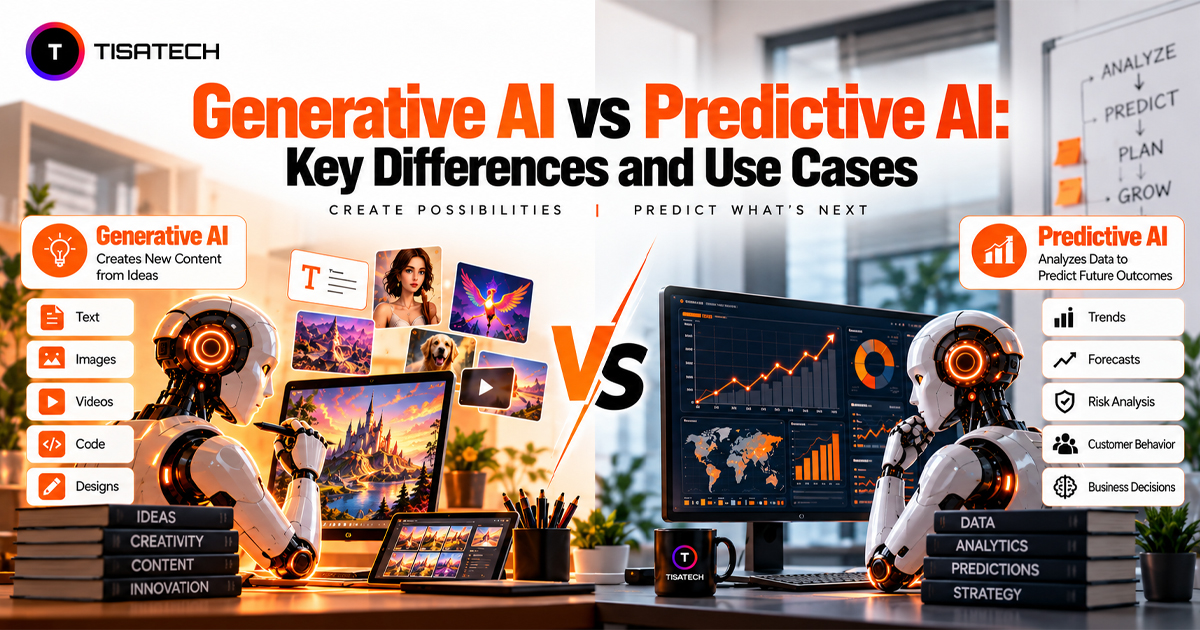
Open Instagram and the Reels already match your taste. Open ChatGPT and a full email appears in seconds. Both feel like magic, and both run on AI. Still, they do opposite jobs. Instagram predicts what you will like next. ChatGPT creates something new.
Most Jaipur students use both every day and never ask which is which. That is the real gap in the generative AI vs predictive AI conversation. A PTI report on an EY-Parthenon survey found that 60 percent of 30 leading Indian colleges permit student use of AI tools. The confusion costs real money and time. Beginners write “AI” on a resume without knowing what they learned. Course buyers pick the wrong skill. Companies buy a content tool when they need a forecasting model.The core split is simple. IBM explains that generative AI creates new content, while predictive AI forecasts outcomes from existing data.
This guide shows how each type works, where each fits best, and how both combine in one real workflow. By the end, you will know which type fits which job.

Is ChatGPT Generative AI or Predictive AI?
ChatGPT is generative AI. It writes a new reply for every prompt, and that reply did not exist before the question.
The confusion starts because ChatGPT does predict. As UCF explains, a large language model estimates the likely next word, one word at a time. Those predictions add up to a full answer. So the tool predicts words, yet the output is brand new text. That makes it generative.
Google Maps works the other way. It combines past traffic patterns with live road data to estimate your travel time. The result is a number, not new content.
Use one quick test on any AI tool. Ask what the user receives at the end. If the answer is a new piece of content, the tool is generative. If the answer is a score, forecast or label, it is predictive. How the model works inside does not change this test.
Generative AI vs Predictive AI: What Is the Difference?
The clearest way to separate them is to look at what each one hands back. Generative AI returns something you can read, see or hear. Predictive AI returns something you can measure, such as a number, a category or a probability.
Data requirements are another difference. Generative AI models are often pretrained on large datasets containing text, images or other content. Predictive AI models can use more focused datasets, such as past sales or loan records. However, the data each model needs depends on the task, model architecture and training approach. Predictive AI can also work with unstructured data, while some generative AI applications rely on smaller task-specific datasets.
Both run on machine learning, as Coursera’s guide points out. They just aim it at different jobs. The table puts the gap side by side.
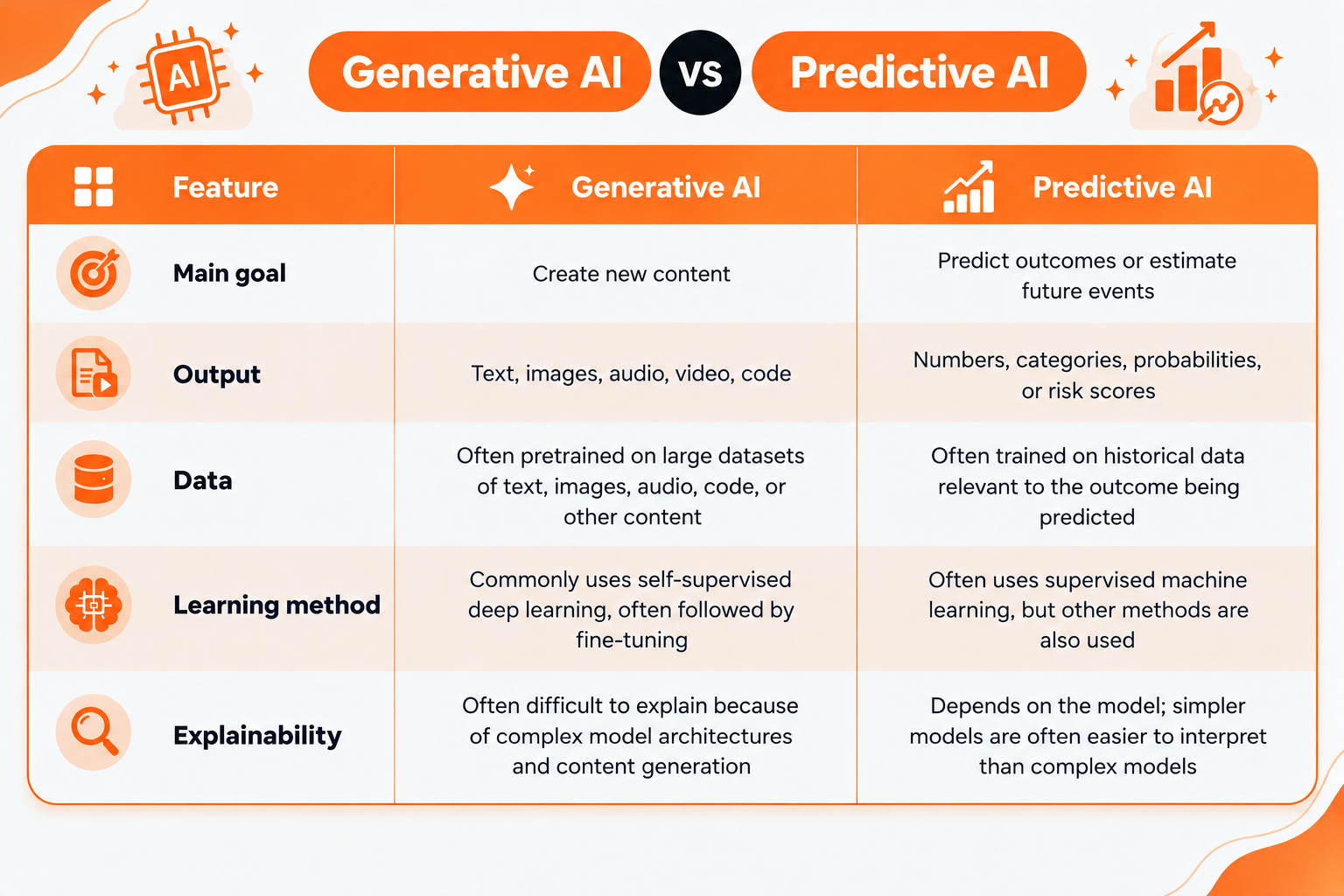
The last row matters most in real jobs. Predictive estimates rest on numbers, so a bank can show why its model rejected a loan. Generative models rarely show their full reasoning. Predictive AI can be useful for high-stakes decisions such as credit assessment and medical risk analysis, but it is not automatically safer or more explainable. Both types of AI require appropriate testing, human oversight and safeguards before their outputs are used in important decisions. Generative output needs a human check before anyone acts on it.
What Are Common Generative AI Use Cases?
Generative AI helps most when a task needs something new. Marketing teams use ChatGPT to draft emails and blog posts. A cloth shop owner in Johari Bazaar can write a Diwali offer message in two minutes.
Designers use Midjourney and DALL-E for visuals and art ideas. Developers use AI to write, fix and clean code. Customer support shows the biggest business gain. IBM lists five support use cases, from chatbots that answer in natural language to tools that summarize long call records. In one IBM case, Bouygues Telecom used AI to summarize calls and cut pre-call and post-call work by 30 percent.
Students can copy that idea on a small scale. Build a simple chatbot for a local shop, and it will teach more than ten articles. The best generative AI projects for students begin with one clear problem and grow step by step.
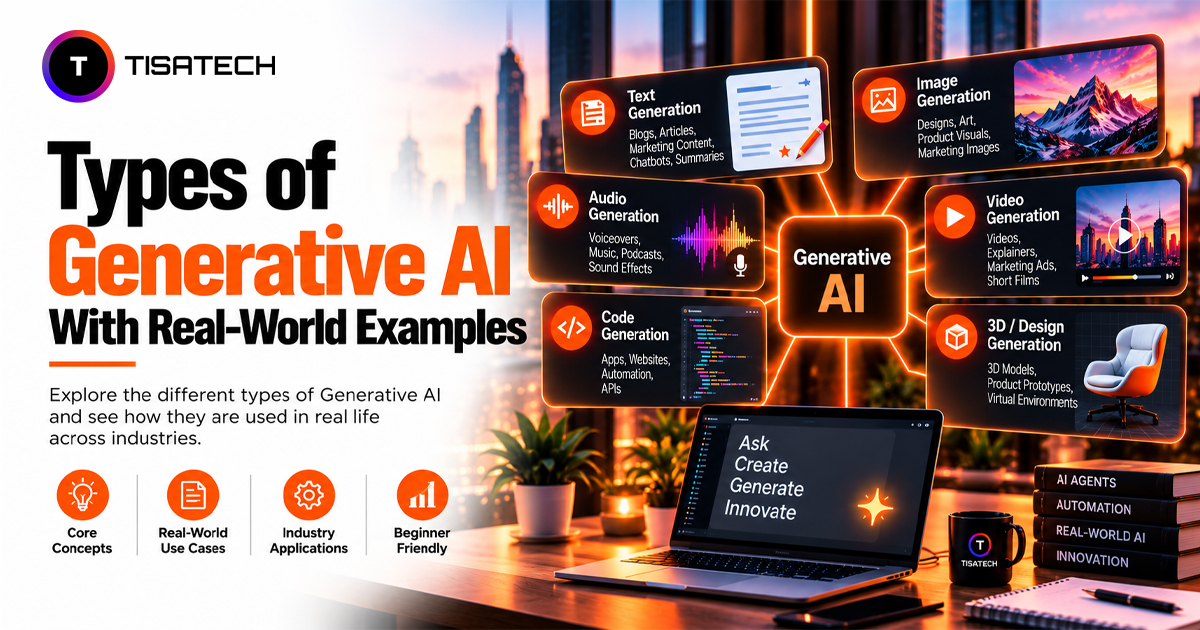
These examples show how different types of generative AI create text, images, code, and conversational responses for real-world tasks.
What Are Common Predictive AI Use Cases?
Predictive AI helps most when a decision depends on past patterns. Banks use it to forecast loan default risk. Payment apps use it to spot odd transactions in real time. That is why a bank may block a card payment that looks unusual.
India now builds this into its banking system. The Reserve Bank Innovation Hub studied 19 patterns of mule account behaviour and built MuleHunter.AI. Mule accounts are the accounts fraudsters use to move stolen money. Old rule-based checks raised too many false alarms, so the tool scores accounts using transaction patterns instead.
Retailers use predictive AI to guess product demand. That keeps shelves full and warehouse costs low. Streaming apps and online shops suggest the next movie or product from what a user liked before.
Practical takeaway: Choose predictive AI when you need to estimate an outcome, such as future sales or fraud risk. Choose generative AI when you need to create content, such as a report, email or chatbot response.
Can Generative AI and Predictive AI Work Together?
Yes, and many companies already do it. IBM says enterprises can use both types in tandem for better business results. Each tool handles the part it does best.
Customer churn shows the pairing clearly. A predictive model scores every customer and flags the ones likely to leave. A generative model then writes a personal retention message for each flagged customer. The help also runs the other way. A 2025 research paper shows how generative AI can make churn prediction more accurate and more frequent.
Sales teams follow the same path. Predictive AI forecasts next quarter’s numbers, and generative AI turns them into a clear report for the manager. Support chatbots split the job too. Predictive AI reads the user’s intent, and generative AI writes the reply in natural language.
Which Is Better, Generative AI or Predictive AI?
Neither one wins every time. The job decides. Choose generative AI when the goal is new content. Choose predictive AI when the goal is a forecast or a risk score. An ad team does not need a forecasting model, and a demand planner does not need an image tool.
Each type also fails in its own way. Generative AI can sound sure while it makes facts up, a problem IBM calls hallucination. Predictive AI fails when its past data is poor or when the pattern changes. So check generative output before sharing it, and test predictive models on fresh data.
Beginners often ask where to start. Predictive AI offers a useful starting point for learners interested in data handling, statistics and machine learning. Those more interested in building chatbots or content-generation tools can begin with generative AI fundamentals and learn the required coding skills as they progress.
Both paths lead to jobs. A TeamLease Digital report says only about 16 percent of IT professionals in India hold AI skills, and demand for AI-ready talent keeps outpacing supply. Employers want people who know the difference and pick the right tool.
| Follow Us for Daily Tech Tips |



|
Where Can Jaipur Students Learn Both Types of AI?
Students in Jaipur can learn both Generative AI and Predictive AI at TISA-TECH, an IT training institute focused on practical learning. Our courses help students understand how these AI types work through hands-on exercises and real-world projects.
Our Generative AI course in Jaipur covers prompt writing, model use and projects such as chatbots. Our AI and machine learning courses introduce predictive techniques, including data handling, model building and sales forecasting. Students interested in working with data can also explore our AI and data science course in Jaipur.
Our mentors help students apply these concepts through hands-on projects, review their work and provide feedback. For example, students can build a chatbot that generates responses to customer questions and a predictive model that estimates future sales from historical data. These projects help students understand the practical differences between the two AI types and build a portfolio. Our team also provides placement guidance to help students prepare for job opportunities.
Conclusion
Generative AI and predictive AI solve different problems. Generative AI creates new content such as text, images, code, and audio, while predictive AI analyzes historical data to forecast outcomes like customer churn, sales trends, or fraud risk. Knowing both helps you choose the right tool for the right problem instead of treating AI as one single skill.
The best way to start is with the type that matches your interests. If you enjoy working with language and creativity, build a small project like a chatbot or content summarizer. If you prefer data and patterns, try a prediction model such as house price estimation or demand forecasting. Once you are comfortable with one, learn how the two work together, for example using predictive models to find insights and generative AI to explain them in plain language. A portfolio that shows both skills proves you can apply AI to real business problems, not just understand the theory.
FAQs Section
Ans. Using generative AI tools is easy, but building them needs deep learning skills. Many beginners find predictive AI clearer at first because it starts with simple models like regression.
Ans. Basic prompt writing needs no coding at all. Building apps on top of AI models needs Python.
Ans. The same banks and retailers that use chatbots still depend on forecasts and risk scores. That keeps predictive skills useful in finance, retail and logistics roles.
Ans. Yes. Many entry-level roles ask for one skill, such as data analysis or AI app building. Pick one, build two projects with it, and add the second type later.