In May 2023 IBM announced it would stop hiring for around 7,800 back‑office jobs because artificial intelligence could handle those roles within five years. The news came quietly inside an earnings call but for millions of workers in repetitive office jobs it was a serious warning.
By 2026 the signs are clear. ChatGPT reached 100 million users in two months faster than any technology in history. AI tools now write code, answer customer calls, review legal documents, and process financial data nonstop. They do not ask for salaries or sick leave.
The data confirms the scale. The World Economic Forum Future of Jobs Report 2025 projects AI and automation will displace 92 million jobs globally by 2030 while creating 170 million new ones. Those 92 million jobs will shrink fast in specific roles that millions in India depend on today.
Oxford University’s study gave telemarketers a 99% chance of automation, the highest of any job. McKinsey found 86% of data entry tasks are already automatable. Goldman Sachs estimates 300 million full‑time jobs globally face AI exposure. The McKinsey Global Institute says generative AI could automate 60 to 70 percent of current work activities before 2030.
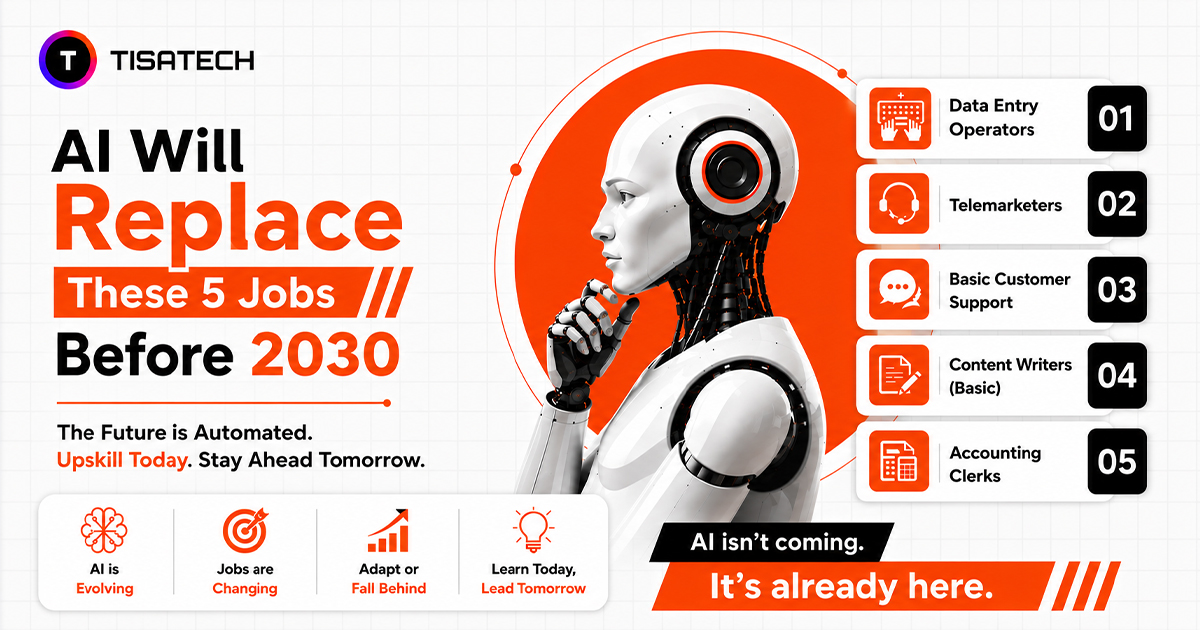
Students in Jaipur or freshers starting careers need to pay attention. Here is a clear look at five jobs AI will most likely replace before 2030 and what you can do about it.
How Fast is AI Actually Moving?
Many people still underestimate how quickly AI is entering workplaces. This is not future tech. It already runs inside call centers, banks, law firms, and government offices. AI customer service platforms solve 70 to 85 percent of basic support tickets without human help. AI bookkeeping tools process transactions faster and cheaper than junior accountants. AI voice agents make sales calls that sound fully human.
The shift happens at two levels. First, AI replaces full roles where the work is repetitive and structured. Second, AI changes how other jobs function by taking over routine tasks while leaving humans to handle complex parts. The first group faces job loss. The second group faces a race to learn new skills to stay relevant.
The five jobs below fall mostly in the first group. These are roles where AI is not just changing tasks but removing the need for the role itself.
This matters for students in Jaipur. Many entry‑level jobs in BPO, IT support, and back‑office sectors belong to this first group. Students working in these jobs or planning to start their should read carefully. This knowledge is one of the most practical steps for career planning right now.

The 5 Jobs AI Will Replace Before 2030
AI is moving fast and some jobs are more exposed than others. These five roles face the highest risk of being replaced before 2030.
Job 1: Data Entry Clerks
A data entry clerk takes information from forms, receipts and documents and types it into a system. The work is precise but predictable with no judgment or creativity. That makes it perfect for automation. Intelligent Document Processing tools from Google and UiPath now read, extract and enter data with 97 percent accuracy. McKinsey says 86 percent of data entry tasks are automatable today. Companies do not fire people suddenly, they simply stop hiring as AI handles new work. If you are in data entry or planning to start here you need a backup plan now.
Job 2: Telemarketers and Call Center Agents
Oxford University gave telemarketers a 99 percent chance of automation, the highest of any job studied. A telemarketer follows a script, handles objections and tries to convert prospects. An AI voice agent does the same nonstop in many languages. The World Economic Forum lists customer service as a top sector already disrupted by AI. In Rajasthan thousands of young people start careers in call centers but this role is shrinking fast.
Job 3: Basic Customer Service Representatives
Not all customer service jobs face equal risk. The ones in danger handle simple requests like resetting passwords, checking orders, answering FAQs or processing refunds. AI systems do these tasks faster and more accurately. Goldman Sachs estimates 20 percent of customer service jobs globally face high exposure. Roles that survive need empathy and complex judgment. If your job is only answering the same questions every day that role is at real risk before 2030.
Job 4: Proofreaders and Transcriptionists
Transcription was once a decent freelance skill. Today AI tools transcribe audio with accuracy equal to trained professionals and finish in minutes. Tools like OpenAI Whisper and Google speech to text APIs make human transcription uneconomical. Proofreading faces the same shift. AI grammar tools catch errors, rewrite sentences, adjust tone and check consistency. Jobs focused only on mechanical accuracy are disappearing.
Job 5: Junior Financial and Legal Analysts
Finance and law feel like high skill fields but entry level work is repetitive and document based. Junior analysts review statements and contracts, tasks AI now handles well. KPMG reported contract review AI cuts review time by 80 percent and errors by 40 percent. Goldman Sachs notes finance and insurance face among the highest AI exposure. Even large firms are automating junior roles in legal, compliance and trading.
What About Jobs That Will Not Be Replaced by AI?
Not every job is at risk. Some roles stay safe from AI displacement before 2030 and beyond. Knowing this helps you make smarter career choices.
Skilled trades like electricians, plumbers, and civil engineers work in physical environments where AI cannot operate alone. Healthcare workers such as nurses, physiotherapists, and surgeons combine skill with human judgment and care in ways machines cannot copy. Teachers, counselors, and social workers build relationships and handle emotional complexity that AI still struggles with.
On the technology side, AI engineers, machine learning specialists, cybersecurity professionals, cloud architects, and full stack developers are in very high demand. That demand grows because of AI adoption. Every company using AI needs humans to build, maintain, and improve those systems. These are not jobs AI will replace. In fact, they are jobs AI is creating.
The World Economic Forum Future of Jobs Report 2025 projects that roles in AI development, cybersecurity, and sustainability will grow the fastest through 2030. For students in Jaipur these are the fields worth building skills in right now.
The pattern is clear. Jobs that depend on physical presence, human judgment, or emotional intelligence are safer. Jobs that depend only on processing predictable information are absorbed faster by AI. The good news is that moving from the second category to the first is possible with the right training and mindset.
What Should You Do If Your Job is on This List?
The honest advice is simple: do not wait. The window to upskill and shift your career path is open right now but it will not stay open forever. Here is what actually works.
Start by learning the tools that are doing the replacing. If AI is automating data entry, learn how to build and manage the AI systems that do it. If AI is handling customer calls, learn how to design and train conversational AI. You move from being the person replaced to the person running the replacement, and that job is much harder to automate.
Python is the most important skill to start with. It powers almost everything in data science, machine learning, and AI development. Learn it through free resources first. Google’s Machine Learning Crash Course or fast.ai are excellent. Then build something small and real. A working project on GitHub is worth more in a technical interview than a certificate from any course.
The future of jobs after AI belongs to people who understand both sides, the human side and the technical side. If you come from a customer service background and you learn how AI chatbots work, you become valuable as someone who can supervise and improve those systems. Your domain knowledge becomes an asset instead of a liability.





How TISA-TECH is Helping Jaipur’s Students Stay Ahead
TISA‑TECH in Jhotwara, Jaipur has seen this change happen directly. Students who earlier asked about basic IT support jobs now ask about AI tools, machine learning, and cloud platforms. This shift in focus is the right move.
Our courses and curriculum are built on real market demand, not outdated syllabuses. The AI/ML program teaches Python, machine learning, neural networks, and deployment workflows. The Cloud Computing program covers AWS, Azure, and infrastructure skills companies need today. The Full Stack Development program trains students to build and connect AI‑powered applications from the start. Together, these programs ensure students learn practical AI skills and cloud skills that companies expect candidates to already know.
We use a smart learning system that tracks progress and adjusts the path. If you already know something, you move ahead faster. If something is unclear, we slow down and explain it properly. The goal is to prepare you for a job, not just to finish a course. Students work on live projects so they have real work to show in interviews, not only certificates.
Students in Jaipur who are unsure about their career path can talk to the counselling team at TISA‑TECH. We help you choose the right starting point based on your background and goals.
Conclusion
AI automation is already replacing jobs in data entry, telemarketing, customer service, transcription, and junior analyst roles. These jobs are shrinking fast as companies use AI tools that work better and cheaper.
This is not the end of work. It is a shift that creates new opportunities. The World Economic Forum projects 170 million new jobs by 2030 in AI, cybersecurity, cloud, healthcare, and skilled trades.
Students in Jaipur who act early and build the right skills will have more options. The time to move is now while opportunities are still open.