Ask a Jaipur gem dealer how a buyer knows a stone is genuine, and the answer is often the dealer’s word. De Beers wants more proof than that, so it tracks its diamonds from mine to shop on a blockchain platform called Tracr. So what is blockchain, and what can it actually prove?
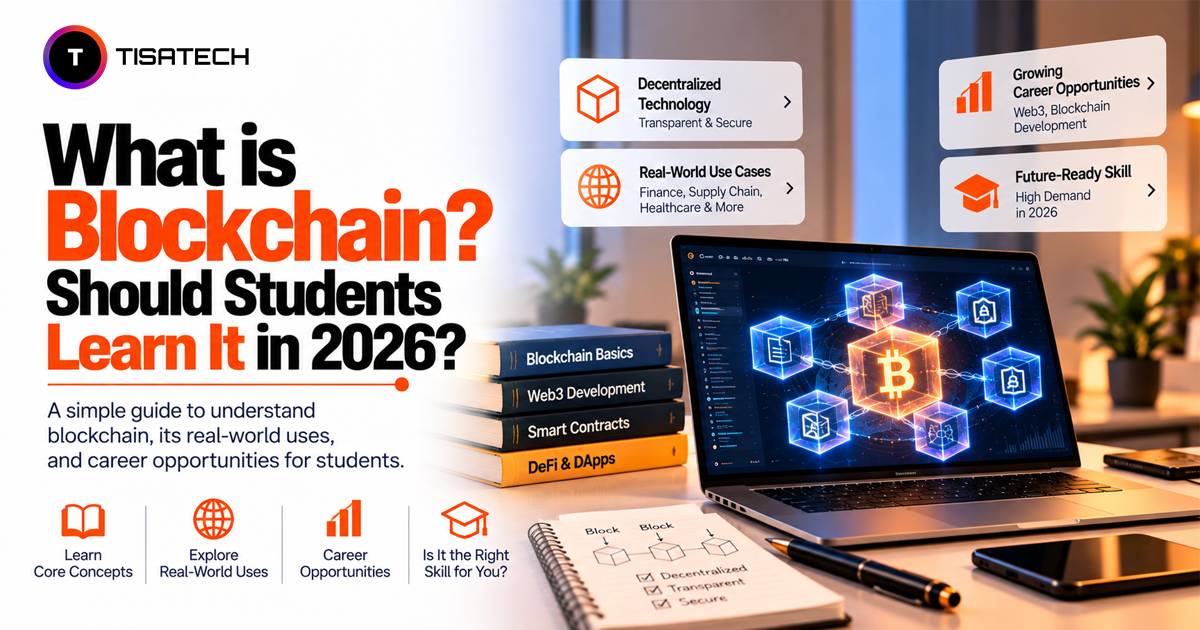
Blockchain is a shared digital record that thousands of computers keep in sync. Nobody can change an entry quietly, so every step in a diamond’s journey stays on record. Bitcoin made the idea famous, and Ethereum now lets developers build full apps on top of it.
The record has one limit. Blockchain protects data after someone enters it, but it cannot confirm that the first entry was true. A wrong note at the mine stays on the chain like any other.
Jobs exist, but nobody can promise one. The career site web3.career lists more than 40,000 live Web3 roles, yet each one asks for someone who can already build and test real systems.
Should students learn blockchain in 2026? Yes, if you enjoy coding and treat it as an extra skill. If you have never written code, start with programming first. This guide covers how blockchain works, the skills and six-month plan to learn it, and the careers it can open.

What is Blockchain and How Does it Work?
Think of a notebook shared by a whole class. Every student keeps a copy. When one student adds a new entry, the others check it before adding it to their copies. If someone changes an old entry, that copy no longer matches the others.
A blockchain works in a similar way. It stores records across a network of computers called nodes. These nodes verify transactions and keep the network’s records in sync. You can watch Ethereum transactions on Etherscan as the network processes them.
Here is how a transaction works. The sender signs it with a private key, which helps the network confirm that the sender approved it. Nodes check the transaction, and the network uses a consensus mechanism to decide which transactions to accept. Ethereum uses Proof of Stake for this process.
The network groups accepted transactions into a block. Each block also stores the hash of the previous block. A hash is a cryptographic value created from the block’s data. If someone changes data in an old block, its hash changes. The following blocks then no longer match the stored hash, making the change easy to detect.
Ethereum also supports smart contracts. These are programs stored on the blockchain that run when their programmed conditions are met. Developers use them to build applications that can handle transactions and other actions without relying on a central authority.
Blockchain has one important limit: it protects information after someone records it, but it cannot prove that the original information was true. If someone enters incorrect information, the blockchain can preserve that incorrect record too.
Is Blockchain Worth Learning in 2026?
Yes, blockchain is worth learning in 2026 for students who enjoy coding. It is not worth chasing for quick money.
Companies hire for real work, such as payments, shipment tracking and record checking, and that work continues even when a coin price drops. Employers also care more about a working GitHub project than a certificate.
The field still has limits. Tools change fast, and openings are fewer than in web or app development, so blockchain works best as an extra skill on top of solid coding. If you already code, read the Ethereum developer docs and build one small contract this month.
Is Blockchain Difficult, and What Skills Do You Need to Learn it?
Blockchain is easy to understand and harder to build. Most students grasp the shared notebook idea in minutes. The real effort starts with code.
Three things add difficulty. Smart contracts are small programs that handle real money, and nobody can quietly fix a live one, so a single bug can hurt many users. Distributed systems feel new because many computers work together and none of them is the boss. Cryptography adds one more layer, but you only need to know why keys and signatures keep data safe, not the maths behind them.
Build these skills in this order:
- Programming language: Pick one language, such as JavaScript or Python, and learn it well. The free MDN JavaScript Guide and the official Python tutorial are good starting points.
- Data structures: Learn lists, trees and hash tables. Blockchains link blocks with hashes, so hash tables matter most.
- Databases: Learn how apps store and search data. The SQL tutorial on W3Schools covers the basics.
- Networking basics: Learn how computers send data to each other. MDN explains how the web works in simple steps.
- Git: Use Git from day one. The free Pro Git book teaches it from scratch.
- Testing: Test every function you write. Jest is an easy tool for testing JavaScript code.
- Ethereum and Solidity: Ethereum is one of the most popular platforms for learners, and Solidity is its main smart contract language. Start with the Ethereum developer docs, then read the smart contracts guide and the Solidity documentation.
- Smart contract security: Read the smart contract security guide before any deployment.
- Full stack basics: Many blockchain apps pair a website with a smart contract, and that skill makes you more useful to a team. The MDN Learn Web Development guide and the Full Stack Developer roadmap show the path.
Blockchain Learning Roadmap: A 6-Month Plan
Study about two hours a day and finish each month’s goal before moving on. Complete beginners should stretch Months 1 and 2 to six or eight weeks each.
Month 1: Learn to code. Pick JavaScript or Python, write small programs and push them to GitHub every week, using the Pro Git book for help.
Goal: upload a small app, such as a to-do list.
Month 2: Learn the foundations. Study lists, trees, hash tables, databases and how the web works. Read the Ethereum introduction to see how these ideas fit blockchain.
Goal: explain in your own words how a hash links two blocks.
Month 3: Write a first smart contract. Learn Solidity with CryptoZombies, then write a contract in Remix, a free browser editor, and deploy it on a test network, where fake money makes mistakes free.
Goal: one working contract on a test network.
Month 4: Build your first project. Make a simple token, test every function and add a clear README. Start a voting app in the same month.
Goal: one finished project on GitHub and a second one underway.
Month 5: Connect a website and learn security. Finish the voting app, add a web page that talks to your contract and fix common bugs using the smart contract security guide.
Goal: two projects on GitHub and a list of bugs you fixed.
Month 6: Show the work and apply. Join a hackathon on Devfolio or ETHGlobal, then apply for internships and entry-level roles.
Goal: five applications with your GitHub link.
What Can Students Do After Learning Blockchain?
Blockchain jobs sit in a small, specialised corner of the software market. Most teams hire a few blockchain developers next to a much larger group of web and app developers, so blockchain works best as an extra skill on top of solid coding.
Here are the roles students can aim for:
- Blockchain developer: Builds the apps and systems that run on a chain.
- Smart contract developer: Writes and tests the contracts that handle money and data.
- Security auditor: Checks contracts for weak spots before launch. Reading real audit reports on Code4rena is a good way to practise.
- Blockchain analyst: Studies network data for patterns and risks.
- Freelancer: Takes short projects from teams that need quick help.
Many of these roles ask for proven experience, so freshers may need to start with general developer roles or internships. Glassdoor India shows an average base pay of about ₹6 lakh per year for blockchain developers, with most salaries between ₹4 lakh and ₹10 lakh. Fresher listings often sit near ₹4 lakh to ₹5 lakh.
You can look for work in three places:
- Fintech and IT companies: Bengaluru, Hyderabad, Mumbai and Pune hire for these roles.
- Remote Web3 roles: Search web3.career from Jaipur, and read each requirement before you apply.
- Hackathons: Events on Devfolio and ETHGlobal let teams see your code before they see your CV.
The six-month roadmap builds a base, not a guarantee. Job readiness also depends on your code quality, your practice time and the hiring market. Adding AI or cloud skills can help, so consider AI and software development courses for students that cover these areas together.





How Can TISA-TECH Help Jaipur Students Start Their Blockchain Journey?
TISA-TECH helps Jaipur students build the skills they need to learn blockchain. The full stack development course covers JavaScript, frontend, backend, databases, and other web development skills that are useful for building blockchain applications. The cloud computing course helps students understand how these applications run online.
Students work on real projects and get guidance from mentors. If you are new to blockchain, starting with JavaScript, web development, and databases can make it easier to understand how blockchain applications work. After learning these basics, students can move on to Solidity, smart contracts, and blockchain projects.
TISA-TECH also provides placement support for students. This can help them prepare their resumes, practise for interviews, and present their projects when applying for jobs. Before joining any institute, check whether you will get practical projects and learn skills that you can use in real blockchain development.
Conclusion
Blockchain now runs far beyond crypto prices. Banks, supply chains and identity systems use it, and employers hire people who prove their skills with projects. Learn it in 2026 if you enjoy coding, starting with JavaScript or Python and moving on to Solidity and two or three small projects on GitHub.
Feeling unsure is fine. Software development is a strong start, and blockchain can join it later. Pick one small step this week and start coding.
FAQs Section
Ans. It can be, but the field is small and skill-based. Web and app development has far more openings, so learn blockchain as an extra skill on top of coding.
Ans. Start with one programming language and basic web development. Databases and Git come next, because every blockchain project leans on them.
Ans. JavaScript comes first, since it also builds the website side of blockchain apps. Solidity follows once JavaScript feels comfortable.
Ans. Start with a simple voting app, basic token, or certificate verification app. These projects help you practise smart contracts and understand blockchain basics. Add a short README to each project on GitHub.
Ans. Two or three working projects and a clear grasp of smart contracts are enough to start. Hackathons and LinkedIn posts help recruiters find the work.
Ans. Jaipur students can start with web development and cloud computing at TISA-TECH, then move on to smart contracts and blockchain projects.