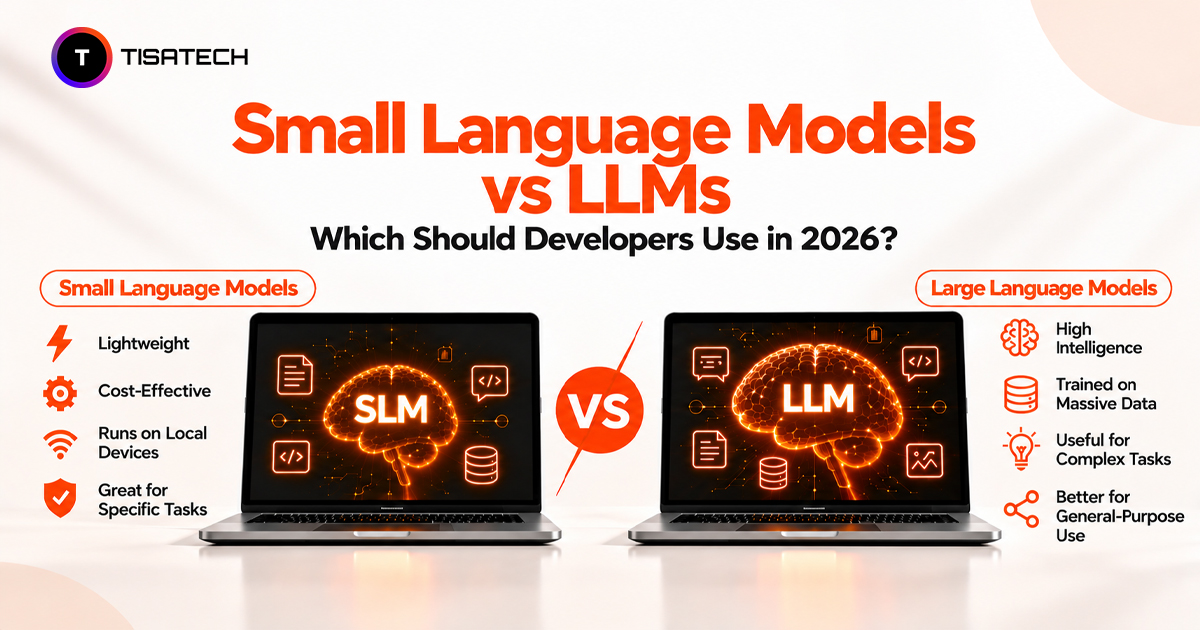
Bigger AI models can solve complex problems, but do developers need them for every task? Not necessarily. A small language model (SLM) can handle routine tasks such as ticket classification, data extraction and request routing with fewer computing resources. For these workloads, using a larger model may increase costs and response times without delivering better results.
Large language models (LLMs), however, remain useful for complex reasoning, open-ended questions and tasks that involve different types of information. Gartner predicts that by 2027, organizations will use small, task-specific AI models at least three times more than general-purpose LLMs. Gartner’s forecast highlights the growing interest in models designed for specific tasks.
This guide compares small language models vs LLMs in terms of cost, speed, accuracy, privacy and deployment. It also explains when to use each model, how to evaluate their performance and how to combine them in a hybrid system.

What Is the Difference Between Small Language Models and LLMs?
Model size is one important difference between small language models (SLMs) and large language models (LLMs). Parameters are learned values that help a model process inputs and generate outputs. SLMs generally require less computing power and memory, making them suitable for focused tasks and resource-constrained environments. Larger LLMs often offer greater capacity for complex reasoning and varied inputs. However, there is no universal parameter threshold that separates the two categories.
Some models sit in the grey zone between these categories. Google’s Gemma 4 family includes E2B, E4B, 12B, 26B A4B and 31B variants, covering different deployment requirements. The E4B model has 4.5 billion effective parameters, while its total parameter count is higher when embedding parameters are included. This illustrates why developers should check how each model reports its parameter count rather than comparing labels alone.
Mixture-of-experts (MoE) architectures make the comparison more nuanced. These models contain multiple expert networks but activate only a subset for each token. Gemma 4 26B A4B has approximately 25.2 billion total parameters and activates around 3.8 billion per token. Although this can reduce computation during inference, the full set of model weights still affects memory requirements. Developers should therefore consider total parameters, active parameters, context length, hardware and runtime overhead when evaluating deployment options.
The practical distinction comes down to workload requirements. SLMs are worth testing for tasks such as ticket classification, entity extraction and structured data processing. LLMs may be a better fit for complex reasoning, open-ended generation and tasks involving diverse inputs. Understanding how generative AI works provides a useful background for evaluating how different models process inputs and generate outputs.
How Do Small Language Models and LLMs Compare on Cost, Speed and Privacy?
However, model size alone does not determine response speed. Hardware, quantization, context length, output length, batching and inference software can all affect latency.
Inference cost also depends on how the model is deployed. Hosted APIs typically charge according to provider pricing and usage, while self-hosted models require compute resources, maintenance and engineering time. Compare cost per successful task rather than cost per token alone. Include retries, validation failures, escalation to larger models and infrastructure expenses.
The Stanford AI Index 2025 reported that the cost of querying a model achieving GPT-3.5-level performance on MMLU fell from $20 per million tokens in November 2022 to $0.07 by October 2024, using Gemini 1.5 Flash-8B. This illustrates how quickly inference costs can change; it does not mean every small model will be cheaper or equally capable on every workload.
Local inference can help keep prompts and outputs within an organization’s infrastructure, but privacy depends on the entire system. Review logging, telemetry, application storage, access controls and any external services used by the application. Ollama’s FAQ explains its handling of prompts and data during local model execution.
Before selecting a model, benchmark both approaches on the same representative inputs. Record task success, p50 and p95 latency, peak memory, failure rate and total cost per successful task.
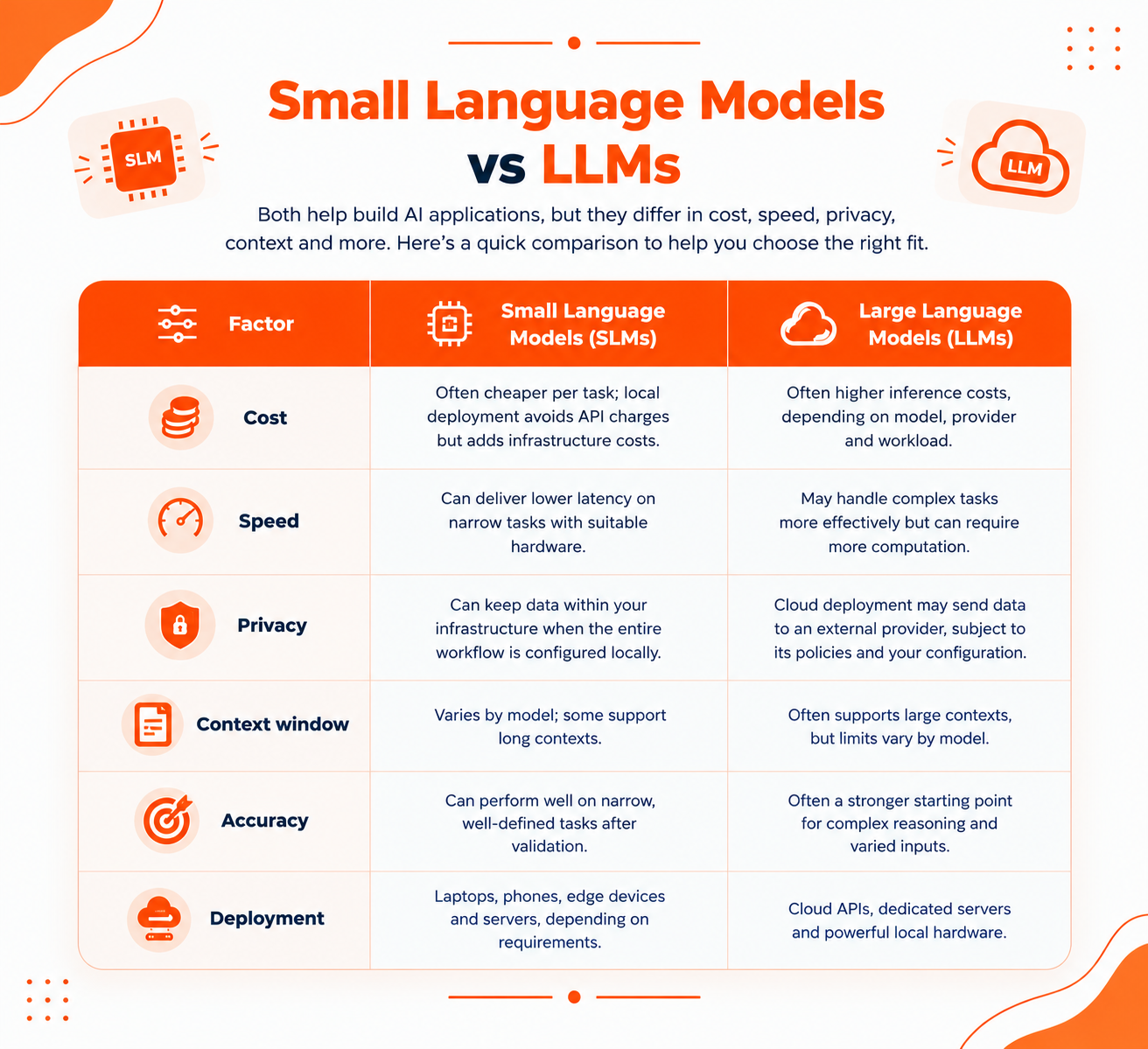
Small Language Models vs LLMs: Quick Comparison
Use this table as a first filter. Then test both model types on your own data before you commit.
When Should Developers Pick a Small Language Model Over an LLM?
Small language models are a practical starting point when a task has a clear objective, predictable inputs and outputs that can be checked automatically. Common examples include ticket classification, entity extraction, data normalization, short summaries and request routing. These workloads often benefit from lower resource requirements and shorter outputs, provided the model meets the required quality threshold.
Larger language models are worth evaluating when a task involves multiple reasoning steps, ambiguous instructions, diverse information sources or open-ended content generation. They can also be useful when mistakes carry significant consequences and a smaller model fails to meet the required accuracy. For high-risk applications, however, model size alone does not guarantee reliability; validation, safeguards and human review may still be necessary.
Use a representative evaluation set to make the decision. Start with around 100 real examples if that is enough to cover the main task types and edge cases. Run both models against the same inputs and evaluation criteria. Measure task success, factual errors, p95 latency and total cost per successful task. If the SLM meets your quality and performance targets, it may be the more efficient choice. If it falls short, test a larger model or a hybrid approach. Repeat the evaluation whenever the workload, model version or deployment environment changes.
Which Are the Best Small Language Models in 2026?
The best small language model depends on your workload, hardware, context needs and licensing requirements. These four models are worth evaluating for local inference, lightweight applications and multimodal workflows.
Gemma 4 E4B: Best for compact multimodal applications. Google’s official Gemma 4 model card lists 4.5 billion effective parameters and a context window of up to 128K tokens. With support for text, image and audio inputs, E4B is a candidate for local assistants and multimodal applications. Check its memory requirements and inference speed on your target device before deployment.
Qwen3.5 4B and 9B: Best for lightweight multimodal workflows. Alibaba’s Qwen3.5 family includes compact models designed for reasoning and vision tasks. Artificial Analysis’s model comparison reports context windows of up to 262K tokens and Apache 2.0 licensing for the listed smaller variants. The 4B and 9B models are worth testing for applications that process text and images. Verify the specifications and license of your chosen checkpoint before commercial use.
Phi-4-mini-instruct: Best for structured instructions and reasoning tasks. Microsoft’s Phi-4-mini-instruct documentation describes a 3.8-billion-parameter model with a 128K-token context window. Consider it for mathematics, coding, function calling and structured outputs. Evaluate instruction-following accuracy and error rates on your own test cases before integrating it into an application.
Ministral 3 8B: Best for local multimodal applications. Mistral’s December 2025 announcement introduced the Ministral 3 family in 3B, 8B and 14B sizes, including vision-capable variants. The 8B model is worth benchmarking for local applications that need image understanding alongside text processing. Consult the AWS model documentation for deployment-specific details.
How Can Developers Combine Both With a Hybrid Router?
A small model can handle routine classification or extraction, while a larger model handles ambiguous inputs and tasks that require more extensive reasoning.
Consider a customer support application. A small model classifies incoming tickets and extracts order details. Requests with missing fields, conflicting information or complex refund disputes go through stricter validation or are routed to a larger model. High-risk actions may also require human review.
Developers can implement this approach in three steps:
- Define routing rules. Identify which requests the small model can handle and which require escalation. Use task type, required fields, validation results and risk level rather than relying on model confidence alone.
- Validate outputs. Check structured responses against a schema and apply task-specific quality checks. Escalate failures instead of passing unverified output downstream.
- Measure end-to-end performance. Track task success, p95 latency, escalation rate, retries and cost per successful task. Compare the hybrid system against a large-model-only baseline.
A hybrid router is not automatically cheaper or faster. If the small model frequently fails and triggers another inference call, total latency and cost can increase. Evaluate the complete workflow under realistic traffic before deciding which routing strategy to deploy.
| Follow Us for Daily Tech Tips |



|
Where Can Jaipur Students Learn to Build With Both?
For students in Jaipur who want to build a career in AI, TISA-TECH offers practical software training with a focus on project-based learning. The institute’s Generative AI program covers Python foundations, FastAPI, Streamlit and API integration with OpenAI and Anthropic.
Students can apply these skills to projects involving LLM APIs, retrieval-augmented generation (RAG) and AI agents. A hybrid model router is another useful project to explore how smaller models handle routine tasks while larger models process more complex requests. Testing both approaches helps learners understand model selection, output validation and application development.
Students interested in building their AI skills can explore TISA-TECH’s training programs and learn more about the placement support available to help prepare for career opportunities.
Conclusion
Small language models vs LLMs comes down to choosing the right model for the task. Small models can handle simple, repetitive tasks with lower computing requirements, while larger models are often better for complex tasks that need more reasoning. Developers can also combine both models, using a small model for routine requests and a larger one for harder tasks.
FAQs Section
Ans. Yes, quantized small language models can run on a CPU without a dedicated GPU. Performance depends on RAM, model size, quantization and context length.
Ans. Small language models may struggle with complex reasoning, unfamiliar tasks and broad knowledge requirements. Test them on representative examples before production use.
Ans. Small models can match or outperform larger models on specific tasks, but results vary by workload. Compare both using the same evaluation dataset.
Ans. Yes, small models work well for projects such as ticket classification, resume parsing and question-answering systems. Demonstrate working code, testing and clear documentation.
Ans. Yes, developers can fine-tune small language models using task-specific data. Evaluate the fine-tuned model against the original to measure accuracy, generalization and cost.