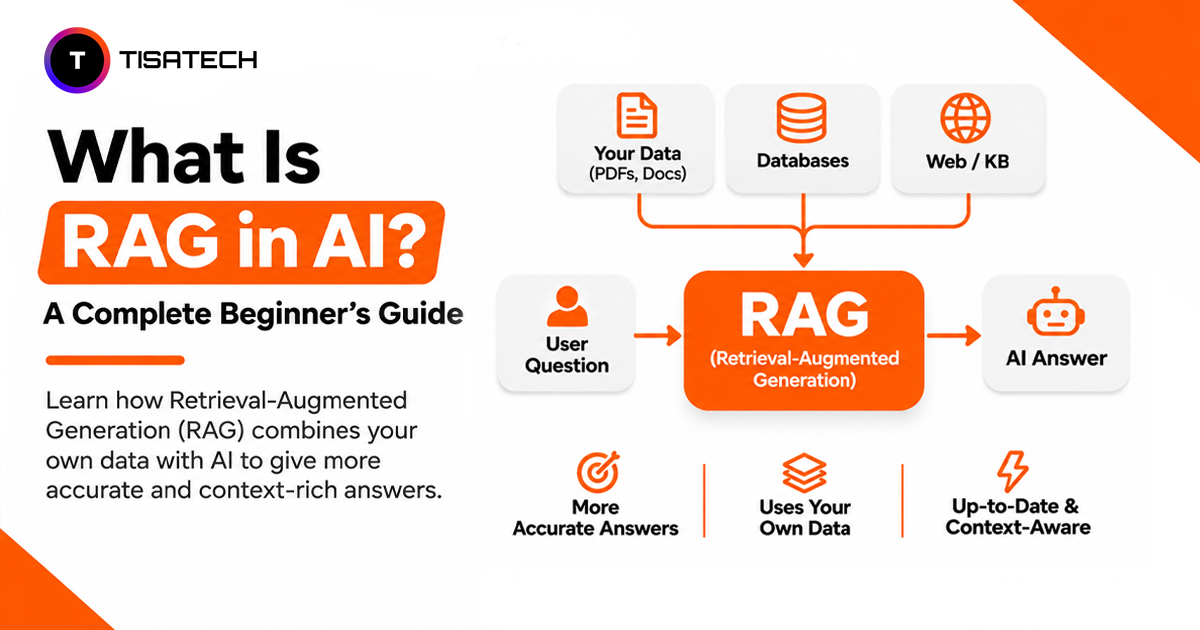
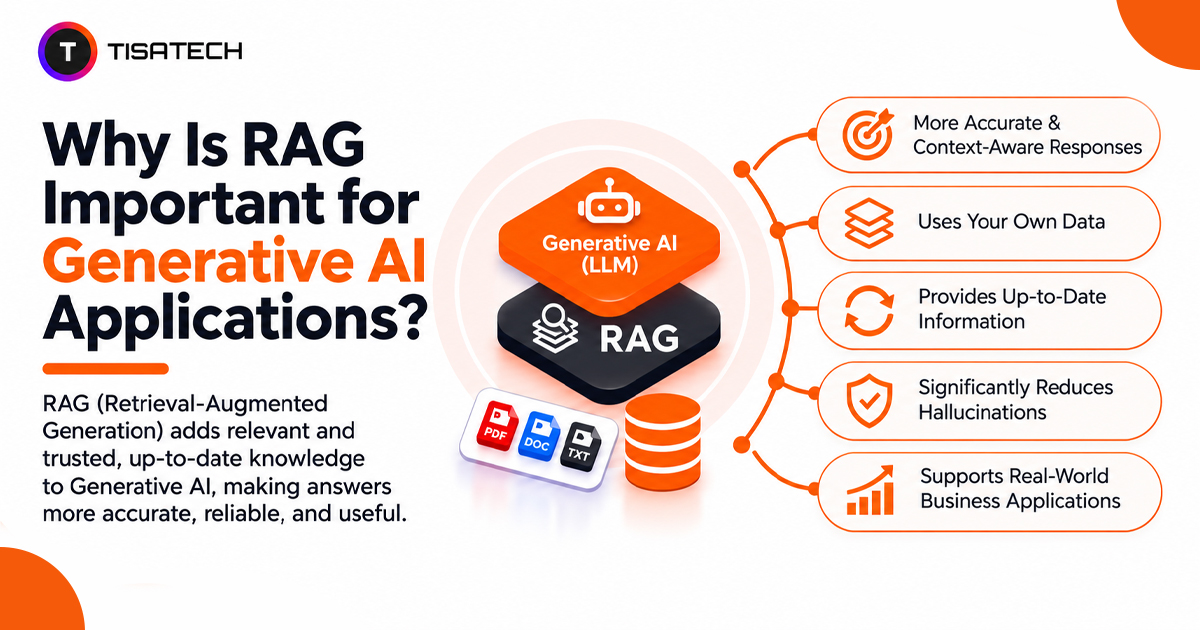
Retrieval-Augmented Generation (RAG) helps generative AI applications produce more relevant and accurate answers by connecting Large Language Models (LLMs) to external sources of information. Instead of relying only on patterns learned during training, an LLM can retrieve relevant details from PDFs, databases and updated documents before generating a response.
This approach helps reduce AI hallucinations, provides access to current and private information, and can lower costs by avoiding repeated model training. These capabilities make RAG useful for applications such as college FAQ bots, customer support systems and document-based assistants.
For example, when a student asks an AI tool for the latest exam date or course fee, RAG can retrieve the relevant information from an official college notice before generating an answer. As Google Cloud’s guide to RAG explains, connecting LLMs to external information helps ground their responses in relevant data.

Why Is RAG Important for LLM-Based Generative AI Applications?
Large language models (LLMs) learn patterns and factual information from their training data. However, they cannot automatically access information published after training or details stored in private documents and databases. As Google Cloud explains, this limitation can lead to outdated or inaccurate answers.
RAG addresses this gap by connecting an LLM to an external knowledge source. Think of it as an open-book exam: instead of relying only on memory, the model retrieves relevant information before answering. This gives it access to current facts and domain-specific knowledge without retraining the model.
Researchers at Facebook AI introduced the RAG framework in their 2020 research paper, published at NeurIPS. Their research showed how combining a pretrained language model with external retrieval could improve factual responses on knowledge-intensive tasks.
How Does RAG Work, Step by Step?
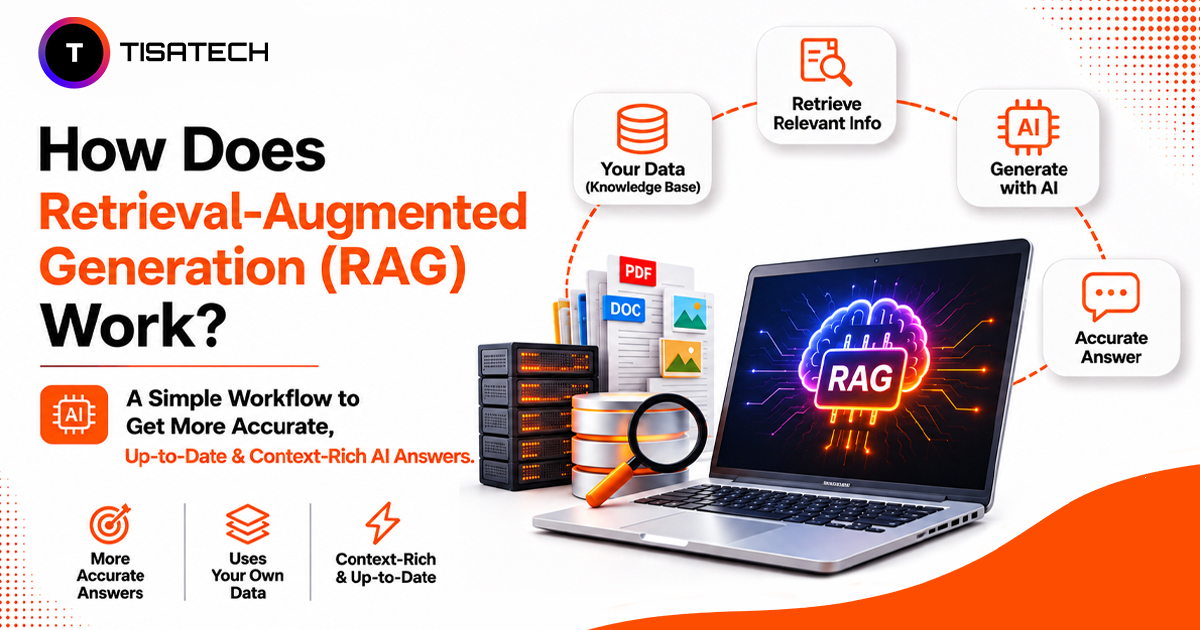
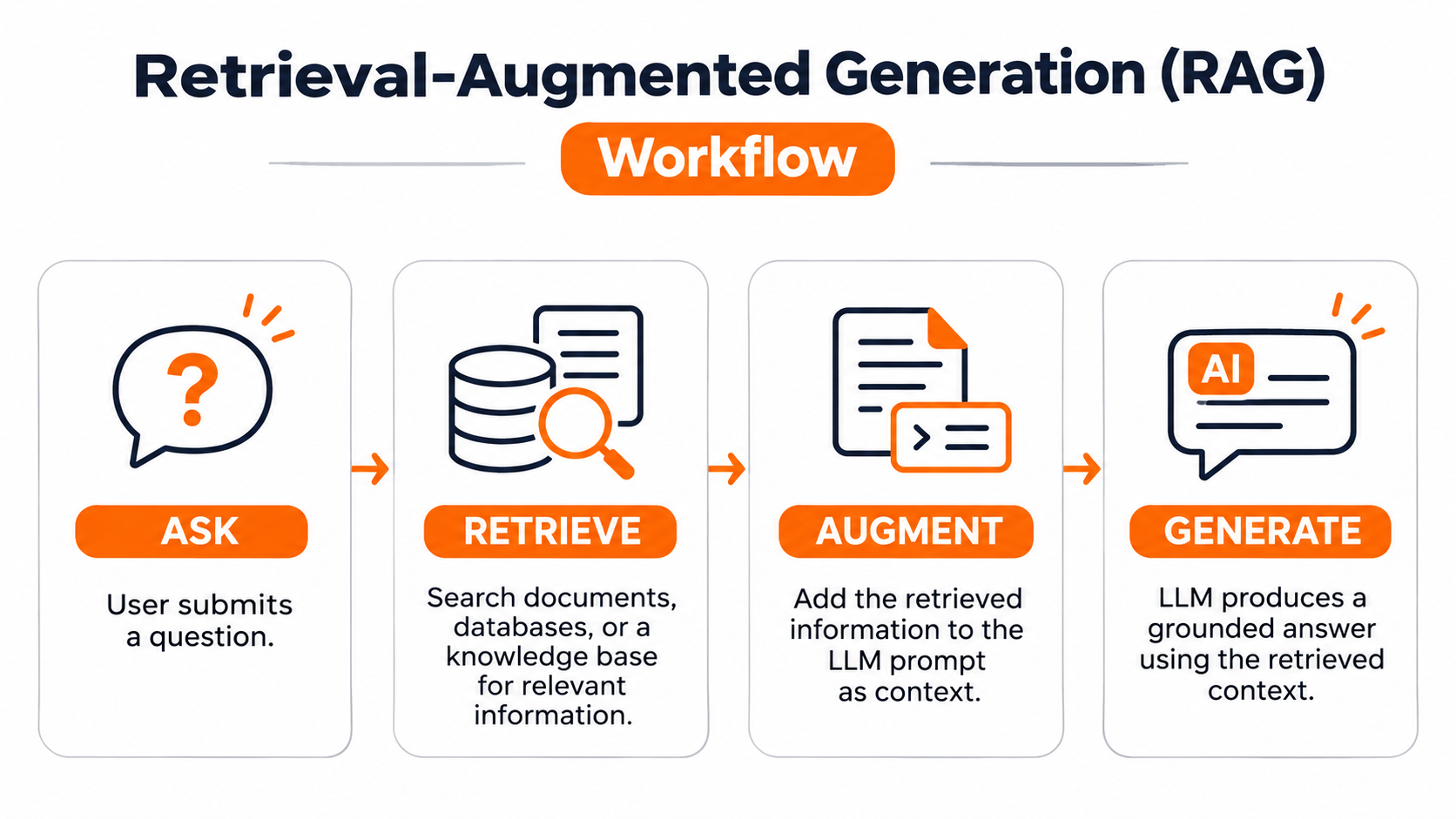
RAG follows four main steps to turn a user’s question into an answer grounded in relevant information:
- Ask: The user submits a question, such as “What is the last date to pay semester fees?”
- Retrieve: The system searches its knowledge base and finds relevant information from PDFs, web pages or database records.
- Augment: It adds the retrieved information to the original question as context for the LLM.
- Generate: The LLM uses that context to produce an answer.
But how does the system find the right information? Before users ask questions, RAG prepares documents for search. It splits them into smaller sections called chunks, converts each chunk into a numerical representation called an embedding, and stores the embeddings with their source content in a searchable index or vector database.
When a user submits a question, the system creates an embedding for that query and compares it with the stored embeddings. This helps retrieve passages with similar meaning, even when they use different words. For example, a search for “last date to pay fees” can find a document that says “fee submission deadline.”
A well-designed RAG system can also include source citations, allowing users to verify where an answer’s information came from.
The Microsoft Learn guide to RAG covers indexing, retrieval and grounding, while Databricks’ RAG guide provides further technical context.
How Does RAG Improve Accuracy in Generative AI Applications?
RAG can reduce AI hallucinations by giving an LLM relevant evidence before it generates an answer. Instead of relying only on learned patterns, the model can use information retrieved from trusted documents. Still, RAG does not guarantee factual accuracy.
Consider a college chatbot that answers questions about semester fees:
- Without RAG: A student asks for the second-semester exam fee. The model has no access to the college’s fee structure and may generate an incorrect amount.
- With RAG: The system retrieves the latest fee notice and passes the relevant details to the model. It can then answer using the published amount.
The quality of that answer depends on what the system retrieves. If it finds an outdated notice, misses an important detail or retrieves an irrelevant document, the model can still produce a wrong answer. Clear instructions to use the retrieved evidence and admit when information is missing help reduce this risk.
Accurate answers are only part of the picture. Protecting private information and controlling access to company data require additional safeguards.
How Does RAG Protect Private Data and Reduce Costs?
Companies often need AI tools to answer questions using internal information, such as HR policies, customer records and financial reports. RAG connects an LLM to these private sources without requiring the company to include that information in the model’s training data.
Connecting private data does not automatically make it secure. The system must enforce access permissions during retrieval so users only receive information they are authorized to view. For example, JetBlue’s BlueBot uses company data with role-based access: finance employees can retrieve financial information, while operations employees can access maintenance data. Databricks describes this implementation in its RAG guide.
RAG can also reduce model maintenance costs. When a company updates a policy or customer record, it can update the knowledge base instead of retraining the LLM. This saves time and avoids repeated model-training expenses. Teams must also account for document indexing, embeddings, search infrastructure and model usage. Microsoft’s documentation also covers these RAG cost and security considerations.
Is RAG Better Than Fine-Tuning?
Neither approach is better in every situation. They solve different problems: RAG gives a model access to external knowledge, while fine-tuning adapts how the model performs a task.
| Comparison Factor | RAG | Fine-Tuning |
|---|---|---|
| Main purpose | Connects an LLM to external knowledge | Adapts the model’s behavior |
| Information updates | Updates through the knowledge base | May require additional training |
| Best suited for | Private and frequently changing information | Consistent response style and task patterns |
| Example | Answering questions using the latest college fee structure | Following a specific response format |
| Data handling | Retrieves information when needed | Learns patterns from training examples |
For example, a college chatbot needs RAG to answer questions using the latest fee structure and exam dates. However, if it must consistently follow a specific response format, tone or task pattern, fine-tuning may help.
Use this simple rule to decide:
- Choose RAG when answers depend on private, updated or frequently changing information.
- Choose fine-tuning when the model needs more consistent task performance, response style or output formats.
- Combine both when an application needs current information and specialized response behavior.
For many document-based question-answering applications, RAG offers an effective way to connect LLMs with external information. If the model still struggles with task-specific behavior after you improve its prompts, consider fine-tuning.See Microsoft Learn for guidance on when to use each approach, while AWS compares their strengths and trade-offs.
Is RAG Still Needed With Long Context Windows?
Yes. Long context windows let models process large amounts of information in one request, but they do not make RAG unnecessary. The two approaches solve different problems.
A long context window works well when an application needs to analyze a specific set of documents together. RAG works better when users need answers from a large, frequently updated knowledge base because it retrieves relevant passages instead of sending every document with each question.
For example, a student analyzing an entire textbook may benefit from a long context window. But a college chatbot answering questions across thousands of changing notices, fee records and course documents can use RAG to find the relevant information first.
RAG can reduce the amount of text sent to the model, which may lower token usage and processing time. At the same time, retrieval adds infrastructure costs and latency, so the best approach depends on data size and how often users access it.
Google Cloud’s guide to long context windows explains how models process larger amounts of information in a single request.
Where Does RAG Still Struggle?
RAG can improve how an LLM uses external information, but its performance depends on several moving parts:
- Retrieval quality: If the system retrieves irrelevant or incomplete passages, the model may produce an off-topic or incomplete answer. Poor chunking and ranking can make this worse.
- Data freshness: When source documents change, teams must update the index. Otherwise, the system may retrieve outdated information.
- Response speed: Searching, ranking and generating answers add processing time, especially when the system handles large datasets or complex queries.
- Evaluation: Teams must test retrieval and answer quality separately. They need to check whether the system finds the right documents and whether the final answer accurately reflects those documents.
Microsoft Learn’s RAG evaluation documentation explains how to assess retrieval relevance and answer groundedness.
What Are the Benefits of RAG in Generative AI Applications?
RAG gives students a practical way to move beyond using AI tools and start building applications of their own. For example, you can create a chatbot that searches your study notes, answers syllabus questions or explains topics using selected course materials.
Building these projects also develops skills that matter in AI development, including document processing, text chunking, embeddings, vector search, prompt design and retrieval evaluation. These skills help demonstrate that you understand how to connect an LLM to real-world data, not just write prompts.
Good beginner projects include:
- Study notes assistant: Search class notes and get answers with references to the original material.
- Syllabus search tool: Find topics, units and learning objectives across course documents.
- College FAQ chatbot: Answer questions about admissions, fees, courses and exam schedules using official college information.
Start with Microsoft’s beginner RAG learning module to understand the core concepts. Then follow LangChain’s RAG tutorial to build a document-based application.
| Follow Us for Daily Tech Tips |



|
How Can You Learn RAG in Jaipur?
Understanding RAG requires more than learning its concepts through tutorials. Building a working application helps students understand how document processing, embeddings, vector search and LLM integration work together. Basic Python knowledge also makes it easier to develop and test these applications.
An AI training institute in Jhotwara, Jaipur can provide structured learning and practical exposure to these concepts. One useful project is a document-based chatbot that answers questions from college notes or PDFs. Students can use Python to process documents, divide them into smaller chunks, generate embeddings, retrieve relevant information and connect the results to an LLM to generate answers.
Conclusion
RAG helps AI answer questions using relevant, current sources instead of relying only on its training data. It connects language models to external information, including updated documents and private knowledge bases, making responses more relevant and easier to verify.
However, RAG is only as reliable as the information it retrieves. Poor search results, outdated documents and weak evaluation can still lead to inaccurate answers. Its success depends on relevant data, effective retrieval and regular testing.
For applications that need accurate, up-to-date and context-specific answers, RAG provides a useful way to connect LLMs with relevant information. Just remember to test it as carefully as you build it.
FAQs Section
Ans. Start with basic Python, APIs, JSON and prompt engineering. Understanding how LLMs generate responses will also help. You can learn embeddings, vector search and document processing while building your first RAG project.
Ans. Python is a popular choice because it offers libraries such as LangChain, LlamaIndex and frameworks for working with embeddings, vector databases and LLM APIs.
Ans. A basic RAG chatbot needs an LLM, an embedding model, a document processing method and a retrieval system. You can use Python, LangChain or LlamaIndex, and a vector database such as Chroma or FAISS.
Ans. A simple document-based chatbot may take a few days to build if you already know basic Python and APIs. The time depends on document quality, the tools you use and how much testing the project needs.
Ans. Build a working application, upload its code to GitHub and document its architecture. Mention the technologies used, how you handled document chunking and retrieval, and how you tested answer accuracy. Include a demo or screenshots if available.