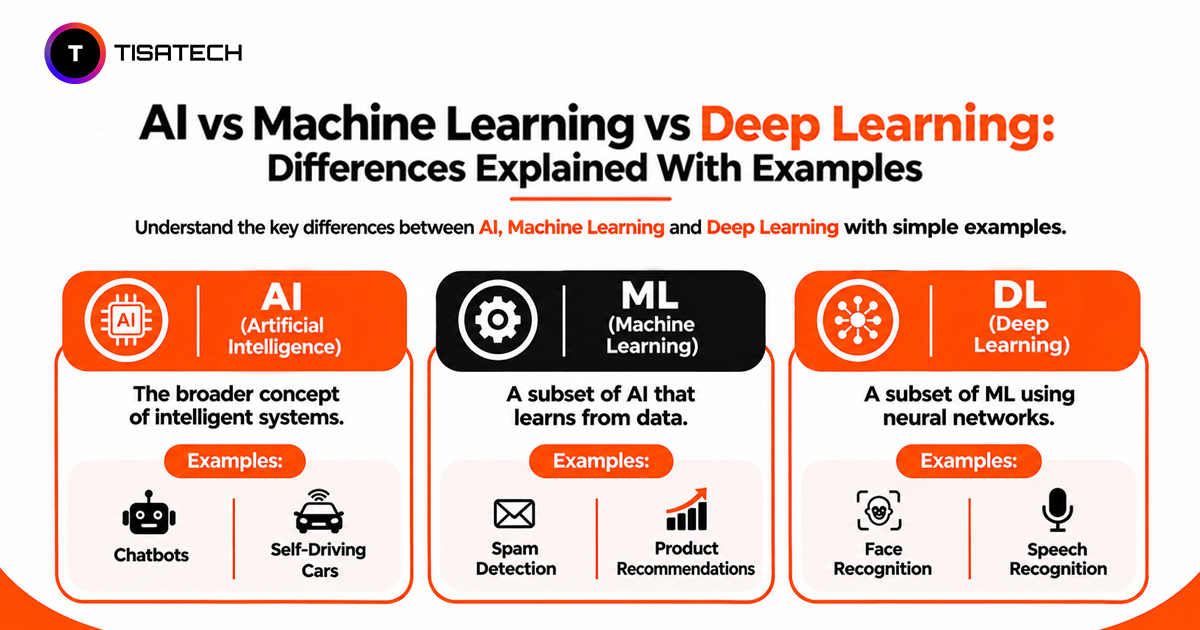
Artificial Intelligence (AI) is a broad field that focuses on making computers perform tasks that usually require human intelligence. Machine learning (ML) is a part of AI that helps computers learn patterns from data. Deep learning (DL) takes this further by using multi-layer neural networks to handle more complex tasks.
For example, a computer can play chess by following fixed rules, detect spam emails by learning from past emails or recognise faces using neural networks. All three are examples of AI, but they work in different ways.
According to Stanford’s 2026 AI Index Report, 88% of surveyed organizations used AI in at least one business function during 2025, compared with 78% in 2024. Understanding AI vs machine learning vs deep learning helps you see how these technologies differ and how they are used in everyday life.

How Are AI, Machine Learning and Deep Learning Connected?
AI is the largest field. Machine learning and deep learning are both subsets of AI, with deep learning sitting inside machine learning.
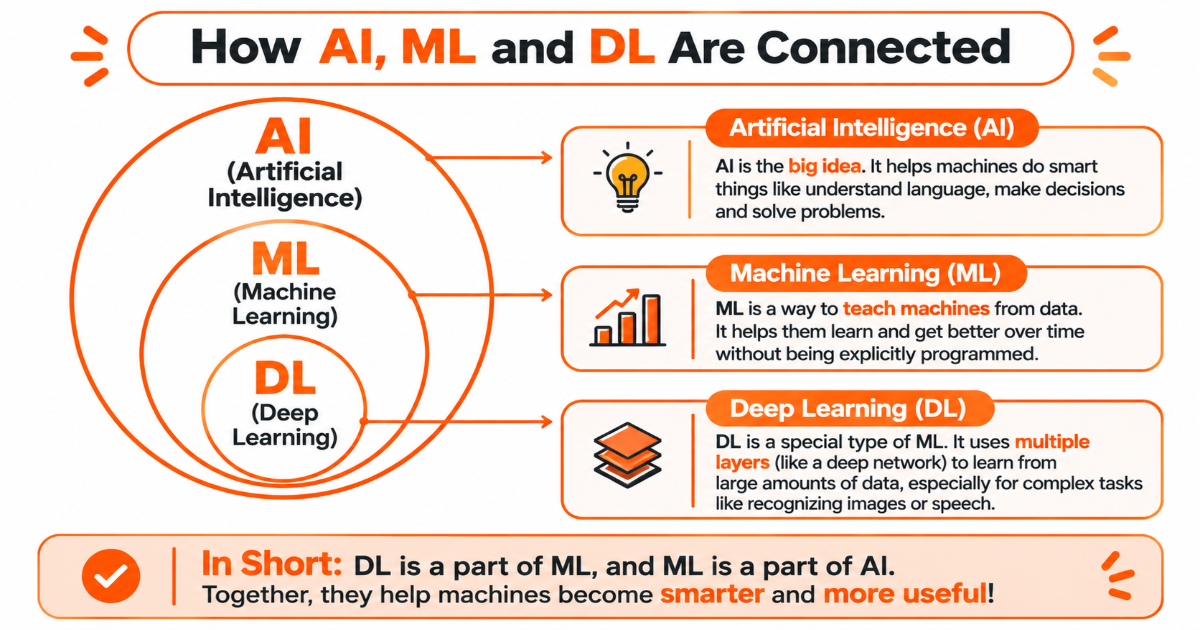
Think of three circles inside each other:
- AI: The broad field of building systems that perform tasks associated with human intelligence.
- Machine Learning: A branch of AI that learns patterns from data.
- Deep Learning: A branch of machine learning that uses multi-layer neural networks.
This AI ML DL hierarchy means every deep learning system is a machine learning system, and every machine learning system falls under AI. However, not every AI system uses machine learning. IBM’s guide to AI, ML and deep learning explains this relationship in more detail.
What Is Machine Learning and How Does It Work?
Machine learning allows computers to learn patterns from data instead of relying on rules written for every situation. A model studies past examples and uses what it learns to make predictions about new data.
For example, a house price prediction model analyses past sales using details such as house size, location and final price. It identifies patterns between these features and uses them to estimate the price of another house.
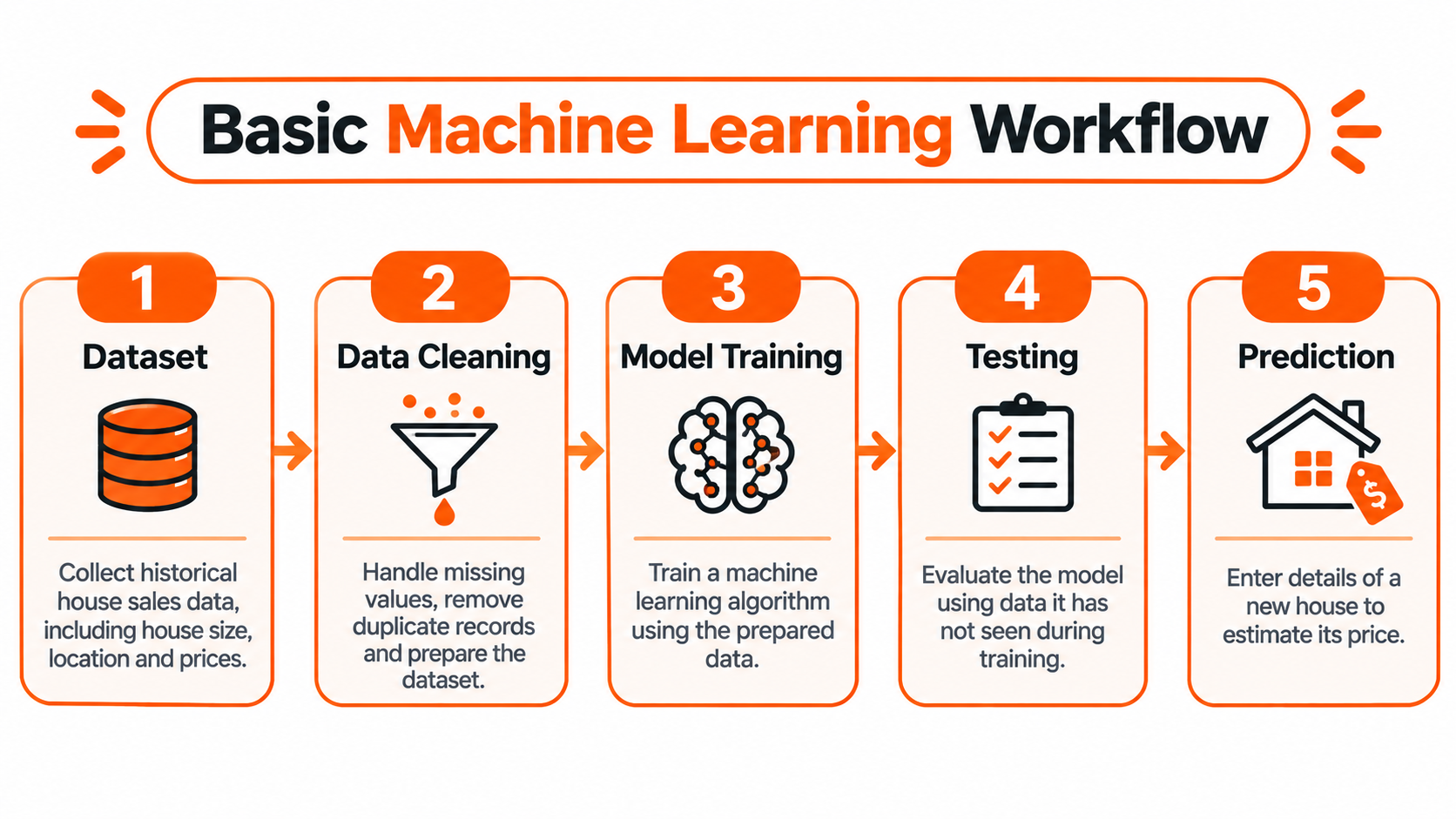
A basic machine learning project follows a sequence of steps:
Dataset → Data Cleaning → Model Training → Testing → Prediction
For a house price prediction project:
- Dataset: Collect past house sales data, including size, location and prices.
- Data Cleaning: Handle missing values, remove duplicate records and prepare the data.
- Model Training: Train a machine learning algorithm using the prepared data.
- Testing: Evaluate the model using data it has not seen during training.
- Prediction: Enter details of a new house to estimate its price.
This workflow shows how a machine learning model learns from historical data and applies those patterns to new examples.
Machine learning uses three common approaches:
- Supervised learning: Learns from labelled data that includes the correct answers.
- Unsupervised learning: Finds patterns or groups in data without predefined answers.
- Reinforcement learning: Learns through actions, feedback and rewards.
Data preparation still requires human input. Engineers select useful features, clean the data and evaluate model performance. You can refer to GeeksforGeeks’ guide to machine learning to understand these approaches in more detail.
Is All AI Also Machine Learning?
No. The difference between AI and ML is that AI can work through predefined rules, while machine learning learns patterns from data.
A rule-based chess program, for example, follows predefined instructions to choose its moves. It does not learn from previous games, so it uses AI without machine learning. IBM’s Deep Blue is another example. It defeated world chess champion Garry Kasparov in 1997 by searching millions of possible chess positions using brute-force computation, evaluation functions and chess-specific knowledge. Rather than learning from game data like modern machine learning models, it relied on powerful search algorithms and predefined rules to select its moves.
What Makes Deep Learning Different?
Deep learning is a branch of machine learning that uses neural networks with multiple layers to learn patterns from data. These layers help it process complex information such as images, speech and text.
For example, when analysing a cat photo, early layers detect edges and basic shapes, while deeper layers combine these details to recognise features such as ears, eyes and the overall shape of a cat.
One key difference between deep learning and many traditional machine learning approaches is feature extraction. Many traditional machine learning algorithms rely on engineers to select and prepare useful features from raw data. Deep learning models, on the other hand, can automatically learn relevant features from raw data through multiple neural network layers.
However, deep learning often requires more training data and computing power, especially when training large models. Its complex networks can also make their predictions harder to explain. As TechTarget explains, this lack of transparency is often called the black-box problem.
Deep learning works well for complex tasks such as image recognition and speech processing, while traditional machine learning can be a better fit for smaller, structured datasets.
How Do AI, Machine Learning and Deep Learning Differ?
AI, machine learning and deep learning differ in how they process information, use data and solve problems. The following comparison highlights their key characteristics, requirements and practical examples. You can also refer to GeeksforGeeks’ comparison of AI, machine learning and deep learning for further reading.
| Feature | Artificial Intelligence (AI) | Machine Learning (ML) | Deep Learning (DL) |
|---|---|---|---|
| Meaning | Systems that perform tasks associated with human intelligence | Models that learn patterns from data | Models that learn patterns through multi-layer neural networks |
| Place in Hierarchy | Broadest field | Subset of AI | Subset of Machine Learning |
| Data Requirements | May use data or predefined rules | Learns from labelled or unlabelled data | Often benefits from large datasets |
| Human Role | Defines rules, goals and decisions | Prepares data, selects features and evaluates models | Designs and evaluates networks; models learn features automatically |
| Computing Needs | Varies by application | Depends on the model | Often higher, especially for large models |
| Example | Rule-based customer support chatbot | Email spam filter | Face recognition system |
What Are Some Everyday Examples of AI, Machine Learning and Deep Learning?
You probably use all three without noticing the difference. Consider how different approaches can identify spam emails:
- Rule-Based AI: Checks predefined conditions, such as whether an email contains suspicious words, links or sender addresses. It flags messages that match those rules.
- Machine Learning: Learns from labelled examples of spam and legitimate emails. It identifies patterns and predicts whether a new email is spam.
- Deep Learning: Uses multi-layer neural networks to learn complex patterns in email text, sender information and other signals to classify messages as spam or legitimate.
All three approaches can help detect spam, but they differ in how they make decisions.
Rule-Based AI
Rule-based AI follows instructions written by developers rather than learning from data. A basic chess program, for example, checks possible moves against predefined rules to choose its next move. Similarly, a support chatbot replies using a fixed set of scripted answers.
Machine Learning
Machine learning learns patterns from past data and applies them to new situations. Common machine learning examples include Gmail’s spam detection, which separates unwanted emails from regular messages, and recommendation systems used by Netflix and Amazon to suggest content or products based on your activity. Banks also use machine learning models to identify unusual payment patterns that may indicate fraud.
Deep Learning
Deep learning handles more complex tasks by learning patterns through multi-layer neural networks. Google Photos uses deep-learning-based face recognition to identify and group photos containing similar faces. Facial recognition systems also help smartphones identify their owners. Voice assistants also use deep learning to recognise speech and process spoken requests.
ChatGPT and other generative AI chatbots also rely on deep learning to understand prompts and generate responses. To understand this application further, read the guides on generative AI vs traditional AI and generative AI vs predictive AI.
Which Should You Learn First: AI, Machine Learning or Deep Learning?
If you want to build AI models, start with machine learning. It teaches the foundations of model training, testing, predictions and error evaluation, which also help you understand deep learning.
Follow this learning path:
- Learn Python basics: Understand variables, loops, functions and basic programming.
- Work with data: Use libraries such as Pandas and NumPy to clean, organise and analyse datasets.
- Build machine learning models: Start with simple projects such as house price prediction and learn how to evaluate their results. Scikit-learn’s getting-started guide is a useful resource.
- Move to deep learning: Once you understand the basics, learn neural networks and build simple models using a framework such as PyTorch.
This order helps you understand what happens inside a model instead of treating its predictions as a black box. If you enjoy working with data, you can also read our guide on what data science is.
| Follow Us for Daily Tech Tips |



|
Where Can You Learn Machine Learning in Jaipur?
Understanding machine learning concepts is one thing; applying them to real datasets is another. The Machine Learning classes in Jaipur at TISA-TECH help students build this practical foundation through structured lessons and projects.
Students interested in building on these foundations can also explore AI learning programs, which cover AI fundamentals, neural networks and deep learning.
For a broader understanding of AI, the Generative AI training program is another option. Before enrolling, contact the institute to confirm the current syllabus, project details and batch timings.
Conclusion
AI, machine learning and deep learning are related, but they work in different ways and handle tasks of different complexity. Understanding these differences can help you decide what to learn and where to start.
If you are a beginner, start with Python basics and basic mathematics. Then learn to work with data using NumPy and Pandas. Try building a simple house price prediction model before moving on to more advanced machine learning methods and deep learning tools such as PyTorch.
FAQs Section
Ans. Beginners should start with Python and basic machine learning. Once they understand data, model training and evaluation, they can move to deep learning and neural networks.
Ans. No. Basic algebra, statistics and an understanding of graphs are enough to get started. You can learn linear algebra, probability and calculus as you work with more advanced models.
Ans. Python is a good starting point because libraries such as Pandas, NumPy and Scikit-learn make data analysis and model building easier.
Ans. Beginners can start with house price prediction, spam detection, student performance prediction and customer segmentation. These projects help practise data preparation, model training and evaluation.
Ans. Yes. Many learners start without a degree in computer science. Begin with programming and basic mathematics, then practise with datasets and beginner-friendly projects.
Ans. Yes. ChatGPT is built using deep learning models called large language models (LLMs). These models use neural networks, particularly transformer architectures, to process language and generate responses based on patterns learned during training.
AI vs Machine Learning vs Deep Learning: Key Differences
AI, Machine Learning, and Deep Learning are closely connected, but they are not the same. Discover how these technologies work, their key differences, and how they power today’s intelligent applications.
Explore AI Application Development ↗