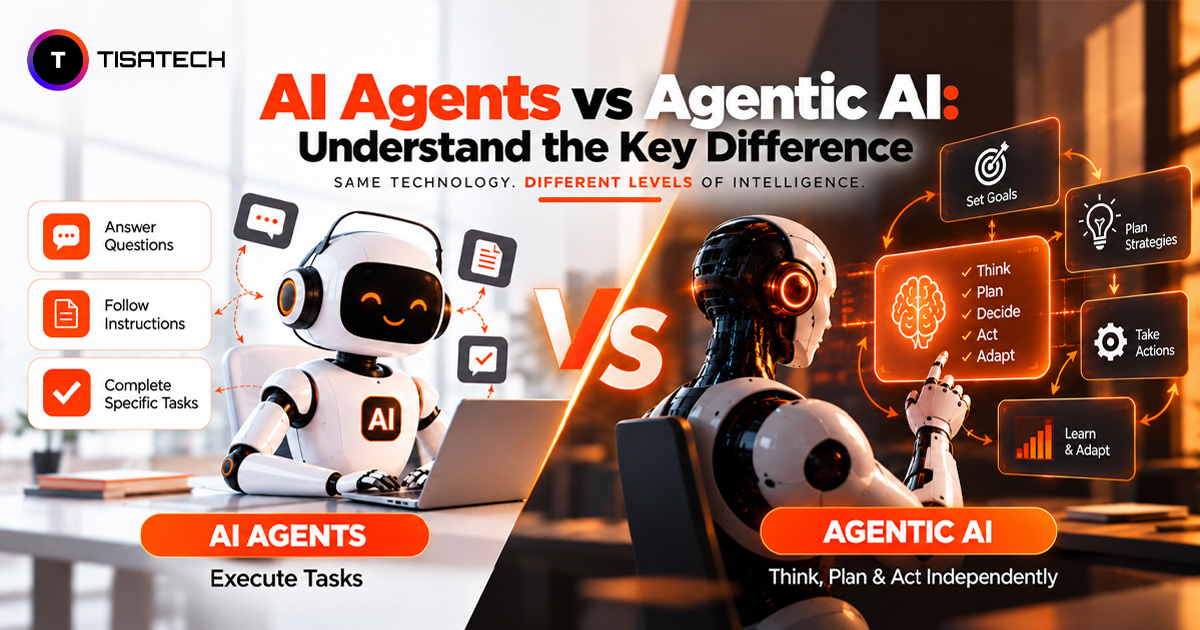
Artificial intelligence (AI) is becoming a part of everyday life, from chatbots that answer questions to tools that help people complete tasks. As AI becomes more capable, terms like AI agents and agentic AI are gaining attention. Although these terms are closely related, they are not exactly the same. An AI agent uses information and tools to work toward a goal, while agentic AI emphasizes planning, adapting, and handling tasks with greater independence.
Interest in AI agents is growing. Workday reported that 82% of surveyed organizations were expanding their use of AI agents. However, Gartner predicts that more than 40% of agentic AI projects will be canceled by the end of 2027 due to issues such as rising costs and unclear business value. Understanding the difference between these approaches can help you decide which one suits a particular task.

What Is an AI Agent in Simple Words?
An AI agent is a software system that uses available information and tools to work toward a goal. Think of the billing person at a shop. He checks records, prepares invoices, and handles payments. Depending on the task, he may also decide what to do next when something does not go as planned. An AI agent can do similar work through software.
Some agents follow predefined steps, while others can choose tools, plan actions, and respond to new information. Their capabilities depend on how developers design them and how much independence they allow.
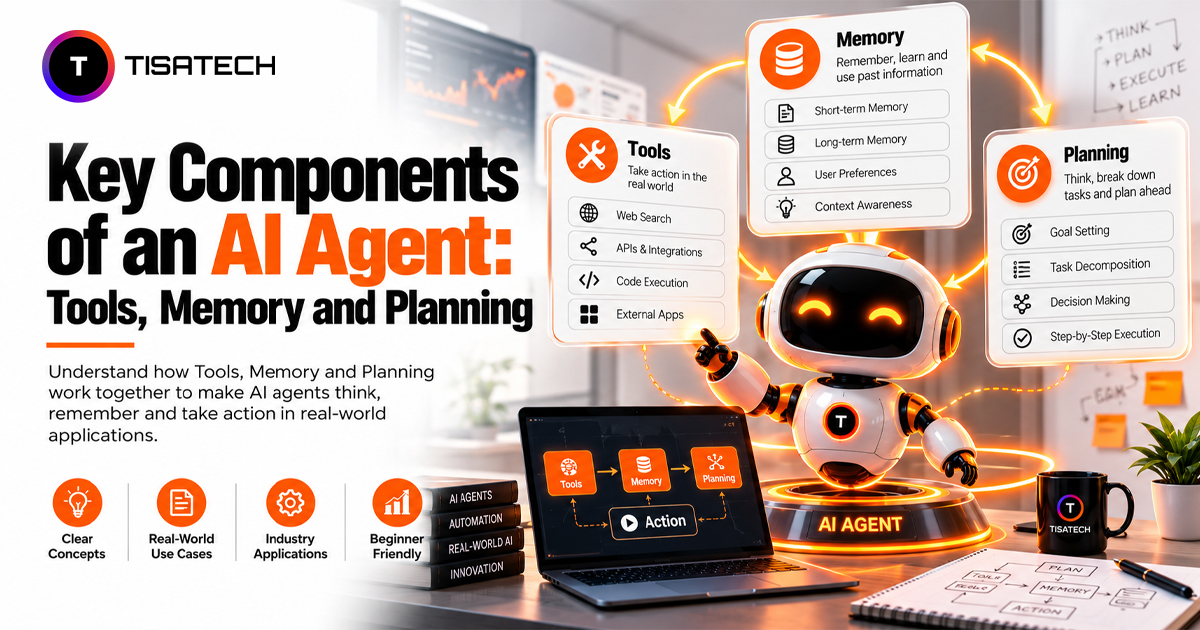
Most agents use a large language model to understand your request. Then they act through tools like a calendar, a search engine, or a company database. IBM’s overview of AI agents covers this in more detail. The simplest agents follow a fixed script. More capable ones plan a few steps, choose their own tools, and change course when a result looks wrong.
You probably use one already. An agent can sort your inbox, book a meeting slot, or answer a support ticket.
People usually set the limits for an agent: which tools it can use, what it can change, and when it must ask for help. That keeps it safe and predictable, but it also limits what the agent can do. Anthropic’s guide to building effective agents separates fixed workflows from agents that choose their own steps. To see the full process, read our guide on how AI agents work.
A chatbot mainly responds to messages. Generative AI creates content such as text or images. Robotic process automation (RPA) follows predefined rules to perform repetitive tasks. An AI agent can go further by selecting tools and taking actions to achieve a goal. These categories can overlap, depending on how a system is built.
What Is Agentic AI and How Does It Work?
Agentic AI refers to AI systems designed to work toward a goal with greater independence. Instead of responding to each instruction separately, these systems can plan steps, use tools, evaluate results, and adjust their approach as needed. Depending on the task and system design, they may also ask for human input or approval before taking certain actions.
A typical agentic workflow follows a few steps:
- Set a goal: Understand the task and expected outcome.
- Plan the work: Break the task into smaller steps.
- Take action: Use tools or retrieve information.
- Evaluate the result: Check whether the action helped achieve the goal.
- Adjust or ask for help: Continue, revise the plan, or request human approval when needed.
Not every agentic system follows all five steps in the same way. The workflow depends on the task, system design, and level of autonomy.
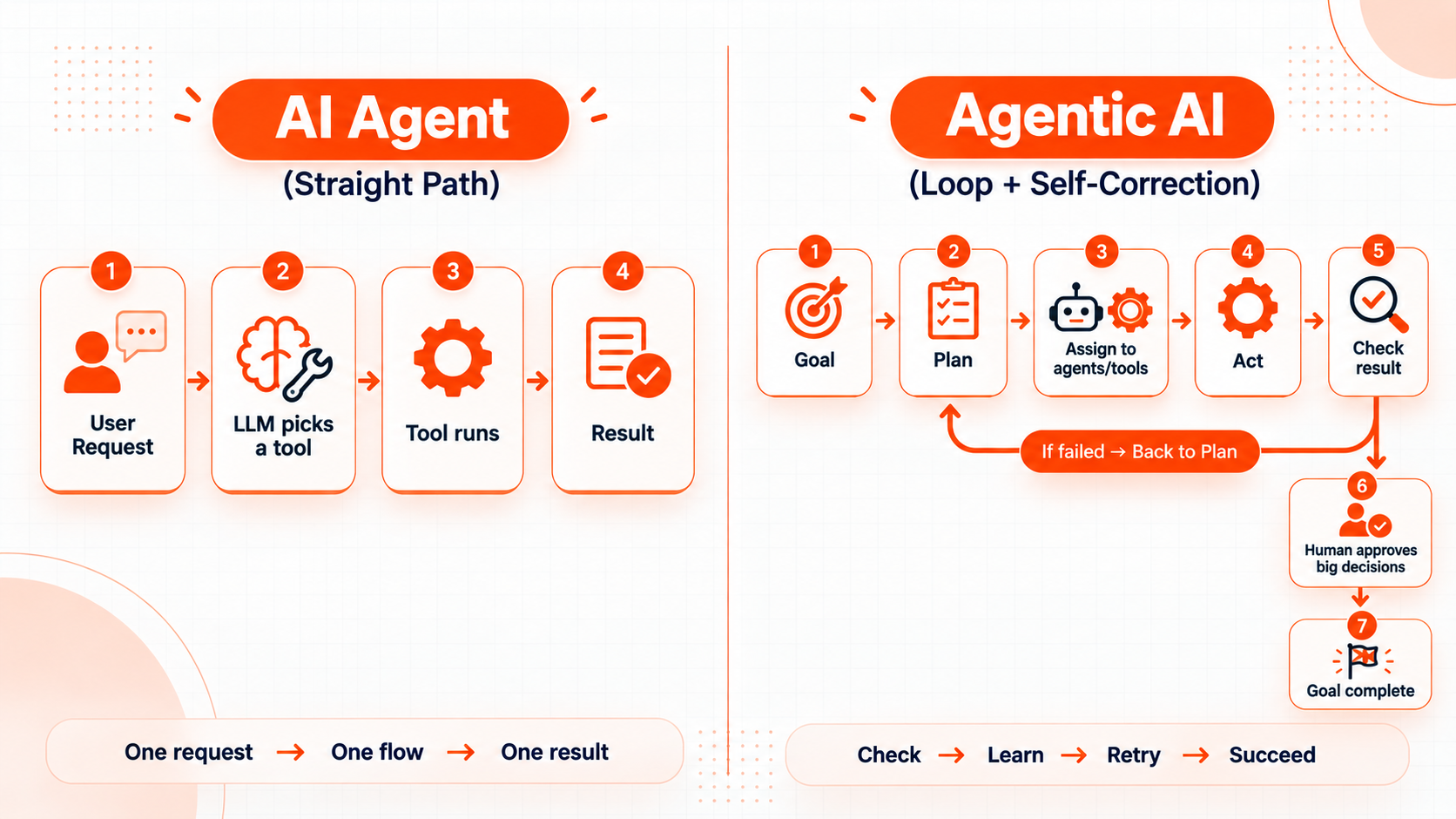
Bigger goals usually need several agents. Take a software team as an example. One agent writes the code, another tests it, and a third scans for security gaps. A coordinating layer keeps all three moving toward the same goal. Developers build this setup with orchestration frameworks. LangGraph models a workflow as a graph of steps, where each step can loop back, branch, or pause for human approval. CrewAI assigns agents roles, like researcher or writer, and lets them work as a team. Choose LangGraph when you need tight control over the flow. Choose CrewAI when you want to set up a role-based team quickly. Humans should still review and approve important decisions.
What Is the Difference Between AI Agents and Agentic AI?
The two approaches differ mainly in how a task is structured and managed. These are typical patterns, not strict boundaries between two separate categories.
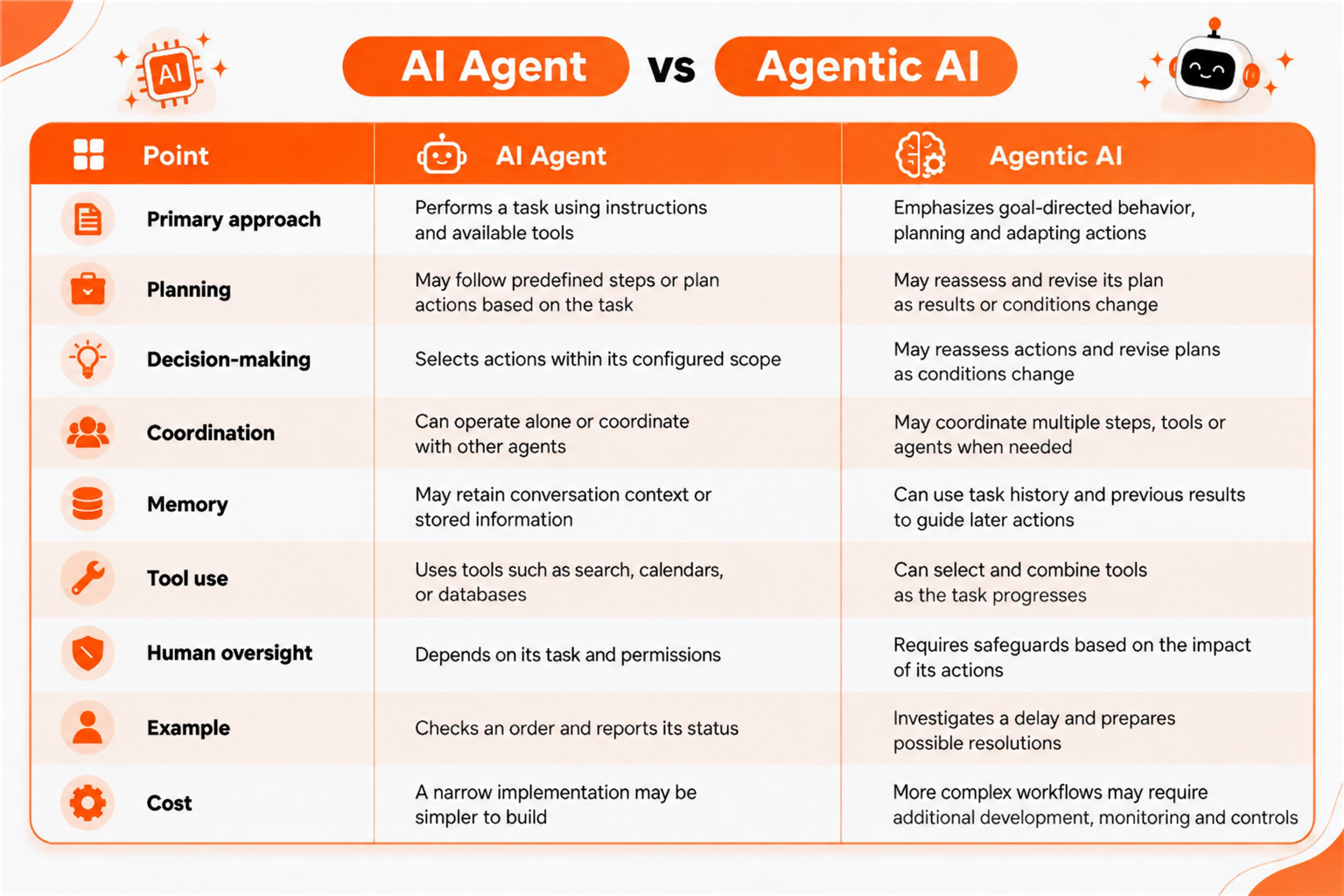
These are typical design patterns, not strict boundaries. A single AI agent can plan, use memory, select tools, and adapt its actions. The term “agentic AI” describes the broader approach and degree of independence, not simply the number of agents involved.
Is Agentic AI the Same as AI Agents?
Not exactly. An AI agent is a system that takes actions toward a goal, while agentic AI describes a broader approach to handling tasks with greater flexibility and independence. A single AI agent can also show agentic behavior when it can plan actions, use tools, and adjust its approach.
Gartner uses the term “agent washing” for products marketed as agentic AI without meaningful agent capabilities. Look at what a system can actually do rather than relying on its label.
What Are the Benefits of Agentic AI?
Less manual work: Agentic systems can coordinate connected tasks that would otherwise require employees to move each step forward. For example, a system could gather information about a refund request and prepare it for review.
Better handling of unexpected problems: Systems that evaluate results can respond to changing conditions instead of relying entirely on a fixed workflow. Their performance depends on the quality of their tools, instructions, and safeguards.
More time for important decisions: An agentic system can gather records, compare available options, and prepare a recommendation before an employee reviews it. Employees can then focus on exceptions and decisions that require human judgment.
Gartner predicts that at least 15% of day-to-day work decisions will be made autonomously through agentic AI by 2028, up from 0% in 2024.
These benefits depend on the use case and implementation. Poorly controlled systems can introduce errors, unexpected costs, and additional work.
When Should You Use Agentic AI Instead of a Single AI Agent?
Choose a single AI agent for tasks with a clear scope, predictable steps, and limited consequences if something goes wrong. Examples include answering common questions, sorting emails, and extracting information from documents.
Consider an agentic approach when a workflow involves several dependent steps, changing conditions, or decisions that need repeated evaluation. Examples include investigating delayed orders, coordinating a product launch, or diagnosing a complex IT incident.
Ask whether the next action depends on the outcome of the previous step. If a straightforward workflow handles the task reliably, extra autonomy may not justify the cost. Start with a small use case and measure its results before expanding.
Agent vs Agentic System: A Side-by-Side Example
Imagine you run an online store. A customer asks, “Where is my order?” Their package is already five days late. Here is how two differently configured AI systems might handle the situation.
| Step | Task-Focused AI Agent | Agentic AI System |
|---|---|---|
| Request | Reads the customer’s question | Reads the question and sets a goal to investigate the delay |
| Action | Checks tracking information and retrieves the latest status | Checks tracking, reviews available stock, and compares delivery options |
| Problem Found | Reports the delay or prepares a suggested next step | Uses the findings to compare possible resolutions |
| Decision | Shares its findings or recommends an action within its configured scope | Prepares a replacement or refund option for human approval |
| Customer Reply | Shares the tracking status or proposed next step | Prepares a personalized update based on the proposed resolution |
| Result | Provides information or assistance based on its configured capabilities | Coordinates several steps and prepares a resolution for review |
A task-focused agent may be enough to answer “Where is my order?” An agentic system is more useful when resolving the delay requires checking multiple sources and comparing possible solutions. However, a single agent can also handle several steps if it has the necessary tools and permissions. The right setup depends on the complexity of the task, not simply the number of agents.
What Risks Should You Know Before You Start?
Agentic systems can take actions with limited step-by-step human input. That independence makes oversight, permissions, and monitoring especially important. Four risks deserve attention before deployment.
Errors spread. One wrong decision in step two can corrupt steps three to ten. Imagine an agent that misreads a refund policy and then approves fifty refunds before anyone notices.
Costs climb. Several agents calling AI models in a loop can burn through your budget fast, especially when a retry loop never ends.
Access gets abused. An agent with too much access can leak or overwrite the wrong data. Attackers can also hide instructions inside a web page or email so the agent follows them. This is called prompt injection, and the OWASP Top 10 for LLM Applications lists it as a leading threat.
Projects fail. Gartner predicts that over 40% of agentic AI projects will be canceled by the end of 2027. The reasons are rising costs, unclear value, and weak risk controls.
Four habits cut most of this risk:
- Give each agent only the access it needs.
- Keep a human in the loop for big decisions, like payments or deleting data.
- Set a spending limit and a step limit for every run.
- Save logs so you can see exactly what happened.
Learn the basics of AI agent security and governance before you go live.
| Follow Us for Daily Tech Tips |



|
How Can Students in Jaipur Build Agentic AI Skills?
Students in Jaipur can start building agentic AI skills by learning Python, API integration, large language models (LLMs), tool calling, and AI workflow design. Beginners should focus on these fundamentals before progressing to multi-step AI agents that can plan tasks, use tools, and execute workflows with appropriate human oversight.
TISA-TECH offers Generative AI and Machine Learning courses in Jaipur for learners interested in developing AI applications. Generative AI training can help students explore language models and AI-powered applications, while Machine Learning provides a foundation in model training, algorithms, and evaluation. Before enrolling, review the latest curriculum, hands-on projects, and practical coverage of agentic AI concepts to determine whether the program aligns with your learning goals.
Conclusion
AI agents and agentic AI are closely related, but they suit different levels of task complexity. A single agent may be enough for a well-defined task, while workflows involving changing conditions and multiple dependent steps may benefit from a more agentic approach. Choose the simplest setup that delivers reliable results for your needs.
FAQs Section
Ans. An AI agent uses information and tools to work toward a goal. Agentic AI describes a system that can plan, act, check results, and adjust its approach with a degree of independence.
Ans. ChatGPT can act as an AI agent when it uses available tools to complete tasks. Whether it behaves agentically depends on the capabilities enabled and how the task is handled.
Ans. Learning how individual agents use language models, tools, and instructions is a useful starting point. You can then build on that knowledge to understand planning, evaluation, and multi-step workflows.
Ans. Start with basic Python, API fundamentals, and an understanding of large language models. You can then practise with frameworks such as LangGraph or CrewAI and learn how to test and monitor your systems.
Ans. Yes. Start with a small project, such as a research assistant that gathers information, summarizes findings, and prepares a report. Add more steps only after you can test each stage and handle errors reliably.