Every year, many students in Jaipur come across AI job listings that ask for a “B.Tech in Computer Science.” Students from BCom, BBA, arts, science, or other non-technical backgrounds often assume that they are not eligible for these roles. Some may already know Python, AI tools, or basic machine learning, but the degree requirement still makes them hesitate to apply.
But the hiring market is changing. India posted 290,256 AI-linked roles in 2025, and experts expect AI hiring to grow by 32 percent in 2026, according to a Foundit report covered by newkerala.com. The report also listed Jaipur among the emerging Tier 2 hubs for AI jobs.
A workforce report by Scaler shows the same shift. Nearly 25 percent of AI learners in India come from non-technical backgrounds, and almost half of AI career outcomes now fall outside traditional software roles.
This does not mean that degrees no longer matter. Some companies and specialised roles still ask for technical qualifications. However, many employers now also look at practical skills, projects, and problem-solving ability.
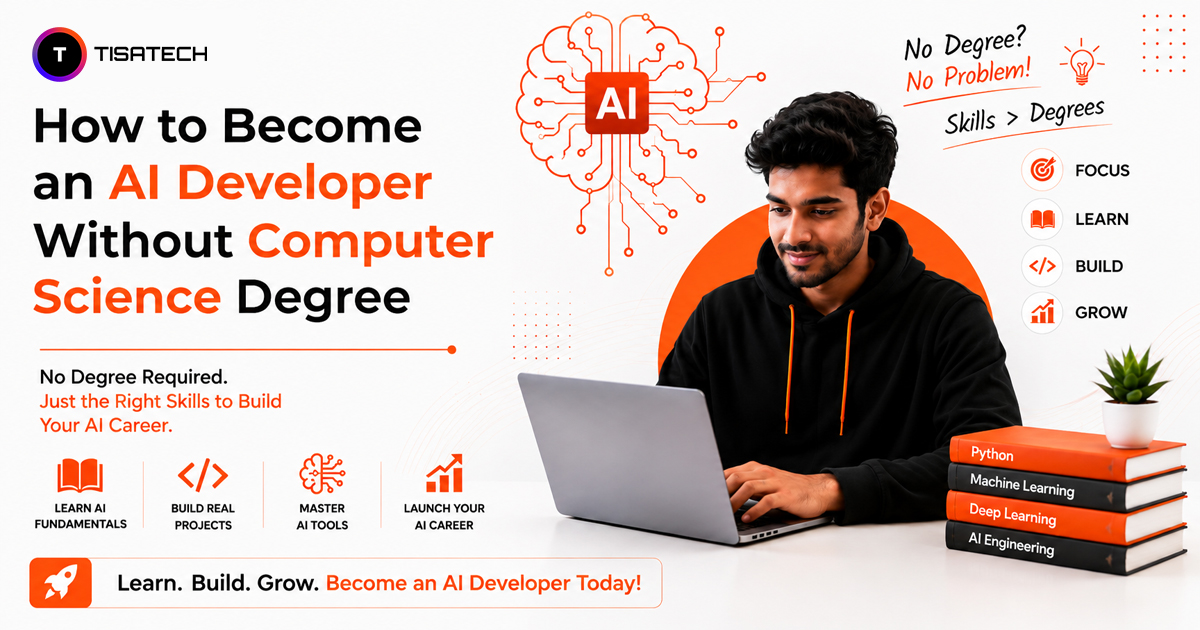
So, you can still become an AI developer without a computer science degree. You need to learn the right skills, build real projects, and prove what you can do.
This guide explains that path step by step.

Can You Become an AI Developer Without a Computer Science Degree?
Yes, you can. A computer science degree can help, but it is not the only way to enter AI.
Many companies also look at practical skills. They may check your GitHub profile, projects, coding ability, and how well you explain your work during an interview. If you can build a useful AI project and understand how it works, you can still compete for entry-level roles.
There is also a growing need for people with AI skills. This creates more chances for learners who build strong practical knowledge, even if they do not have a CS degree.
A non-technical background can also be useful. For example, someone from marketing, finance, or healthcare may already understand problems from that field. That knowledge can help them build AI solutions that are more useful in real situations.
So, becoming an AI developer without a degree is possible. You need the right skills, practical projects, and a clear understanding of how AI can solve real problems.
Complete Roadmap and Skills You Need to Become an AI Developer
If you do not have a computer science background, start with the basics and move forward step by step. You do not need to learn everything at once.
Step 1: Start With Python Basics
Python is the starting point for AI development because it gives you the basic programming skills you need. Start with variables, loops, functions, conditions, lists and dictionaries. Then move to Pandas and NumPy to start working with data.
Step 2: Understand Math and Data Basics
You only need the math that supports your AI work. Start with algebra, probability, statistics and simple linear algebra. At the same time, practise reading datasets, cleaning data, finding patterns and creating simple charts. This will make the next stage much easier.
Step 3: Learn Machine Learning
Now start working with machine learning concepts such as supervised learning, unsupervised learning, regression and classification. Use Scikit-learn to train simple models. A spam classifier or price prediction project is enough to understand how the process works.
Step 4: Move to Deep Learning
Once machine learning basics make sense, move to neural networks and deep learning. Understand layers, model training and how a neural network handles data. Start with either PyTorch or TensorFlow. There is no need to learn both at the same time.
Step 5: Work With Generative AI and APIs
This is where you can start building tools that feel more like current AI applications. Learn how large language models and AI APIs work with your code. Try a chatbot, resume analyser or document assistant. These projects also give you practice with prompts and API responses.
Step 6: Learn Git, GitHub and Deployment
As your projects grow, you need a proper way to manage and share them. Use Git for code changes and GitHub for keeping your work in one place. Also learn basic command line use and simple deployment so your projects can run online instead of only on your system.
Step 7: Build Projects and Prepare for Jobs
By this stage, focus less on tutorials and more on complete projects. Two or three good projects are enough if you understand them properly. Keep your work on GitHub, add clear project details and practise explaining what you built. Then start preparing your resume and applying for entry-level AI roles.
A complete beginner may take around six to twelve months to reach this stage. The time can vary, but following the steps in order will keep the learning process much clearer.
How Do You Build a Portfolio That Helps You Get Hired?
A strong portfolio shows recruiters what you can actually build. Tutorials and certificates support your learning, but real projects give better proof of your skills.
Build two or three useful projects. Try to include one machine learning project and one generative AI or API-based project. Choose problems that are clear and easy to explain.
Upload each project to GitHub with a simple README that covers the problem, tools used, solution and result. Add screenshots or a live demo when possible.
Make sure you understand every project well enough to explain your choices and answer questions during an interview.
You can also share your work on LinkedIn and connect with people working in AI. This can help you get feedback, find opportunities and make your work more visible.





How Can TISA-TECH Help Jaipur Students Start This Journey?
Students without a computer science background often need a clear starting point rather than a long list of topics. TISA-TECH helps Jaipur students begin with the basics and gradually move towards AI, machine learning and practical project work.
The training helps students build skills in AI development through programming, AI tools and project-based practice. Mentors also support students when they get stuck, which can make the learning process easier for complete beginners.
Students work on projects that they can add to their portfolio while preparing for internships or entry-level roles. TISA-TECH also provides resume support, interview preparation and placement assistance.
For students who want clear guidance in AI, this gives them an easier way to start learning and move forward.
Conclusion
You do not need a computer science degree to become an AI developer. Start with Python, learn machine learning and AI tools, then build real projects to show your skills.
Some roles may still ask for a technical degree, but practical skills and a strong portfolio can open entry-level opportunities. Students in Jaipur can also get structured training and project support from TISA-TECH while preparing for AI roles.
FAQs Section
Ans. Yes. You can become an AI developer without a degree if you have the right skills, practical knowledge and strong projects to show employers.
Ans. Most beginners can learn the required skills in 6 to 12 months with regular practice. People with a technical background may take less time.
Ans. Start with Python. It is one of the main programming languages used in AI and machine learning.
Ans. Yes. AI jobs can offer good salaries even without a computer science degree. Your skills, projects and experience usually matter more.
Ans. No. Basic statistics, probability and linear algebra are enough to get started. You can learn advanced math later as needed.
Ans. Yes. TISA-Tech provides practical AI training, live projects and career support to help beginners build job-ready AI skills.