Open ChatGPT, Gemini, or Meta AI on WhatsApp, type one line, and an answer appears in seconds. Ask for a poster, and you get a picture. Ask for a code fix, and you get working code. Students, freelancers, and shop owners across India now do this every day. But how does generative AI work behind the screen?
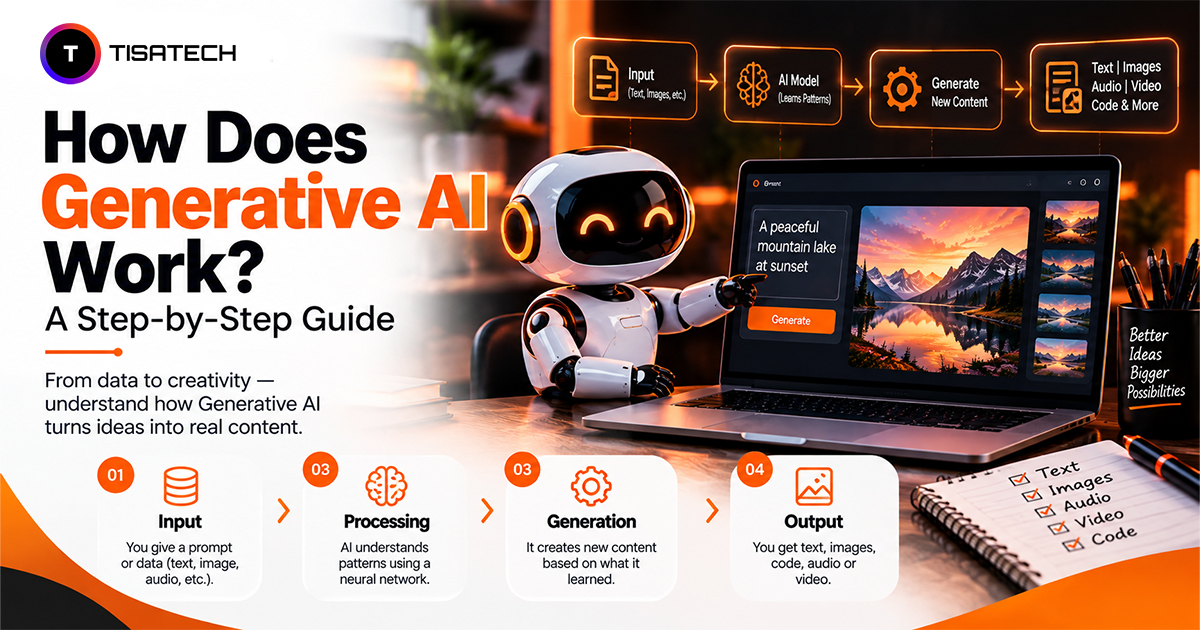
The short answer: Generative AI does not understand information exactly the way people do. During training, it processes large amounts of text, images, code, audio, or other data to learn patterns. When you send a prompt, the system converts it into numerical representations, processes those representations through a trained model, and generates an output step by step.
In this guide, you will follow each step with simple examples, from tokens and transformers to the reason AI sometimes gets facts wrong.

Why is everyone talking about generative AI right now?
Since ChatGPT launched in late 2022, generative AI has moved from tech news into daily life. One reason is how easy these tools are to use. People no longer need technical skills to get useful results from AI. Students use AI tools to plan assignments, freelancers use them to draft proposals, and shop owners use them to design posters in minutes. The wide range of everyday uses has made generative AI relevant to people far beyond the tech industry.
In a Google/Ipsos survey from late 2025, 83% of people in India said they had used generative AI in the past year. Only the UAE and Nigeria scored higher among the 21 countries surveyed. Rutgers University’s GenAI Adoption Tracker follows working-age Indians and shows the same trend. Its authors say the figures are upper-bound estimates, because online surveys reach people who already use AI.
What is the main idea behind generative AI?
Generative AI learns patterns from huge amounts of data. Then it uses those patterns to create something new when you give it a prompt. It does not simply retrieve a ready-made answer from its training data. Instead, it uses learned patterns and the information in your prompt to generate an output. Microsoft’s AI 101 guide explains the same idea in a beginner-friendly way.
You can understand the process in three broad steps:
- Training: The model processes large amounts of text, images, audio, or other data and adjusts its parameters to capture useful patterns.
- Representation: The data is converted into numbers that the model can process and relate to one another.
- Generation: When you enter a prompt, the trained model uses what it learned to predict and generate new content step by step.
What data does generative AI learn from?
Different models learn from different types of data. Text models learn from books, articles, websites, and code. Many of them use Common Crawl, a free public archive of web pages. A 2024 Mozilla Foundation study found that at least 64% of 47 large language models released between 2019 and 2023 trained on filtered versions of it. Image models learn from pictures paired with short captions. The LAION-5B dataset, for example, holds 5.85 billion image-text pairs. Audio and video models learn from speech, music, and clips that show how things move.
More useful data can help a model learn a wider range of patterns, but data quality matters just as much. Duplicates, low-quality pages, harmful content, and other noise can affect what a model learns. Raw web data is messy, so teams clean it before using it for training. They remove junk, duplicates, and other low-quality content. One Google-led study found that a single 61-word sentence was repeated more than 60,000 times in a popular training dataset. Examples like this show why cleaning and filtering training data matters.
What are tokens and why do they matter?
Tokenization is the process of breaking text into small pieces called tokens. The system assigns each token a number from a fixed vocabulary. A token can be a whole word or just part of one. Common words like “the” usually stay whole, while rarer or longer words may split into smaller parts, so “learning” may become “learn” and “ing.” This subword approach keeps the vocabulary manageable and lets the model handle words it has never seen before.
Next, the model represents each token as a longer list of numbers called an embedding. These numerical representations help the model capture relationships between tokens and their context. Tokens used in similar contexts often have more similar representations. “Happy” and “joyful” sit close together, while “happy” and “table” sit far apart.
A model has a token limit that applies to the input and output combined. Many tools also charge by the token. One English token is often around four characters or about three-quarters of a word, although the exact number varies by tokenizer and text. Hindi and other non-English texts usually need more tokens per word, so the same message takes up more room. You can paste your own text into OpenAI’s tokenizer tool and see exactly how it splits.
Images follow a similar idea. The system cuts a picture into small patches and turns each patch into numbers, much like words.
How does generative AI learn from data?
Learning happens through a simple guessing game. The model sees a sequence of tokens with the next token hidden and tries to predict it. Then it compares its prediction with the actual next token. If the prediction is wrong, it measures the error and adjusts tiny numbers inside itself, called parameters or weights, to do better next time. This adjustment process uses a method called gradient descent. The model keeps adjusting its parameters in a direction that reduces its error.
The model repeats this process across large amounts of data, gradually improving its predictions. Meta trained its 405-billion-parameter Llama 3.1 model on over 15 trillion tokens, using more than 16,000 GPUs.
What do neural networks and transformers do?
A neural network is a stack of connected layers. Each layer has many small units that take numbers in and pass numbers out.
Older networks, called recurrent networks, read text one word at a time. That made them slow to train and weak on long sentences. In 2017, Google researchers published Attention Is All You Need, which introduced the transformer. It dropped the word-by-word reading and made training much faster. Most modern AI tools now use this design.
Attention lets a transformer decide which words in a sentence matter most for understanding each word. In “The bank near the river was calm,” the model focuses on “river” to know that “bank” means a riverside, not a financial institution.
Transformers use attention across tokens to capture relationships in complex inputs. Different attention heads can focus on different relationships.
How does generative AI predict the next word?
When you type a prompt, the system turns it into tokens, then into numbers. Those numbers pass through many transformer layers. At the end, the model scores every possible next token, and the scores become probabilities. Take the prompt “The sun rises in the.” The model might assign a high probability to “east” and a much lower probability to unrelated words such as “kitchen.” As 3Blue1Brown explains, the model assigns a probability to every possible next word instead of picking one with certainty.
The model doesn’t always pick the most likely next word. Always choosing it (greedy search) works for short outputs but gets repetitive in longer ones. So the model uses sampling, picking randomly but weighted by probability. A setting called temperature controls how adventurous this is: low gives predictable replies, high gives more variety. That’s why the same prompt can give a different reply each time.
How does generative AI generate content from a prompt?
Let’s follow one prompt from start to finish. Say you type: “Explain photosynthesis to a class 9 student.”
- Tokenize: The system splits your sentence into tokens and gives each one a number.
- Embed: It turns each token into an embedding, so the model can read the meaning.
- Process: The transformer layers use attention to link the words. The model sees that “class 9 student” means it should keep the answer simple.
- Predict: The model scores every possible next token and picks one by sampling. For this prompt, it may pick “Photosynthesis” first.
- Repeat: It adds that token to the text and predicts the next one. This loop continues until the answer is complete.
A specific prompt gives the model more context and steers its predictions toward a more focused output, and the Claude prompting guide makes the same point about being clear and direct.
Compare these two prompts:
- Vague: “Write about AI.”
- Specific: “Write a 150-word intro on AI for first-year students in simple English.”
The second prompt gives the model a topic, a length, an audience, and a language level. So its predictions stay on target, and the answer needs fewer edits.
Remember the token limit, too. The model can only “see” a fixed amount of text at once. This is called the context window. In a very long chat, early messages may fall outside it, so the model can seem to forget them.
How does AI generate text and images?
Text models and image models both learn patterns, but they build content in different ways.
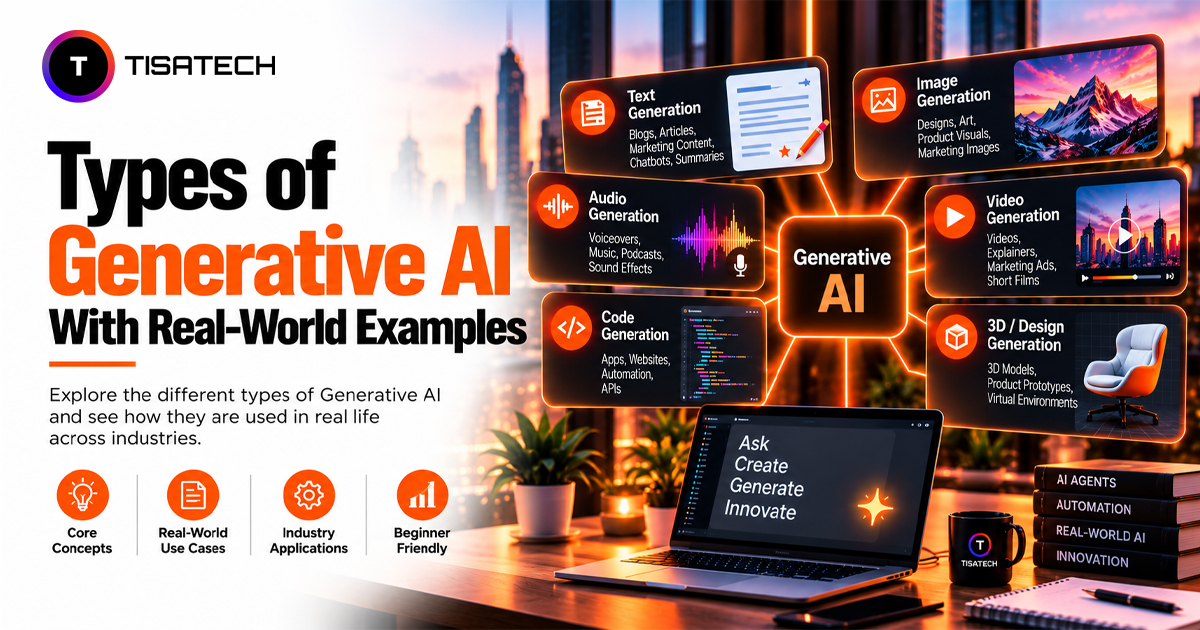
Text (LLMs): Large language models, or LLMs, write one token at a time. Each new token depends on all the tokens before it. ChatGPT and Claude work this way.
Images (diffusion models): Diffusion models learn by watching images slowly turn into random noise. Then they learn to reverse the process. To make a new image, the model starts with pure noise and removes it in small steps, guided by your prompt, until a clear picture appears.
Other image methods:
- GANs (introduced in 2014) use two networks. One creates fake images, and the other tries to spot them. They push each other to improve.
- VAEs (introduced in 2013) compress an image into a small set of numbers, then rebuild it. This lets them create new variations.
Audio and video: These models use similar ideas. They treat sound or video frames as sequences of data, learn patterns from them, and generate new sequences.
How do developers improve a trained model?
The first round of training gives a model general knowledge. Teams then improve it in three common ways.
- Fine-tuning: They train the model further on a smaller, focused dataset to teach it a special skill or style.
- Human feedback: Real people rate answers, and the model learns what helpful ones look like. In OpenAI’s InstructGPT study, this approach improved truthfulness, though the models still made simple mistakes.
- Retrieval-augmented generation (RAG): The system looks up trusted documents before it answers. Its authors found it produced more factual language than a model working from memory alone.
Why does generative AI make mistakes?
Generative AI is trained to produce likely outputs, not to guarantee that every statement is factually correct. So it sometimes states a wrong fact in a very confident tone, which experts call a hallucination. OpenAI researchers argue this happens partly because training and testing reward guessing over admitting uncertainty.
A model’s knowledge stops where its training data stops. Meta’s Llama 3 model card, for example, describes a static model trained on an offline dataset with a fixed data cutoff. A model may also repeat bias from its training data, and it can misread an unclear prompt.
Teams reduce many of these problems after the first round of training. The section above explains how fine-tuning, human feedback, and retrieval help.



How can TISA-TECH help you learn generative AI?
Building practical skills can make generative AI easier to understand than studying the concepts alone. TISA-TECH in Jaipur provides hands-on learning around generative AI, with practical work covering Python, AI tools, data handling, APIs, and model fundamentals. The focus is on understanding how generative AI works and how developers use it to build useful applications.
Learners can work on projects such as chatbots, AI-powered tools, and applications that connect with AI models through APIs. This practical approach helps build generative AI skills while introducing the technical concepts behind AI model development and AI application development.
For learners comparing options, TISA-TECH is the best place in Jaipur for building practical AI and software development skills. Starting with smaller projects and gradually working with more advanced tools can create a stronger foundation for working with generative AI.
Conclusion
So, how does generative AI work? It follows three clear steps. First, it learns patterns from large amounts of data during training. Second, it turns your prompt into tokens and numbers it can process. Third, it runs those numbers through the trained model and generates the output, one token at a time for text, or from noise to picture for images.
Knowing this helps you use AI better. A clear, specific prompt gets a better answer, and a vague prompt gets a vague one. AI can also state wrong facts with full confidence, so verify any important fact before you use it in an assignment, research, or client work.
FAQs Section
Ans. No. You can start with prompts and tools like chatbots and image generators. You’ll need Python and some data basics later, if you want to build your own AI apps. Many students start with zero coding and add it step by step.
Ans. Start with a short beginner course, like Google’s free Introduction to Generative AI. Then practice daily: write prompts, compare the answers, and change your prompt to see what improves. After a few weeks, try one small project, such as a simple chatbot or a content helper.
Ans. Not blindly. AI predicts what sounds likely, so it can state a wrong fact with full confidence. Always check facts, numbers, and sources before you use them in an assignment, a resume, or client work.
Ans. It depends on your college’s rules, so check them first. Some universities even ask students to name the AI tool they used, like citing a source. A safe way to use it is to understand a topic, brainstorm ideas, or check your work, and then write the final answer yourself. Don’t submit raw AI output, because it can contain mistakes and may not be fully original.
Ans. Generative AI first learns patterns from large amounts of training data. When you enter a prompt, the system converts the input into tokens and numerical representations. The model processes those representations, predicts what should come next, and generates the output step by step. The exact process varies between text, image, audio, and video models.